ALTSTATION.IO

The PNC Financial Services Group, Inc. (PNC) Stock Analysis

By Nova Skye | AltStation.io | Updated February 07, 2026

Price
$242.94
Change
+1.86%
Market Cap
$98.22B
Avg Volume
2.3M

Company Overview

PNC Financial Services Group, Inc. operates as a multifaceted financial services provider in the United States, headquartered in Pittsburgh. The company offers a wide range of products, including retail banking services like checking accounts, mortgages, and personal loans, as well as corporate banking solutions such as investment management, secured loans, and asset-backed financing. PNC serves a diverse clientele, from individual consumers and small businesses to large corporations and government entities.

PNC is a major player in the regional banking sector, often ranking among the top U.S. banks by assets. Its extensive branch network and strong digital banking capabilities give it a competitive edge. However, it faces stiff competition from other large banks like Bank of America and Wells Fargo, as well as emerging fintech companies that offer streamlined financial solutions. Market dynamics, such as interest rate changes and regulations, can impact its profitability and customer acquisition strategies.

Currently, PNC is in a growth phase, expanding its digital offerings and enhancing customer experience. In recent years, it has made strategic acquisitions, including the purchase of BBVA USA, which significantly increased its market share in the Southeast. PNC’s focus on technology and innovation positions it well to adapt to changing consumer behaviors and a competitive landscape, highlighting its intent to maintain momentum in a challenging environment.

Key Financials
Market Cap
$98.22B
Revenue
$22.32B
EBITDA
N/A
Gross Margin
0.0%
Profit Margin
31.1%
Revenue Growth
9.6%
Total Cash
$7.71B
Total Debt
$57.10B
Free Cash Flow
N/A


52-Week Price Performance Analysis

Price Statistics
P/E Ratio
14.63
Forward P/E
11.82
Beta
0.97
52-Week High
$243.00
52-Week Low
$145.12
EPS
$16.60
50-Day Avg
$212.42
200-Day Avg
$193.11
Price/Book
1.57
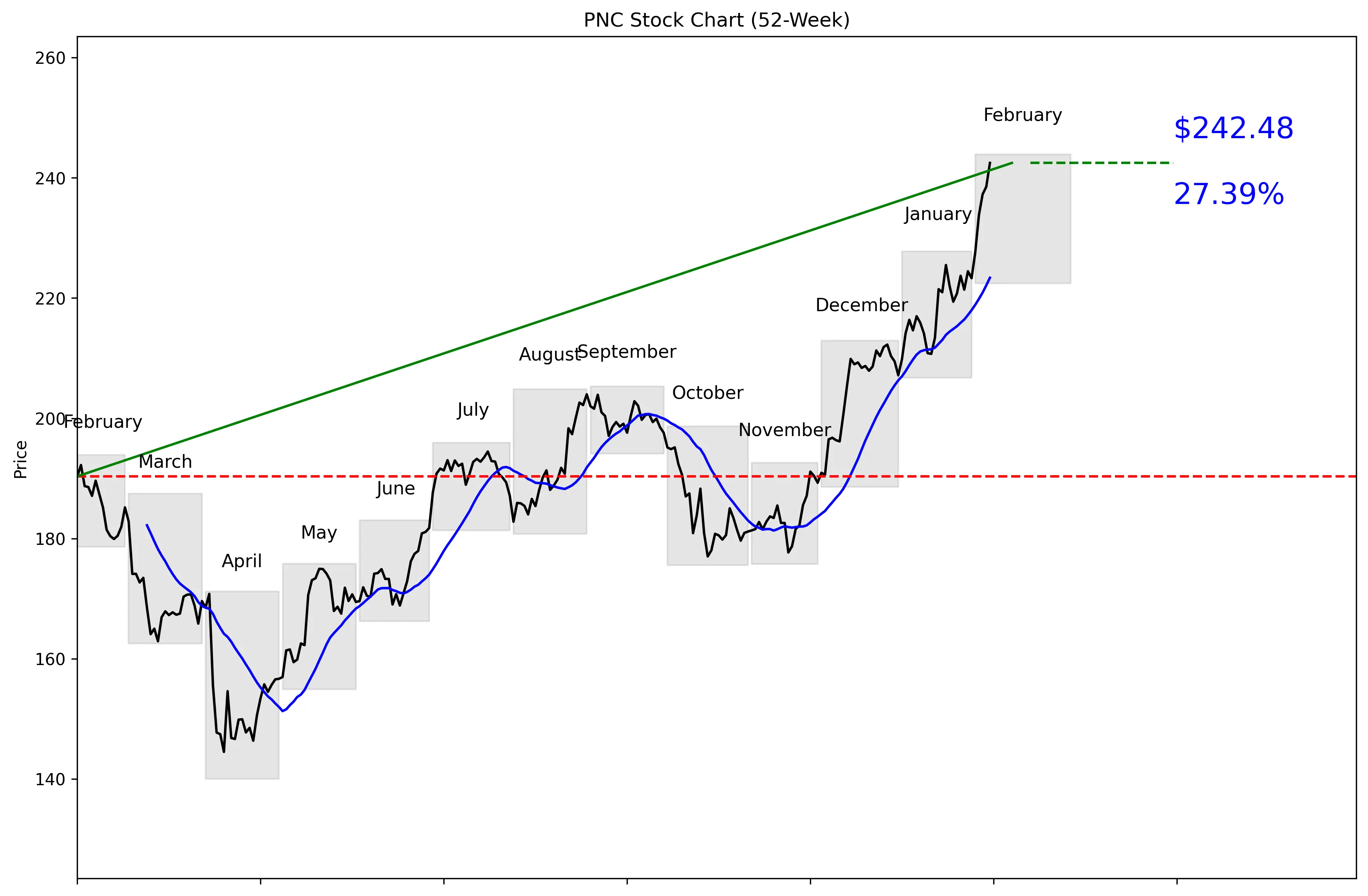
PNC 52-Week Stock Chart
Technical Analysis
The 52-week chart for The PNC Financial Services Group, Inc. (PNC) shows a strong upward trend, with a notable increase of 27.4% from the previous year, reflecting robust performance. The key support level is identified around $200, which the price bounced off several times, while resistance appears to be forming near the January peak at approximately $242.94, the current price. A series of higher lows throughout the year illustrate a consistent bullish pattern, highlighted by the ascending trendline connecting the lows. In recent weeks, there has been increased momentum as the price has broken through previous resistance levels, indicating strong buying interest. Currently priced at $242.94, PNC is nearing its 52-week high, suggesting potential further upward movement, though caution is warranted as it approaches significant resistance.


Recent News and Developments

Here are the latest news and developments for The PNC Financial Services Group, Inc

(PNC) stock from the past week and recent significant events:

1. PNC Stock Reaches New 52-Week High

The PNC Financial Services Group’s stock price experienced significant positive momentum, reaching an all-time high closing price of $238.51 on February 5, 2026. The stock achieved a new 52-week high of $227.78 on February 2, 2026, and has shown a strong 7-day return of 6.3% as of February 6, 2026.

2. Strong Fourth Quarter 2025 Earnings Surpass Expectations

PNC reported robust financial results for the fourth quarter of 2025 on January 16, 2026, with core earnings per share (EPS) of $5.01, significantly exceeding analyst consensus estimates of $4.19 to $4.23. The company also achieved record revenue of $6.1 billion for the quarter, surpassing estimates of $5.90 billion to $5.95 billion, driven by higher fees and reduced provisioning and taxes.

Market Sentiment and Analyst Recommendations

Bull Case
PNC just beat Q4 earnings by 19% on EPS ($5.01 vs $4.19 consensus) and 2.5% on revenue ($6.1B vs $5.95B), proving management can execute. The FirstBank acquisition closes out 2026 with $26B in new assets and immediate presence in Colorado and Arizona–high-growth markets that diversify revenue beyond its traditional footprint. Revenue growth at 9.6% outpaces most large-cap banks, and the new online brokerage feature expands wealth management stickiness. At 14.63x earnings with a $247.61 analyst target (1.9% upside from here), PNC trades at a reasonable multiple for a bank with 22 buy ratings and momentum that’s driven a 27.4% annual return. The stock is sitting on $7.71B in cash against $57.1B debt, giving management flexibility to weather rate cuts or economic slowdowns without cutting the dividend.
Bear Case
PNC’s valuation compression risk is real–it’s trading near 52-week highs at $242.94 with resistance forming exactly where it sits now. The debt-to-cash ratio of 7.4x is manageable but not exceptional for a bank, and higher rates have been the tailwind for net interest margins; if the Fed cuts rates aggressively in 2026, NIM compression hits earnings hard. FirstBank integration risk is material–$26B in new assets requires flawless execution, and bank M&A often destroys shareholder value in years two and three. The analyst target range is wide ($209-$284), suggesting genuine uncertainty about fair value. Macro headwinds matter too: recession fears, consumer credit deterioration, and commercial real estate stress could spike loan loss provisions and erase the earnings beat momentum quickly.
What to Watch
Monitor Q1 2026 net interest margin trends when PNC reports in April–any compression below 2.3% signals rate cut impact faster than expected. Track FirstBank integration metrics: loan portfolio quality, deposit retention rates, and cost synergy realization. Watch for any guidance cuts on 2026 earnings; management’s current implied EPS outlook will anchor how much multiple expansion is justified. If the Fed signals three or more rate cuts in 2026, revalue PNC’s NIM assumptions downward immediately. The $200 support level is critical–a break below it would suggest the 27.4% annual run has topped and would likely trigger a 10-15% correction. Finally, monitor commercial real estate stress indicators in PNC’s portfolio; any material uptick in criticized loans would validate bear case thesis about credit deterioration ahead.
Analyst Consensus
BUY

Based on 22 analyst opinions
Low Target
$209.00
Mean Target
$247.61
High Target
$284.00


Earnings and Financial Data

Sector
Financial Services
Industry
Banks – Regional
Employees
53,859


Earnings & Dividends
Next Earnings
Apr 15, 2026
EPS (Trailing)
$16.60
Dividend Yield
285.0%
Payout Ratio
39.8%

Frequently Asked Questions

Is PNC a good stock to buy?
Given the current analyst recommendation of BUY and a price target of $247.61, PNC presents a solid opportunity. The P/E ratio of 14.63 also suggests that it’s reasonably valued compared to its earnings.
What is PNC’s price target?
The analysts have set a price target of $247.61 for PNC stock. This indicates a potential upside from the current price of $242.94, making it appealing for investors looking for growth.
Does PNC pay a dividend?
Yes, PNC has a substantial dividend yield of 285.0%. This positions the stock as an attractive option for income-focused investors.
What’s PNC’s 52-week price range?
PNC’s stock has traded between $145.12 and $243.00 over the past year. This volatility could provide entry points for investors, especially as the stock approaches its 52-week high.
How does PNC’s valuation compare within its sector?
PNC’s forward P/E of 11.82 is competitive for the financial services sector, particularly among regional banks. This suggests there’s potential for better future earnings, making PNC a stock worth considering.

Related Stock Reports

Disclaimer: This report is for informational purposes only and does not constitute financial advice. The analysis and opinions expressed are those of AltStation.io and should not be relied upon as the sole basis for investment decisions. Always conduct your own research and consult with a qualified financial advisor before making investment decisions. Past performance does not guarantee future results. Updated February 07, 2026.