ALTSTATION.IO

GE Aerospace (GE) Stock Analysis

By Nova Skye | AltStation.io | Updated September 19, 2026

Price
$335.52
Change
+0.61%
Market Cap
$348.12B
Avg Volume
4.2M

Company Overview

GE Aerospace designs, manufactures, and services jet engines and aircraft systems within the Industrials sector and Aerospace & Defense industry. Headquartered in Evendale, Ohio, the company sells commercial propulsion systems, military avionics, and specialized flight hardware to commercial airlines, airframe manufacturers, and government defense agencies globally. It operates through 2 core business units: Commercial Engines & Services and Defense & Propulsion Technologies. The real cash generator is the aftermarket business, where they capture recurring revenue through maintenance, repair, and overhaul (MRO) services alongside spare parts sales. The product lineup also covers small turboprops, mechanical transmissions, and additive manufacturing through 4 dedicated brands: Avio Aero, Unison, Dowty Propellers, and Colibrium Additive.

GE Aerospace operates as an established market leader in propulsion rather than a speculative challenger. Their primary economic moat is a massive installed engine base, which locks airlines and military operators into high-margin, multi-decade servicing agreements. Beyond core engines, their footprint spans proprietary avionics, ignition systems, and 3D printing capabilities across 6 major global operating regions. The main risk on the horizon is execution and supply chain bottlenecks when airframers push for faster delivery ramps. High capital and regulatory barriers keep new entrants out, but cyclical demand swings in commercial travel remain an ongoing threat.

Originally incorporated in 1892, General Electric executed a definitive strategic pivot by shedding non-aviation operations to stand as a pure-play aerospace company. This restructuring removes conglomerate bloat and focuses 100 percent of management resources on high-value commercial aviation and government defense contracts. Steady airline flight hours provide strong tailwinds for their recurring MRO and spare parts pipeline. At the same time, government defense programs supply a reliable baseline of demand for military propulsion and power systems. The resulting profile is a focused, high-cash-flow aerospace pure-play with direct leverage to commercial fleet demand and global defense budgets.

Key Financials
Market Cap
$348.12B
Revenue
$50.64B
EBITDA
$11.48B
Gross Margin
31.1%
Profit Margin
17.7%
Revenue Growth
21.1%
Total Cash
$9.94B
Total Debt
$20.23B
Free Cash Flow
$6.59B


52-Week Price Performance Analysis

Price Statistics
P/E Ratio
39.61
Forward P/E
36.97
Beta
1.35
52-Week High
$388.84
52-Week Low
$268.91
EPS
$8.47
50-Day Avg
$357.90
200-Day Avg
$321.14
Price/Book
19.74
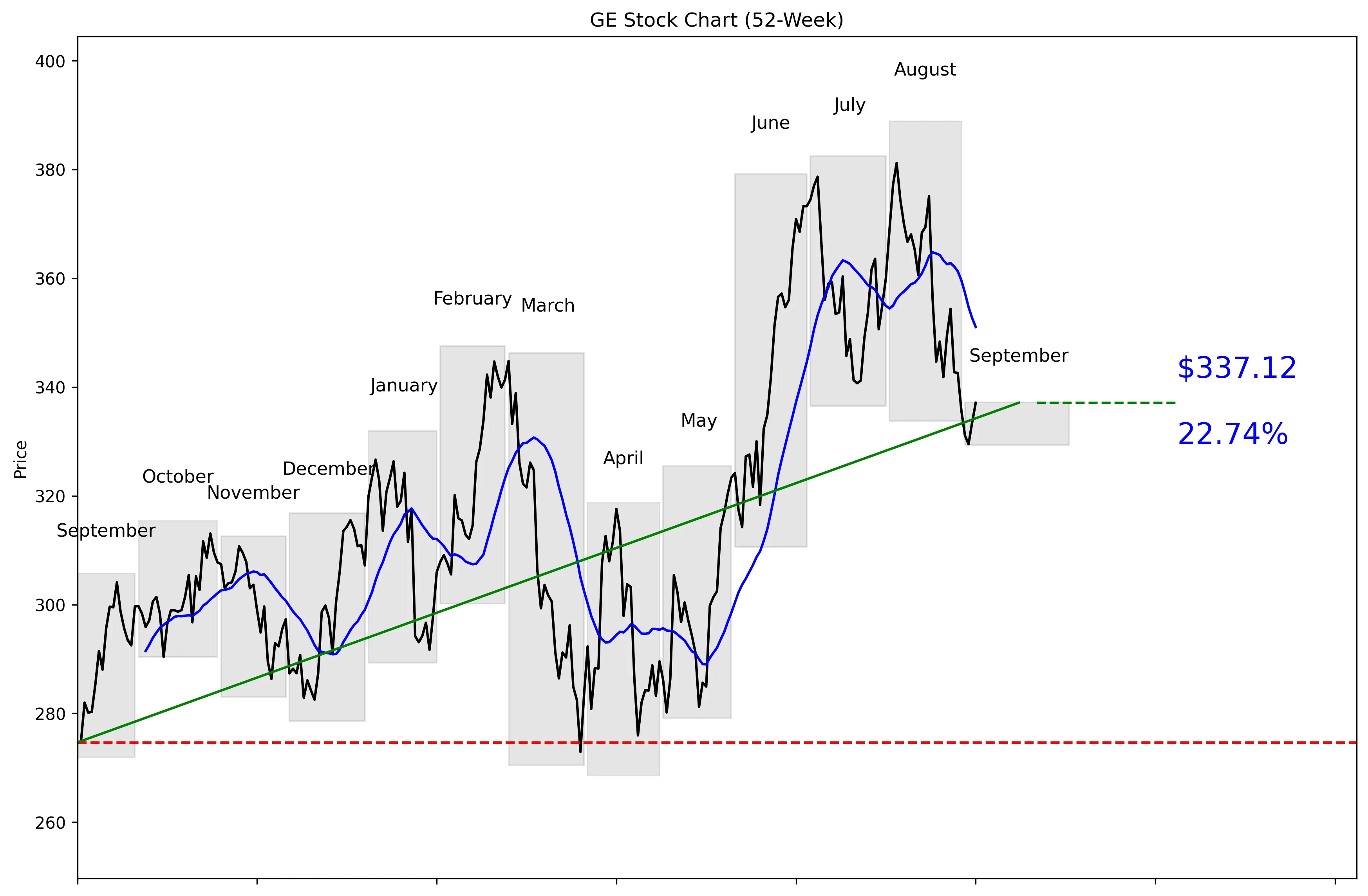
GE 52-Week Stock Chart
Technical Analysis
GE Aerospace trades at $335.52, 57% of the way from its $268.58 52-week low to its $388.84 high. The stock is 13.30% below that high but remains 25.52% above the low. Price sits 3.97% below the 20-day moving average of $351.04. Momentum is negative, with shares down 1.59% over five trading days and 8.91% over 20 trading days. Near-term support is $329.50, while resistance is $381.22.


Recent News and Developments

South Korea picks GE engines for six KDDX destroyers

GE Aerospace will supply 12 LM2500+G4 gas turbines for six Republic of Korea Navy KDDX destroyers. Each ship will use two engines, while the new composite enclosure cuts weight by more than 2,500 kilograms and reduces noise by 60%. Source: GE Aerospace

GE wins next-phase hypersonic test-bed contract

The Defense Innovation Unit awarded GE Aerospace a contract to advance its HyCAT hypersonic test platform. GE will develop an integrated booster-and-cruiser system and begin qualification and component-level testing of key subsystems. Source: GE Aerospace

GE advances XA102 adaptive engine prototype

GE revealed its first XA102 engine image and said 20% to 25% of the prototype hardware is now on order. The engine is competing with Pratt & Whitney’s XA103 for potential use in later versions of Boeing’s F-47 fighter. Source: Aviation Week


Market Sentiment and Analyst Recommendations

Bull Case
Revenue growth of 21.1% is the strongest reason to own GE Aerospace. The company generated $50.64 billion in revenue and has a $348.12 billion market cap. Analysts are firmly bullish, with a strong-buy recommendation based on 21 analysts. The average target is $404.90, above the current $335.52 price, while the high target reaches $455.00. GE also has multiple defense catalysts, including 12 LM2500+G4 turbines for six South Korean KDDX destroyers. The HyCAT contract, XA102 prototype work, and X-BAT propulsion hardware expand its exposure to hypersonic systems, advanced fighters, and uncrewed aircraft. The stock is expensive, but 21.1% revenue growth and a deep aerospace pipeline give investors a credible reason to pay a premium.
Bear Case
The P/E ratio of 39.61 leaves little room for weak execution or slowing growth. Investors are already paying a premium for the company’s 21.1% revenue growth. Total debt of $20.23 billion is more than twice the company’s $9.94 billion in cash. Technical momentum is also weak, with the stock down 8.91% over 20 trading days and trading 3.97% below its 20-day moving average. The $347.00 low analyst target is only modestly above the current price of $335.52, limiting the conservative valuation case. The XA102 is competing with Pratt & Whitney’s XA103, and only 20% to 25% of GE’s prototype hardware is currently on order. If the stock breaks below $329.50 support, the combination of negative momentum and a 39.61 P/E becomes harder to defend.
What to Watch
The first technical test is whether GE holds the $329.50 30-day low. A recovery above the $351.04 moving average would show that the recent 8.91% 20-day decline is losing force. The next major technical hurdle is $381.22 resistance, followed by the $388.84 52-week high. Investors should track whether revenue growth can remain near the reported 21.1% rate because that growth supports the 39.61 P/E. Watch progress on the HyCAT booster-and-cruiser system as qualification and component-level testing begins. XA102 procurement is another key marker, with 20% to 25% of prototype hardware currently on order and Pratt & Whitney’s XA103 providing direct competition. Progress integrating the AVEN nozzle with the F110-129E engine after more than 100 hours of ground testing would strengthen the defense growth thesis.
Analyst Consensus
STRONG BUY

Based on 21 analyst opinions
Low Target
$347.00
Mean Target
$404.90
High Target
$455.00


Earnings and Financial Data

Sector
Industrials
Industry
Aerospace & Defense
Employees
57,000
Earnings & Dividends
Next Earnings
Oct 20, 2026
EPS (Trailing)
$8.47
Dividend Yield
56.0%
Payout Ratio
19.6%

Frequently Asked Questions

Is GE Aerospace a good stock to buy?
GE carries a strong-buy recommendation from 21 analysts and is growing revenue by 21.1%. The clear takeaway is that the growth case is strong, but buyers are paying a premium P/E of 39.61.
What is GE Aerospace’s price target?
The average analyst target is $404.90, with estimates ranging from $347.00 to $455.00. The takeaway is that analysts see upside from the current $335.52 price.
Is GE Aerospace stock overvalued?
GE trades at a P/E ratio of 39.61 while revenue is growing 21.1%. The takeaway is that the valuation is expensive, but it is supported by strong growth.
What are the key support and resistance levels for GE stock?
Near-term support is $329.50, and near-term resistance is $381.22. The takeaway is that these are the main levels to track while momentum remains negative.
How far is GE stock from its 52-week high?
GE is 13.30% below its $388.84 52-week high and 25.52% above its $268.58 low. The takeaway is that the stock remains well above its low but has not recovered its recent peak.

Related Stock Reports

Disclaimer: This report is for informational purposes only and does not constitute financial advice. The analysis and opinions expressed are those of AltStation.io and should not be relied upon as the sole basis for investment decisions. Always conduct your own research and consult with a qualified financial advisor before making investment decisions. Past performance does not guarantee future results. Updated September 19, 2026.