DECODING MARKETS
DexCom, Inc., headquartered in San Diego, California, is a leading medical device company specializing in continuous glucose monitoring (CGM) systems. With products like the Dexcom G6 and G7 systems, DexCom plays a vital role in managing diabetes and metabolic health for patients, caregivers, and clinicians both in the United States and globally. The company manufactures innovative devices that provide real-time glucose data, aimed at improving patient outcomes and facilitating better decision-making for people with diabetes.
Founded in 1999, DexCom operates in the healthcare sector, specifically within the medical devices industry, and has positioned itself as a market leader in CGM technology. Its offerings also include Dexcom Share for remote monitoring and the Dexcom Real-Time API for integrating CGM data, providing a comprehensive suite of solutions for diabetes management. With a total revenue of approximately $4.52 billion, DexCom demonstrates strong financial health and scalability, supported by a favorable "strong buy" recommendation circulating in the investment community.
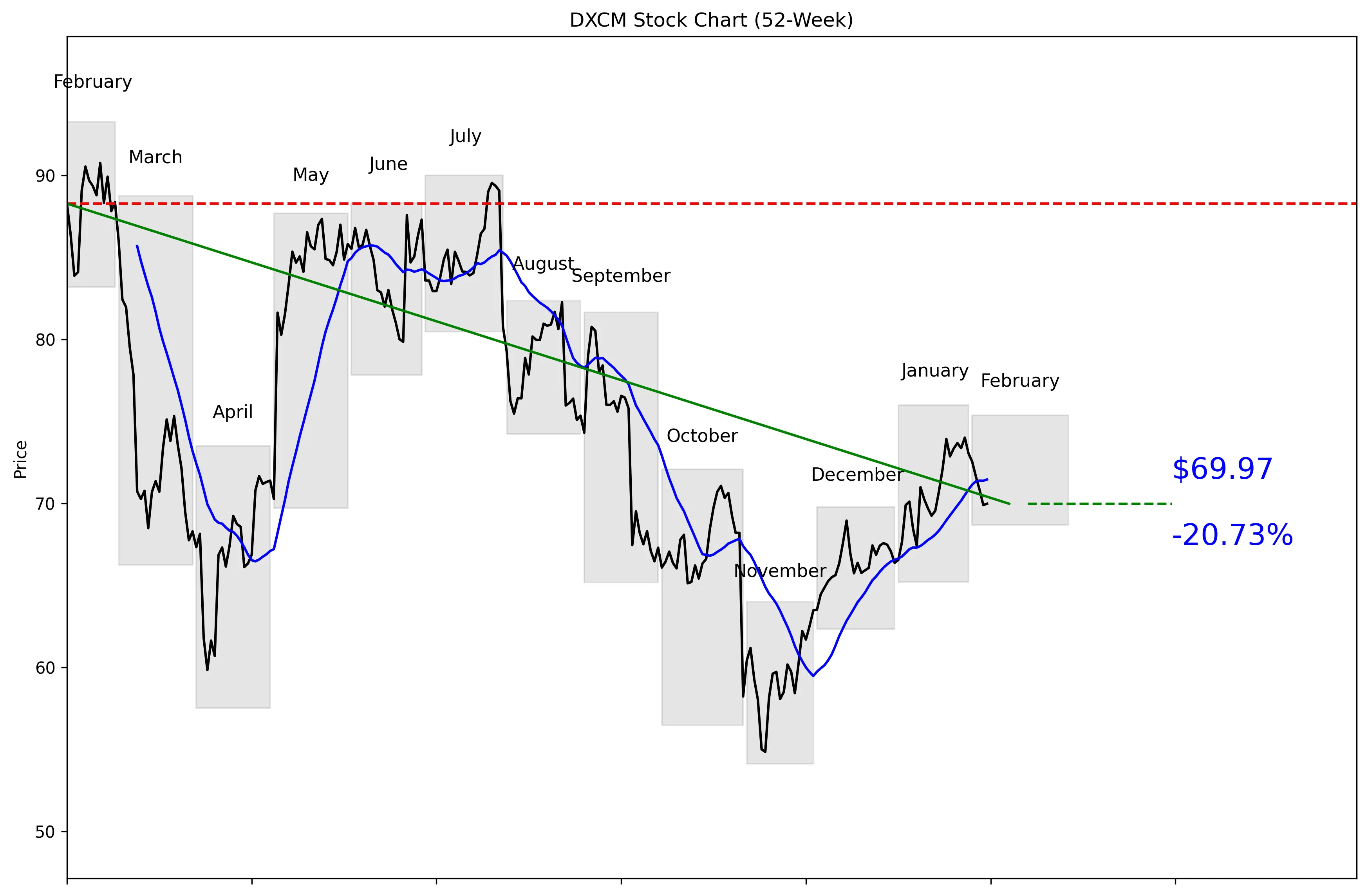
52-Week Price Performance Chart
The stock chart for DexCom, Inc. (DXCM) indicates an overall bearish trend over the past year. Starting from a fifty-two week high of $93.25, the stock has experienced considerable sell-offs, reaching a fifty-two week low of $54.11. Recent trading has revealed a current price of $67.12, resting above the fifty-day moving average of $64.03, which may suggest a short-term bullish trend. However, a broader inspection of the price action reveals significant turbulence framed by lower highs and lower lows.
Key technical levels to consider include the resistance level around $80, which the stock struggled to maintain during several attempts throughout the year, and the support level established around $60, where the stock found a base in April and November. The trend remains bearish, indicated by the red resistance zone, but recent upward movements in December warrant monitoring for potential breakouts. Investors should note that a sustained rise over $67.56 may signal a shift in momentum, while a retreat below the $60 support could indicate further bearish sentiment.
In summary, while there have been attempts at recovery, the persistent downtrend and failures to breach key resistance levels highlight a cautious approach for investors assessing DexCom's stock performance.
DexCom reported robust financial performance in its third-quarter results for 2025, with total revenue surging 22% year-over-year to $1.21 billion, surpassing analyst expectations. The company recorded an adjusted earnings per share (EPS) increase to $0.61, up from $0.45 in the prior-year period. Despite these achievements, a moderate adjustment in gross margin to 61% reflects challenges such as increased material discard rates during manufacturing, which could impact future profitability.
The company's valuation metrics suggest potential for price appreciation, currently trading at approximately $67.12, with analysts projecting a target mean price of $84.77 and a high price target of $112.00. This divergence reflects an estimated upside of over 65% from current levels. Furthermore, DexCom's EBITDA of around $1.02 billion suggests favorable operational efficiency, showcasing its ability to generate significant cash flow amidst ongoing market pressures.
However, it should be noted that the stock also faces challenges highlighted by a downgrade by multiple analysts, primarily due to rising patient concerns regarding the accuracy and reliability of the new G7 sensor. On the flip side, the balance between outstanding shares and short positions (approximately 4.41% of float) indicates a stable investor sentiment toward the company.
DexCom, Inc. has faced heightened scrutiny following a March 4, 2025, warning letter issued by the FDA regarding manufacturing process flaws at its San Diego and Mesa facilities. This letter indicated inaccuracies stemming from modifications made to the G6 and G7 sensors without prior approval, contributing to a notable decline in stock price to a four-year low of $64.
In its subsequent third-quarter results, the company faced a setback when it slightly lowered its gross margin outlook due to manufacturing issues. Additionally, management hinted that growth in 2026 might not meet analysts' expectations, spurring a 12.8% drop in share value during after-hours trading on October 30, 2025.
Compounding these challenges, reactions from analysts have been mixed. Oppenheimer issued a downgrade to "perform" from "outperform," while Baird's Jeff Johnson shifted his view to "neutral," citing difficulties in penetrating the "basal only" diabetes patient market and heightened competition from rivals such as Abbott and Medtronic. These developments raise concerns regarding DexCom's long-term growth trajectory under the current market landscape.
The overall sentiment surrounding DexCom, Inc. is cautiously optimistic but reflects underlying risks. Analyst consensus has produced a strong buy recommendation, with a mean rating of 1.45 based on 26 analyst opinions, suggesting overwhelming positivity regarding future performance. The target high price of $112.00 indicates significant upside potential; however, this is underscored by significant downside risks highlighted by recent news events.
The most prevalent moderate price target of $84.77 reflects reasonable expectations for growth, while the lower target price of $68.00 indicates a potential bearish scenario if recent issues are not resolved. Given the current stock price at $67.12, investors may find an opportunity for substantial returns, but they need to remain vigilant regarding the company's ability to address quality and performance issues impacting its products.
In summary, while DexCom exhibits promising revenue growth and a strong market position, investors should weigh the opportunities for growth against the risks of regulatory scrutiny and increased competition in the medical devices space. Investors looking to enter or maintain a position in DXCM should consider following the stock's movement relative to resistance levels, monitor further developments regarding product reliability, and stay informed on analyst commentary as the market evolves.
Investing in DexCom presents both substantial potential rewards and risks; as always, thorough research and consideration of one's financial objectives and risk tolerance remain paramount.
| Metric | Value |
|---|---|
| Market Cap | $26.3b |
| Total Debt | $2.6b |
| Total Cash | $3.3b |
| Shares Outstanding | 390.0m |
| Float Shares | 387.1m |
The information provided in this monthly report is for informational purposes only and should not be construed as financial, investment, or trading advice. AltStation.io does not guarantee the accuracy, completeness, or timeliness of the data and analyses presented. The content is based on publicly available information, and while we strive to ensure its accuracy, errors and omissions may occur.
Investing in stocks, cryptocurrencies, and other financial instruments involves significant risk, including the potential loss of principal. Past performance is not indicative of future results. Readers should conduct their own research and consult with a qualified financial advisor before making any investment decisions. AltStation.io and its affiliates are not responsible for any losses incurred as a result of using this report.
By using this report, you acknowledge that you understand and accept these terms.
Report Updated: December 11, 2025
Data Last Updated: 2026-01-30 12:47:32