ALTSTATION.IO

Intuit Inc. (INTU) Stock Analysis

By Nova Skye | AltStation.io | Updated February 07, 2026

Price
$443.37
Change
+1.95%
Market Cap
$123.43B
Avg Volume
2.4M

Company Overview

Intuit Inc. is a software company based in Mountain View, California, that focuses on financial management and business solutions. Its primary products include QuickBooks for business management, TurboTax for tax preparation, and Credit Karma for personal finance advice. The company serves a wide range of customers, from small business owners to individual consumers, through various channels like direct sales, app stores, and partnerships.

Intuit is a market leader in the financial software space, particularly for small to mid-sized businesses. Its edge comes from a strong brand recognition, comprehensive product offerings, and a user-friendly experience. However, it faces competition from companies like Square for payments, H&R Block in tax preparation, and newer startups in personal finance. Market dynamics such as rising interest rates and regulatory changes could pose challenges, but Intuit’s established position helps mitigate these threats.

Currently, Intuit is in a growth phase, capitalizing on the shift towards digital financial solutions. Recent milestones include the integration of Mailchimp into their ecosystem, enhancing their marketing automation capabilities. The company has also been investing in AI features across its products to improve user experience. Overall, Intuit’s focus on innovation and expanding its product suite positions it well for future growth in the technology sector.

Key Financials
Market Cap
$123.43B
Revenue
$19.43B
EBITDA
$5.85B
Gross Margin
80.7%
Profit Margin
21.2%
Revenue Growth
41.0%
Total Cash
N/A
Total Debt
N/A
Free Cash Flow
$5.06B


52-Week Price Performance Analysis

Price Statistics
P/E Ratio
30.43
Forward P/E
16.76
Beta
1.23
52-Week High
$813.70
52-Week Low
$411.11
EPS
$14.57
50-Day Avg
$611.06
200-Day Avg
$677.91
Price/Book
6.39
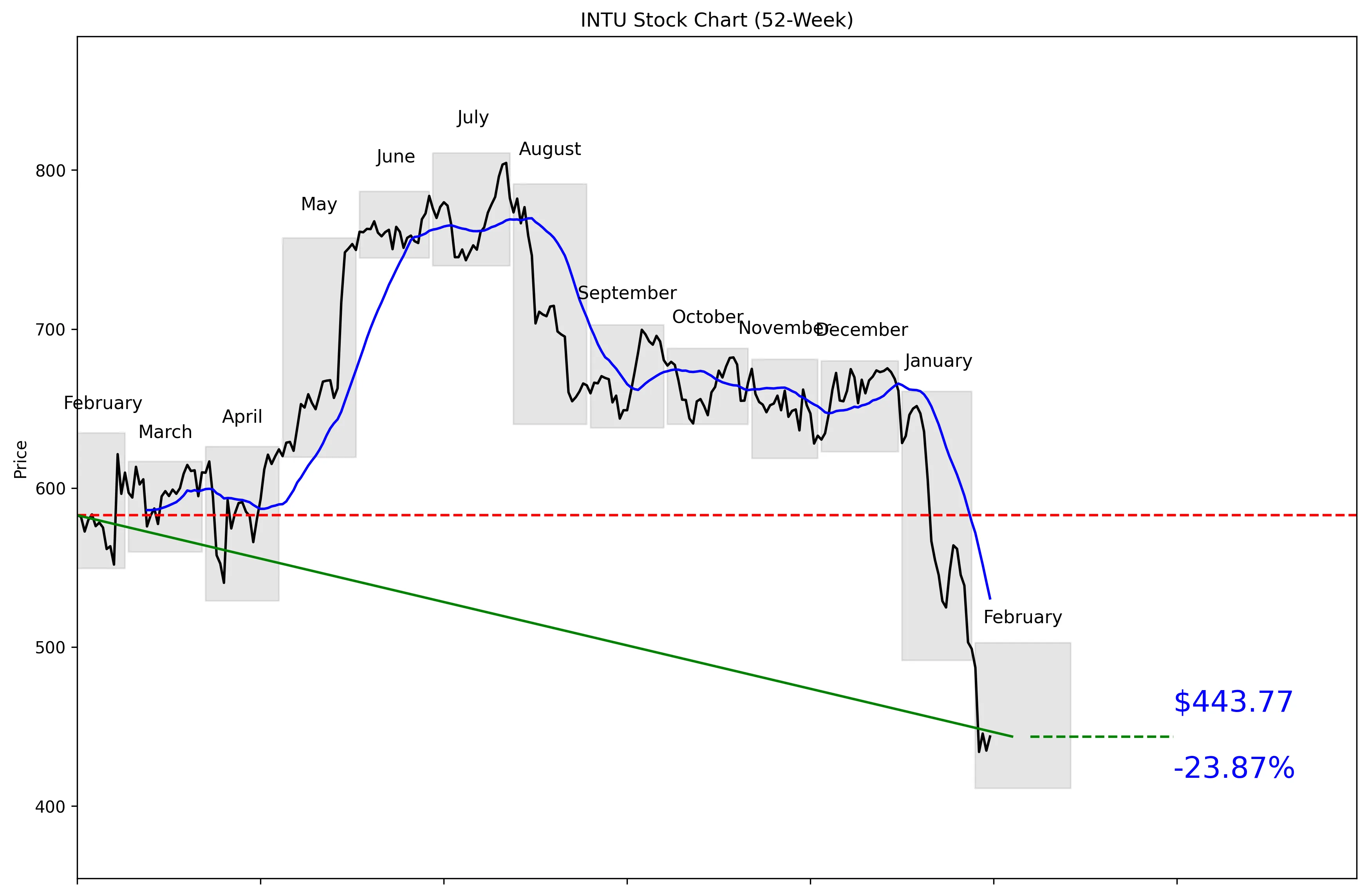
INTU 52-Week Stock Chart
Technical Analysis
Over the past 52 weeks, Intuit Inc. (INTU) has experienced a downward trend, with a significant decline of 23.9%, currently priced at $443.37. Key support levels are identified around $400, as noted from previous lows, while resistance is evident at $600, which has acted as a pivot point in various upswings. The chart displays a pronounced descending triangle formation, suggesting increasing selling pressure leading into recent weeks. Recent momentum has been notably bearish, highlighted by sharp declines in the weeks leading up to the current price, indicating a lack of buyer confidence. The current price sits well below the 52-week high of approximately $800, reflecting a considerable drawdown and suggesting potential continued weakness in the stock unless bullish signals emerge.


Recent News and Developments

Here’s a summary of the latest news and developments for Intuit Inc

(INTU) stock from February 1st to February 7th, 2026:

1. Oppenheimer Adjusts Price Target Amid Broader Analyst Sentiment

On February 3, 2026, Oppenheimer set a new price target for Intuit (INTU) at $696.00, suggesting a potential upside of over 60% within the next 12 months. Despite this, the consensus rating from 20 analysts as of February 7, 2026, remains a “Buy,” with 55% recommending “Buy” and 35% a “Strong Buy,” though there have been mentions of some firms trimming their targets. Conversely, Zacks.com issued a “Sell” rank (#4) for Intuit on February 4, 2026.

2. Intuit Partners with Affirm for “Pay-Over-Time” in QuickBooks

Intuit announced a new multi-year partnership with Affirm (AFRM) on February 2, 2026, making Affirm the exclusive “pay-over-time” solution integrated into QuickBooks Payments. This feature aims to help small and mid-market businesses offer flexible payment options to their customers, including 0% APR installment plans, while the businesses receive immediate upfront payment. The integration, which requires no additional technical setup, addresses cash flow challenges for small businesses.

Market Sentiment and Analyst Recommendations

Bull Case
Intuit’s 41% revenue growth is genuinely impressive for a company at $19.43B in annual revenue, proving the core business still scales. The Affirm partnership addresses real friction in SMB cash flow management and expands QuickBooks Payments’ competitive moat against Square and Stripe. The Accountant Suite transition consolidates fragmented products into a cleaner, higher-margin offering that can drive better unit economics. Analyst consensus remains strongly bullish with 55% Buy and 35% Strong Buy ratings despite recent weakness, suggesting institutional conviction hasn’t broken. At $443, the stock is down 46% from its $813 high, which creates a meaningful reset for a company that still grows faster than most software peers. The 60% upside target from Oppenheimer implies the market is pricing in worst-case scenarios on AI disruption that may not materialize.
Bear Case
A 30.43 P/E on a software stock is not cheap even with 41% growth, especially when that growth is decelerating from higher bases. The 34% year-to-date decline and descending triangle formation suggest real momentum breakdown, not just noise. AI disruption is a legitimate threat to tax and accounting software where automation could compress margins faster than Intuit can pivot. The transition away from QBOA to paid tiers risks customer churn among accountants, a core user base that generates recurring revenue. Zacks’ Sell rating and analyst target trims indicate the consensus is cracking. The stock has fallen 30% since November and sits near 52-week lows, which typically signals institutional selling ahead of deteriorating fundamentals, not a buying opportunity.
What to Watch
Monitor next earnings call for guidance on subscription growth rates and customer acquisition costs in QuickBooks Online, the crown jewel. Track Affirm integration adoption metrics starting Q1 2026 as a leading indicator for whether the partnership actually drives incremental revenue or just shifts existing payment mix. Watch for any further analyst downgrades or target cuts, especially from the 32 current Buy raters, as that would confirm momentum is broken. The December QBOA discontinuation deadline will reveal actual churn rates among accountants moving to the new suite. Support at $400 is critical on the chart, a break below signals further capitulation. Finally, monitor competitive pressure from AI-native tools and whether Intuit’s own AI features in QuickBooks gain meaningful traction in earnings reports through 2026.
Analyst Consensus
BUY

Based on 32 analyst opinions
Low Target
$600.00
Mean Target
$777.85
High Target
$971.00


Earnings and Financial Data

Sector
Technology
Industry
Software – Application
Employees
18,200


Earnings & Dividends
Next Earnings
Feb 26, 2026
EPS (Trailing)
$14.57
Dividend Yield
103.0%
Payout Ratio
29.7%

Frequently Asked Questions

Is INTU a good stock to buy?
Yes, Intuit Inc. (INTU) is currently rated as a “BUY” by analysts with a target price of $777.85. Given its strong market cap of $123.43 billion and a solid forward P/E of 16.76, the stock presents a compelling investment opportunity.
What is INTU’s price target?
The target price for Intuit Inc. (INTU) is set at $777.85. This reflects a significant upside potential compared to its current price of $443.37.
Does INTU pay a dividend?
Yes, Intuit offers a dividend yield of 103.0%. This makes it an attractive option for income-focused investors, considering the stable nature of its software business.
What is INTU’s P/E ratio?
Intuit’s P/E ratio stands at 30.43. While this may seem high, the forward P/E of 16.76 suggests expectations for growth and improved earnings ahead.
What is INTU’s 52-week range?
Intuit’s stock has traded between $411.11 and $813.70 over the last 52 weeks. This wide range indicates volatility, but also emphasizes the potential for recovery and growth in the stock.

Related Stock Reports

Disclaimer: This report is for informational purposes only and does not constitute financial advice. The analysis and opinions expressed are those of AltStation.io and should not be relied upon as the sole basis for investment decisions. Always conduct your own research and consult with a qualified financial advisor before making investment decisions. Past performance does not guarantee future results. Updated February 07, 2026.