ALTSTATION.IO

Mastercard Incorporated (MA) Stock Analysis

By Nova Skye | AltStation.io | Updated November 03, 2026

Price
$659.44
Change
+3.36%
Market Cap
$574.49B
Avg Volume
2.9M

Company Overview

Mastercard Incorporated is a global payments technology powerhouse headquartered in Purchase, New York. Operating in the Financial Services sector under the Credit Services industry, the company has run payment networks worldwide since its founding in 1966. Mastercard does not lend money directly to consumers; it sells transaction processing, credit and debit programs, and digital payment infrastructure under the MasterCard, Maestro, and Cirrus brands. Its paying client base spans everyday consumers and merchants to commercial enterprises, fintechs, and government institutions.

Mastercard operates as an entrenched market leader, controlling an essential toll road for global commerce alongside Visa. Its competitive edge rests on massive network effects: billions of cardholders demand acceptance, which forces merchants and banks worldwide to stay plugged into the system. The main threats to this model come from tightening regulatory pressure on interchange fees and government-backed real-time payment rails. Even so, displacing a network deeply integrated into thousands of financial institutions is an enormous challenge for any competitor.

Right now, Mastercard is actively diversifying beyond traditional swipe fees into higher-margin software and security services. The company is expanding Mastercard Move for in-app peer-to-peer and cross-border money transfers, while accelerating commercial payments through dynamically generated Virtual Card Numbers. It is also pushing heavily into cybersecurity, data analytics, and agentic AI solutions to deepen its enterprise relationships. Mastercard is not just protecting its core processing volume; it is transforming into the essential security and data backbone of digital transactions.

Key Financials
Market Cap
$574.49B
Revenue
$36.29B
EBITDA
$23.03B
Gross Margin
100.0%
Profit Margin
46.7%
Revenue Growth
14.0%
Total Cash
$10.46B
Total Debt
$23.94B
Free Cash Flow
$16.63B


52-Week Price Performance Analysis

Price Statistics
P/E Ratio
34.51
Forward P/E
28.51
Beta
0.77
52-Week High
$660.35
52-Week Low
$464.52
EPS
$19.11
50-Day Avg
$586.73
200-Day Avg
$535.73
Price/Book
85.17
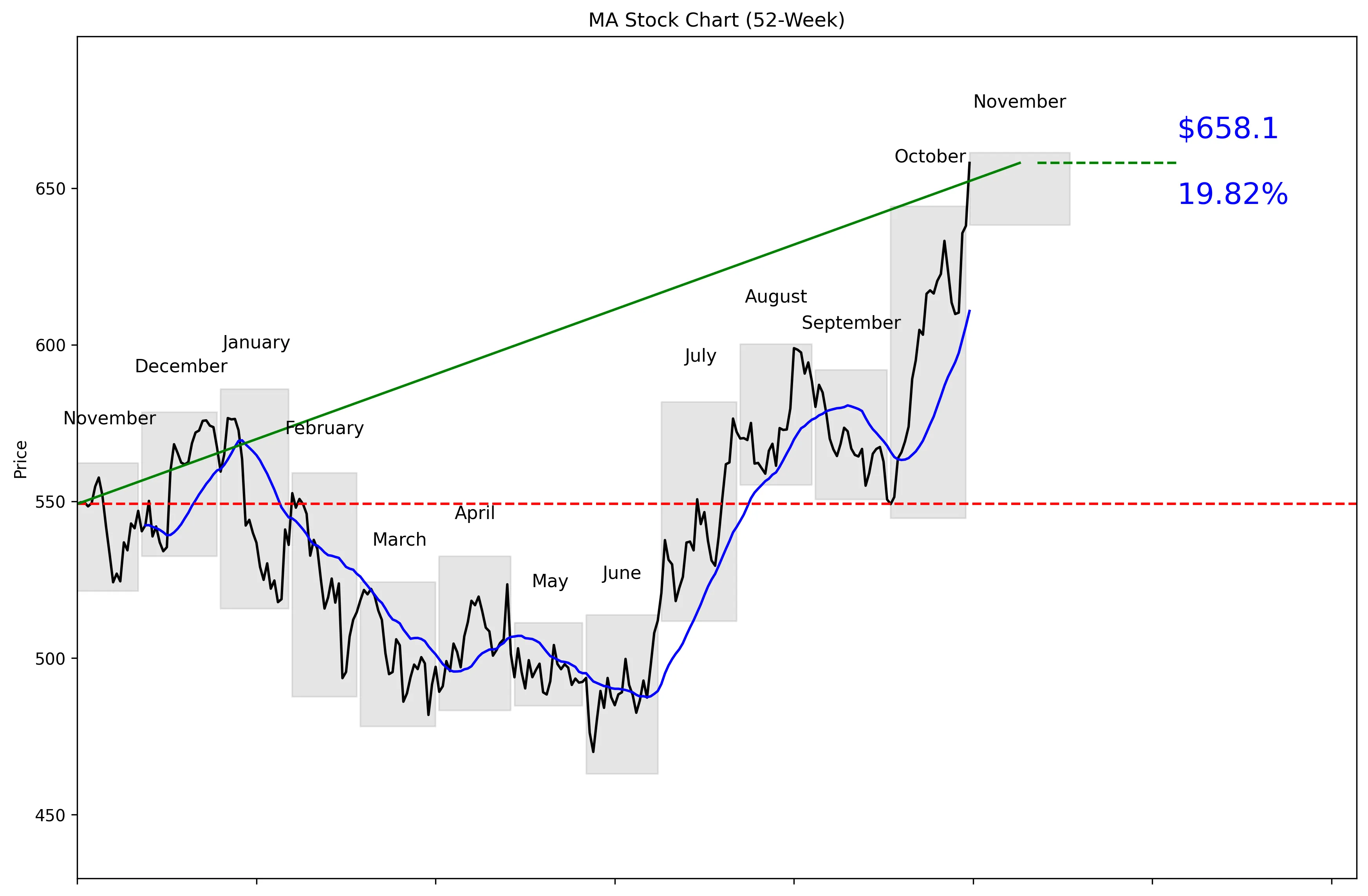
MA 52-Week Stock Chart
Technical Analysis
MA trades at $659.44, just 0.49% below its $661.34 52-week high and 42.13% above its $463.04 low. The stock sits 98% of the way from its 52-week low to high, confirming a powerful upward trend. Price is 7.74% above the 20-day moving average of $610.83, while momentum reached 7.27% over five trading days and 16.74% over 20 trading days. MA has moved above the listed near-term resistance of $658.10, making that level an important test for continued strength. Near-term support sits much lower at the 30-day low of $549.17.


Recent News and Developments

Mastercard posts 14% revenue growth

Third-quarter revenue rose 14% to $9.8 billion, while net income increased 18% to $4.6 billion. Adjusted EPS climbed 21% to $5.31 as gross dollar volume grew 7%, cross-border volume rose 11% and switched transactions increased 9%. Source: U.S. Securities and Exchange Commission

KeyBanc and BofA raise Mastercard targets

KeyBanc maintained Overweight and raised its price target from $722 to $735, while BofA maintained Buy and lifted its target from $735 to $775. BofA remained constructive on growth but flagged weaker cash conversion caused by customer incentives, litigation expenses and settlement timing. Source: Benzinga

Mastercard shares rally after earnings

MA gained 4.16% to close at $635.70 on October 29, followed by a 0.36% increase to $638.01 on October 30. The stock added another 3.15% on November 2, closing at $658.10. Source: Stock Analysis


Market Sentiment and Analyst Recommendations

Bull Case
Mastercard’s third-quarter revenue rose 14% to $9.8 billion, matching its reported 14.0% revenue growth rate. Net income increased 18% to $4.6 billion, while adjusted EPS climbed 21% to $5.31. The underlying payment network remained strong: gross dollar volume grew 7%, cross-border volume rose 11%, and switched transactions increased 9%. Analysts remain firmly bullish, with a strong_buy recommendation from 37 analysts and a consensus target of $701.98. KeyBanc raised its target from $722 to $735, while BofA lifted its target from $735 to $775. Mastercard Max could improve card engagement, especially given Mastercard’s finding that 68% of affluent millennials would use their card more if they better understood its benefits. The buy case is straightforward: double-digit growth, expanding earnings, strong payment activity, and broad analyst support.
Bear Case
The biggest problem is valuation: MA trades at 34.51 times earnings while sitting only 0.49% below its 52-week high. At $659.44, the stock is already above the stated near-term resistance level of $658.10 and 7.74% above its 20-day moving average. That setup leaves little room for a weak quarter or slower payment growth. Mastercard also carries $23.94 billion in total debt against $10.46 billion in total cash. BofA specifically flagged weaker cash conversion caused by customer incentives, litigation expenses, and settlement timing. UK regulators are demanding stronger fee transparency and pricing governance, creating another source of scrutiny even though the rules do not cap fees. The business is performing well, but the current price demands that the performance stay strong.
What to Watch
The next quarter needs to show that Mastercard can sustain its 14.0% revenue growth rate and continue expanding earnings faster than sales. Investors should track whether gross dollar volume holds near 7% growth, cross-border volume near 11%, and switched transactions near 9%. Cash conversion deserves close attention after BofA flagged pressure from customer incentives, litigation expenses, and settlement timing. The UK pricing-governance rules took effect for major fee changes on November 30, so any effect on fee decisions or merchant relationships matters. Watch whether the stock can hold above the former near-term resistance of $658.10 and challenge the $661.34 52-week high. A drop below the $610.83 20-day moving average would weaken the current momentum signal, while the $549.17 30-day low remains the listed near-term support. Continued progress toward the $701.98 analyst target would support the bull case; failure to maintain double-digit growth would challenge it.
Analyst Consensus
STRONG BUY

Based on 37 analyst opinions
Low Target
$550.00
Mean Target
$701.98
High Target
$800.00


Earnings and Financial Data

Sector
Financial Services
Industry
Credit Services
Employees
39,800
Earnings & Dividends
Next Earnings
Jan 28, 2027
EPS (Trailing)
$19.11
Dividend Yield
55.0%
Payout Ratio
17.6%

Frequently Asked Questions

Is MA a good stock to buy?
MA has a strong_buy recommendation from 37 analysts and reported 14.0% revenue growth. The takeaway is that analysts favor the stock, but its 34.51 P/E reflects high expectations.
What is MA’s price target?
The analyst target is $701.98, with estimates ranging from $550.00 to $800.00. The takeaway is that analysts see potential above the current $659.44 price, but their forecasts vary widely.
Is MA stock overvalued?
MA trades at a P/E of 34.51 and sits 98% of the way from its 52-week low to high. The takeaway is that the stock carries a premium valuation near the top of its annual range.
What are MA’s support and resistance levels?
The listed near-term support is $549.17, while near-term resistance is $658.10. The takeaway is that the current $659.44 price has moved slightly above the stated resistance level.
How strong is MA’s stock momentum?
MA gained 7.27% over the last five trading days and 16.74% over the last 20 trading days. The price is also 7.74% above its $610.83 20-day moving average, so the takeaway is that momentum is strong.

Related Stock Reports

Disclaimer: This report is for informational purposes only and does not constitute financial advice. The analysis and opinions expressed are those of AltStation.io and should not be relied upon as the sole basis for investment decisions. Always conduct your own research and consult with a qualified financial advisor before making investment decisions. Past performance does not guarantee future results. Updated November 03, 2026.