ALTSTATION.IO

Parker-Hannifin Corporation (PH) Stock Analysis

By Nova Skye | AltStation.io | Updated February 07, 2026

Price
$977.21
Change
+1.18%
Market Cap
$123.34B
Avg Volume
671.7K

Company Overview

Parker-Hannifin Corporation manufactures motion and control technologies for a broad range of sectors including aerospace, defense, industrial, transportation, energy, and HVAC. Their product lineup includes motion-control systems, hydraulic pumps, valves, filtration solutions, and various sealing technologies. Key customers are original equipment manufacturers (OEMs), distributors, and direct sales channels across North America, Europe, Asia Pacific, and Latin America.

Parker-Hannifin is a market leader in the Specialty Industrial Machinery sector. The company benefits from its strong brand reputation and diverse product offerings, which give it a competitive edge over challengers like Eaton and Rexroth Bosch. However, rising material costs and supply chain disruptions pose potential threats to margins. In addition, the increasing demand for more sustainable technologies could shift market dynamics in the long term.

Currently, Parker-Hannifin is navigating a growth phase, driven by strong demand in sectors like aerospace and renewable energy. They’ve made significant investments to expand their product lines and enhance automation capabilities. Recent milestones include strategic acquisitions aimed at bolstering their position in high-growth markets, positioning them well for future advancements and profit potential.

Key Financials
Market Cap
$123.34B
Revenue
$20.46B
EBITDA
$5.36B
Gross Margin
37.4%
Profit Margin
17.3%
Revenue Growth
9.1%
Total Cash
$427.00M
Total Debt
$9.87B
Free Cash Flow
$2.47B


52-Week Price Performance Analysis

Price Statistics
P/E Ratio
35.69
Forward P/E
28.75
Beta
1.24
52-Week High
$988.86
52-Week Low
$488.45
EPS
$27.38
50-Day Avg
$903.04
200-Day Avg
$766.46
Price/Book
8.62
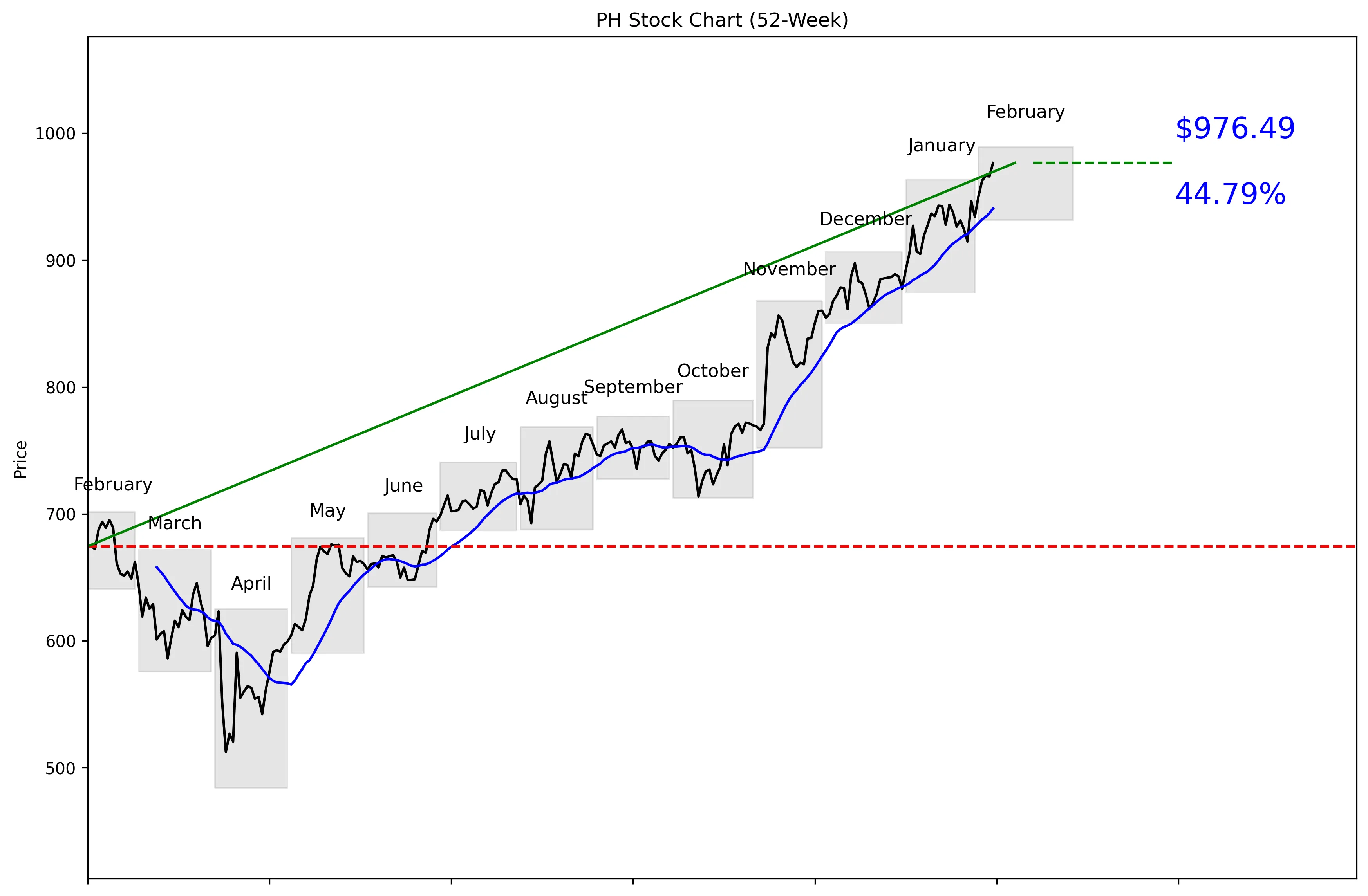
PH 52-Week Stock Chart
Technical Analysis
Parker-Hannifin Corporation (PH) has demonstrated a robust upward trend over the past 52 weeks, with a significant 44.8% increase in price, reflecting strong investor confidence and market demand. Key support is identified at approximately $700, which provided a solid base during several pullbacks, while resistance is evident around the $976.49 to $1,000 range, where recent price action has struggled to maintain upward momentum. The chart indicates a series of higher highs and higher lows, suggesting a bullish pattern, with notable upward movements occurring from December through February. In recent weeks, the stock has maintained its momentum, testing the upper resistance level but facing challenges to break through decisively. Currently priced at $977.21, PH is near the high end of its 52-week range, implying potential overbought conditions and the possibility of a pullback if it fails to breach resistance.


Recent News and Developments

Market Update

Here’s a summary of the latest news and developments for Parker-Hannifin Corporation (PH) stock in the past week:

Market Update

### Parker-Hannifin Exceeds Q2 Earnings and Revenue Expectations, Raises Full-Year Outlook

Market Update

On January 29, 2026, Parker-Hannifin (PH) announced strong second-quarter fiscal year 2026 results, surpassing analyst estimates for both earnings per share (EPS) and revenue. The company reported adjusted EPS of $7.65, topping the consensus estimate of $7.19, and revenue increased by 9% to $5.2 billion, exceeding analysts’ expectations of $5.07 billion. Following the positive report, Parker-Hanni

Market Sentiment and Analyst Recommendations

Bull Case
Parker-Hannifin just beat Q2 earnings by 6.4% and revenue by 3% while raising full-year guidance to $30.40-$31.00 EPS, signaling management confidence and operational execution. The aerospace segment is firing on all cylinders with robust demand, and industrial markets are showing recovery signs, which positions PH to capture upside as manufacturing activity normalizes. Revenue growth of 9.1% paired with 23 analyst consensus buys and an average price target of $1,017.83 (4.2% upside from current price) shows Wall Street is aligned on the story. The company carries a manageable debt-to-cash ratio with $9.87B debt against $427M cash, and at a 35.69 P/E, it’s not unreasonable for a cyclical compounder in a recovery phase. The stock’s 44.8% gain over 52 weeks reflects real momentum, not speculation, and the recent analyst upgrades from Citigroup, JPMorgan, and Truist suggest institutional conviction is building.
Bear Case
At $977.21, Parker-Hannifin is trading near its 52-week high with technical resistance around $976-$1,000, meaning much of the good news is already priced in. The 35.69 P/E is expensive for a cyclical industrial company, especially if aerospace demand cools or industrial recovery stalls faster than expected. The net debt position of $9.44B after subtracting cash is substantial, and any earnings miss or guidance cut would likely trigger a sharp selloff given how extended the valuation has become. The analyst price target range is wide ($610-$1,139), indicating real disagreement about fair value, and the bear case ($610) suggests 37% downside is on the table if execution falters. Recent price action shows the stock struggling to break above $1,000, which could signal that buyers are exhausted and a pullback to support levels like $700 is possible if sentiment shifts.
What to Watch
Monitor Q3 earnings in April 2026 for confirmation that the aerospace tailwind continues and industrial markets don’t deteriorate. Track the company’s ability to maintain or expand operating margins as revenue grows, since execution on cost management will determine if guidance gets raised again or held flat. Watch for any commentary on commercial aircraft production rates and defense spending trends, as these drive the aerospace segment that’s currently lifting the stock. The $1,000 level is a critical technical threshold; a clean break above it could trigger momentum buying toward $1,100, while a rejection would suggest the rally is losing steam. Keep an eye on the debt-to-EBITDA ratio and free cash flow generation to ensure leverage doesn’t creep higher, which would limit financial flexibility if rates stay elevated or the economy weakens unexpectedly.
Analyst Consensus
BUY

Based on 23 analyst opinions
Low Target
$610.00
Mean Target
$1017.83
High Target
$1139.00


Earnings and Financial Data

Sector
Industrials
Industry
Specialty Industrial Machinery
Employees
57,950


Earnings & Dividends
Next Earnings
Apr 30, 2026
EPS (Trailing)
$27.38
Dividend Yield
74.0%
Payout Ratio
25.7%

Frequently Asked Questions

Is PH a good stock to buy?
Parker-Hannifin (PH) is currently recommended as a BUY by analysts, with a target price of $1017.83, indicating potential upside of about 4.2% from the current price of $977.21. Given its solid market cap of $123.34B and strong fundamentals, it presents a compelling investment opportunity.
What is PH’s price target?
Analysts have set a price target of $1017.83 for Parker-Hannifin (PH). This target suggests healthy growth potential, as it is approximately 4.2% above the current trading price.
Does PH pay a dividend?
Yes, Parker-Hannifin offers a dividend yield of 74.0%. This high yield is attractive for income-focused investors seeking reliable returns in addition to stock appreciation.
What is PH’s P/E ratio?
Parker-Hannifin’s price-to-earnings (P/E) ratio stands at 35.69, with a forward P/E of 28.75. These figures indicate that the stock may be valued at a premium, reflecting investor confidence in its growth prospects.
What is PH’s 52-week price range?
Parker-Hannifin’s 52-week price range is $488.45 to $988.86. This volatility indicates the potential for significant price movements, which investors should consider when evaluating entry points.

Related Stock Reports

Disclaimer: This report is for informational purposes only and does not constitute financial advice. The analysis and opinions expressed are those of AltStation.io and should not be relied upon as the sole basis for investment decisions. Always conduct your own research and consult with a qualified financial advisor before making investment decisions. Past performance does not guarantee future results. Updated February 07, 2026.