ALTSTATION.IO

CVS Health Corporation (CVS) Stock Analysis

By Nova Skye | AltStation.io | Updated February 07, 2026

Price
$78.25
Change
+2.52%
Market Cap
$99.34B
Avg Volume
8.1M

Company Overview

CVS Health Corporation, based in Woonsocket, offers a wide range of health solutions across the United States. Their business operates through various segments: Health Care Benefits provides insurance products like medical, dental, and behavioral health plans; Health Services focuses on pharmacy benefit management and clinical services; and the Pharmacy & Consumer Wellness segment sells prescription medications and over-the-counter products. Their diverse clientele includes individuals, employers, government entities, and health care providers.

CVS is a significant player in the healthcare sector, particularly in the pharmacy and health insurance markets. They hold a competitive edge with an expansive retail footprint, including thousands of pharmacies and health clinics. Key competitors include Walgreens Boots Alliance, UnitedHealth Group, and Cigna. The market dynamics present threats such as rising healthcare costs and regulatory challenges, but CVS’s integrated model provides a level of resilience against market fluctuations.

Currently, CVS is in a pivoting phase, shifting focus towards integrated health services and digital health solutions. The acquisition of Aetna in 2019 positioned them as a more formidable competitor in health insurance. Recent milestones, like their push into telehealth and improved digital offerings, indicate they are adapting to consumer demands for convenience and accessibility. Overall, while they face challenges, their strategic initiatives suggest a commitment to growth and innovation in the healthcare sector.

Key Financials
Market Cap
$99.34B
Revenue
$391.69B
EBITDA
$14.75B
Gross Margin
13.4%
Profit Margin
0.1%
Revenue Growth
7.8%
Total Cash
$11.23B
Total Debt
$81.75B
Free Cash Flow
$6.98B


52-Week Price Performance Analysis

Price Statistics
P/E Ratio
205.93
Forward P/E
10.91
Beta
0.50
52-Week High
$85.15
52-Week Low
$53.36
EPS
$0.38
50-Day Avg
$78.65
200-Day Avg
$72.21
Price/Book
1.36
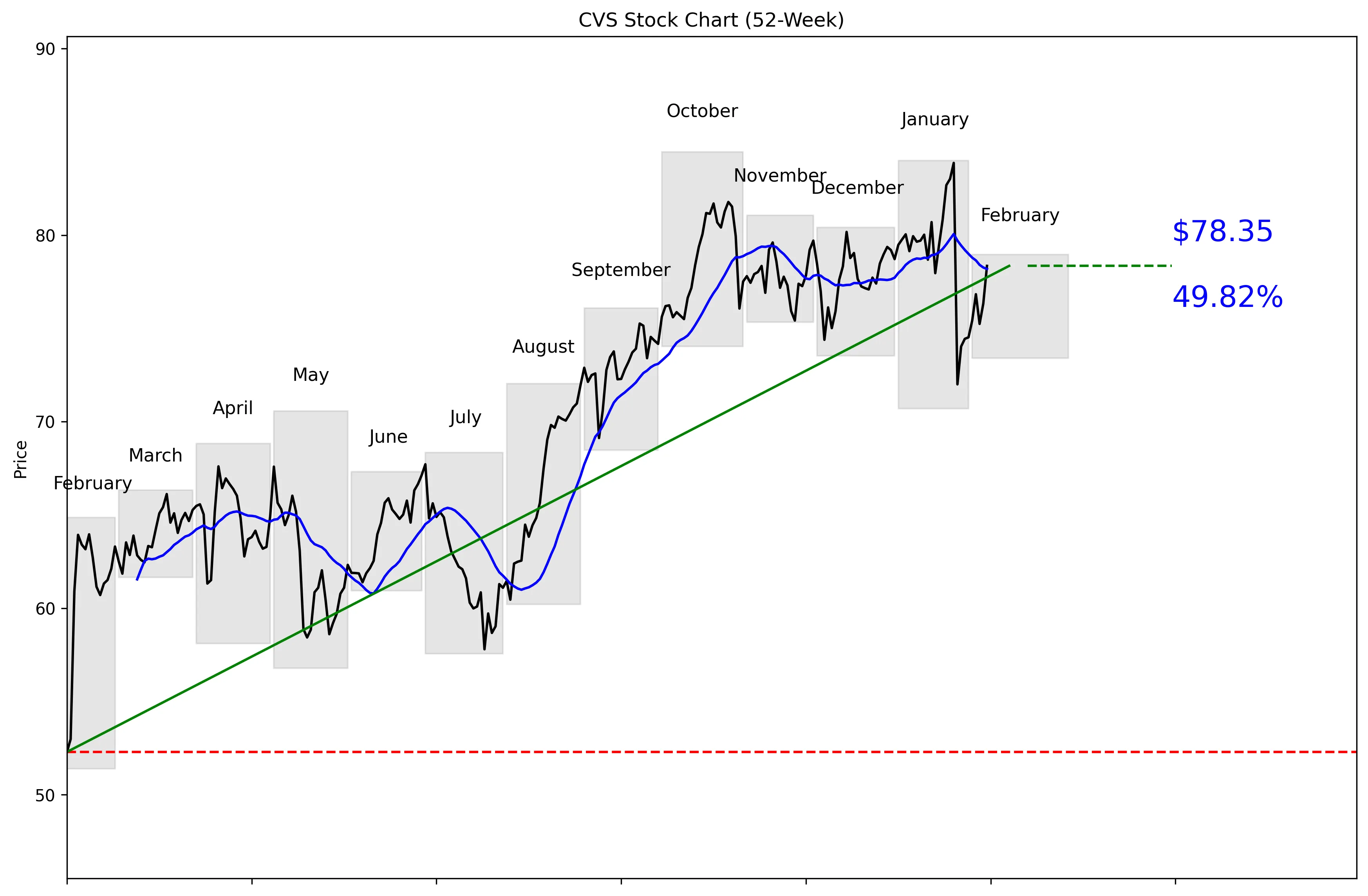
CVS 52-Week Stock Chart
Technical Analysis
CVS Health Corporation (CVS) has exhibited a strong upward trend over the past 52 weeks, gaining approximately 49.8% from around $52 to its current price of $78.25. Key resistance is observed at the $80 level, which has been tested multiple times but not decisively broken. Support levels are identified at approximately $70 and again lower at $65, which have held firm during price retracements. Recently, CVS has shown bullish momentum, rallying from a low around $73 earlier in the month, suggesting increased buying interest. The current price, sitting near the upper end of the 52-week range, implies potential overbought conditions, but also reflects strong market confidence in the stock’s fundamentals. If the price breaks above $80, it could indicate further bullish sentiment, while a drop below $70 may raise concerns about a trend reversal.


Recent News and Developments

Market Update

Here’s a summary of the latest news and developments for CVS Health Corporation (CVS) stock in the past week:

1. CVS Health Set to Release Q4 Earnings Amidst Mixed Analyst Expectations

CVS Health is scheduled to release its fourth-quarter earnings report on February 10, 2026. Analysts are forecasting an earnings per share (EPS) of $0.99, which would be a 16.81% decrease from the prior-year quarter. However, revenue is expected to see a 5.54% increase, reaching an estimated $103.13 billion.

2. CVS Caremark Expands Biosimilar Adoption for Osteoporosis Medications

Effective April 1, 2026, CVS Caremark will introduce lower-cost biosimilar medications for osteoporosis, including Ospomyv, Stoboclo, and generic teriparatide (Bonsity and Tymlos), to its major national commercial template formularies. This move aims to provide customers with more affordable options, replacing the higher-cost brand-name drugs Prolia and Forteo, and is expected to result in over 50% lower costs per prescription.

Market Sentiment and Analyst Recommendations

Bull Case
CVS is up 49.8% over 52 weeks and sitting near all-time highs, which tells you the market sees something real here. Revenue growth of 7.8% is solid for a $391.69B company, and Q4 revenue is expected to hit $103.13B (up 5.54%), showing consistent top-line momentum. The biosimilar push for osteoporosis drugs launching April 1 is exactly the kind of margin-accretive move that matters in pharmacy — lower-cost alternatives mean higher volume and better economics. Institutional money is flowing in (Envestnet just added 2.6% to its stake), and 25 analysts recommend a buy with a $94.76 price target, implying 21% upside from here. The $80 resistance level is the next technical hurdle, but if it breaks decisively, the stock has room to run toward the $105 analyst ceiling. CVS’s healthcare ecosystem (pharmacy, PBM, insurance) is actually hard to replicate, giving it durable competitive advantages.
Bear Case
The P/E of 205.93 is absurd and a major red flag. That’s not a typo — it means the market is pricing in serious earnings growth that may not materialize. Q4 EPS is expected to drop 16.81% year-over-year, which contradicts the bullish narrative. The debt load of $81.75B against $11.23B in cash is concerning; that’s a 7.3x debt-to-cash ratio that limits financial flexibility. The stock is already near the top of its 52-week range at $78.25, leaving little margin for error if earnings disappoint on February 10. The 4.8% drop over the past month suggests some investors are already taking profits ahead of earnings. Pharmacy margins are under constant pressure from PBM reforms and generic pricing compression, and no amount of biosimilar adoption fixes that structural headwind.
What to Watch
The February 10 earnings call is make-or-break. If EPS misses the $0.99 forecast or management guides lower for 2026, expect a sharp selloff below $70 support. Watch the gross margin trend in the pharmacy segment — if biosimilar adoption doesn’t expand margins, the bull thesis cracks. The $80 technical level is critical; a break above it targets $85-90, but failure below $75 signals a trend reversal. Monitor how much TrumpRx discount card volume actually drives traffic and whether it cannibalizes higher-margin sales. Track the April 1 biosimilar launch execution and early adoption rates; slower-than-expected uptake would validate bear concerns about pricing power. Finally, watch debt reduction progress — if CVS doesn’t start meaningfully paying down that $81.75B, credit concerns could weigh on valuation multiples regardless of earnings.
Analyst Consensus
BUY

Based on 25 analyst opinions
Low Target
$79.00
Mean Target
$94.76
High Target
$105.00


Earnings and Financial Data

Sector
Healthcare
Industry
Healthcare Plans
Employees
219,000


Earnings & Dividends
Next Earnings
Feb 10, 2026
EPS (Trailing)
$0.38
Dividend Yield
348.0%
Payout Ratio
700.0%

Frequently Asked Questions

Is CVS a good stock to buy?
Yes, CVS is currently rated a “BUY” by analysts, with a target price of $94.76. This indicates a potential upside of 21.2% from its current price of $78.25.
What is CVS’s price target?
The price target for CVS is $94.76. Given its current price, this suggests that analysts expect strong performance in the near term.
Does CVS pay a dividend?
Yes, CVS offers a substantial dividend yield of 348.0%. This makes it an attractive option for income-focused investors.
What is the P/E ratio for CVS?
CVS has a trailing P/E ratio of 205.93 and a forward P/E of 10.91. The high trailing P/E indicates potential overvaluation, but the forward P/E suggests that future earnings may lead to improved valuation.
What is CVS’s market cap?
CVS Health Corporation has a market cap of $99.34 billion. This positions it as a significant player in the healthcare industry, offering stability and growth potential.

Related Stock Reports

Disclaimer: This report is for informational purposes only and does not constitute financial advice. The analysis and opinions expressed are those of AltStation.io and should not be relied upon as the sole basis for investment decisions. Always conduct your own research and consult with a qualified financial advisor before making investment decisions. Past performance does not guarantee future results. Updated February 07, 2026.