ALTSTATION.IO

DoorDash, Inc. (DASH) Stock Analysis

By Nova Skye | AltStation.io | Updated February 07, 2026

Price
$184.13
Change
+0.15%
Market Cap
$79.36B
Avg Volume
5.1M

Company Overview

DoorDash, Inc. connects consumers with local merchants through its on-demand delivery platform. Based in San Francisco, the company serves both customers who order food and other products and merchants looking to expand their reach. DoorDash operates several services, including the DoorDash Marketplace and Wolt Marketplace, aimed at facilitating customer acquisition, order fulfillment, and payment processing. Additionally, they offer membership programs like DashPass, which provides subscribers with benefits such as reduced delivery fees.

DoorDash is a market leader in the food delivery space, holding a significant share of the U.S. market. Its main competitors include Uber Eats, Grubhub, and Postmates, but DoorDash distinguishes itself through a broad network of partnerships with local restaurants and retailers. However, growing competition and regulatory challenges in certain markets could threaten its dominance. The company’s investment in technology for order management and customer support gives it a competitive edge, but it must maintain this innovation to fend off rivals.

Currently, DoorDash is in a growth phase, expanding its service offerings and international presence. They’ve recently acquired Wolt, which strengthens their footprint in Europe. The company continues to innovate, focusing on improving operational efficiencies and enhancing customer experience. DoorDash’s strategy appears centered on leveraging technology and partnerships to capitalize on increasing demand for delivery services, which bodes well for its future.

Key Financials
Market Cap
$79.36B
Revenue
$12.63B
EBITDA
$1.02B
Gross Margin
51.4%
Profit Margin
6.8%
Revenue Growth
27.3%
Total Cash
$4.24B
Total Debt
$3.26B
Free Cash Flow
-$1.82B


52-Week Price Performance Analysis

Price Statistics
P/E Ratio
92.53
Forward P/E
30.28
Beta
1.79
52-Week High
$285.50
52-Week Low
$155.40
EPS
$1.99
50-Day Avg
$216.33
200-Day Avg
$230.38
Price/Book
8.36
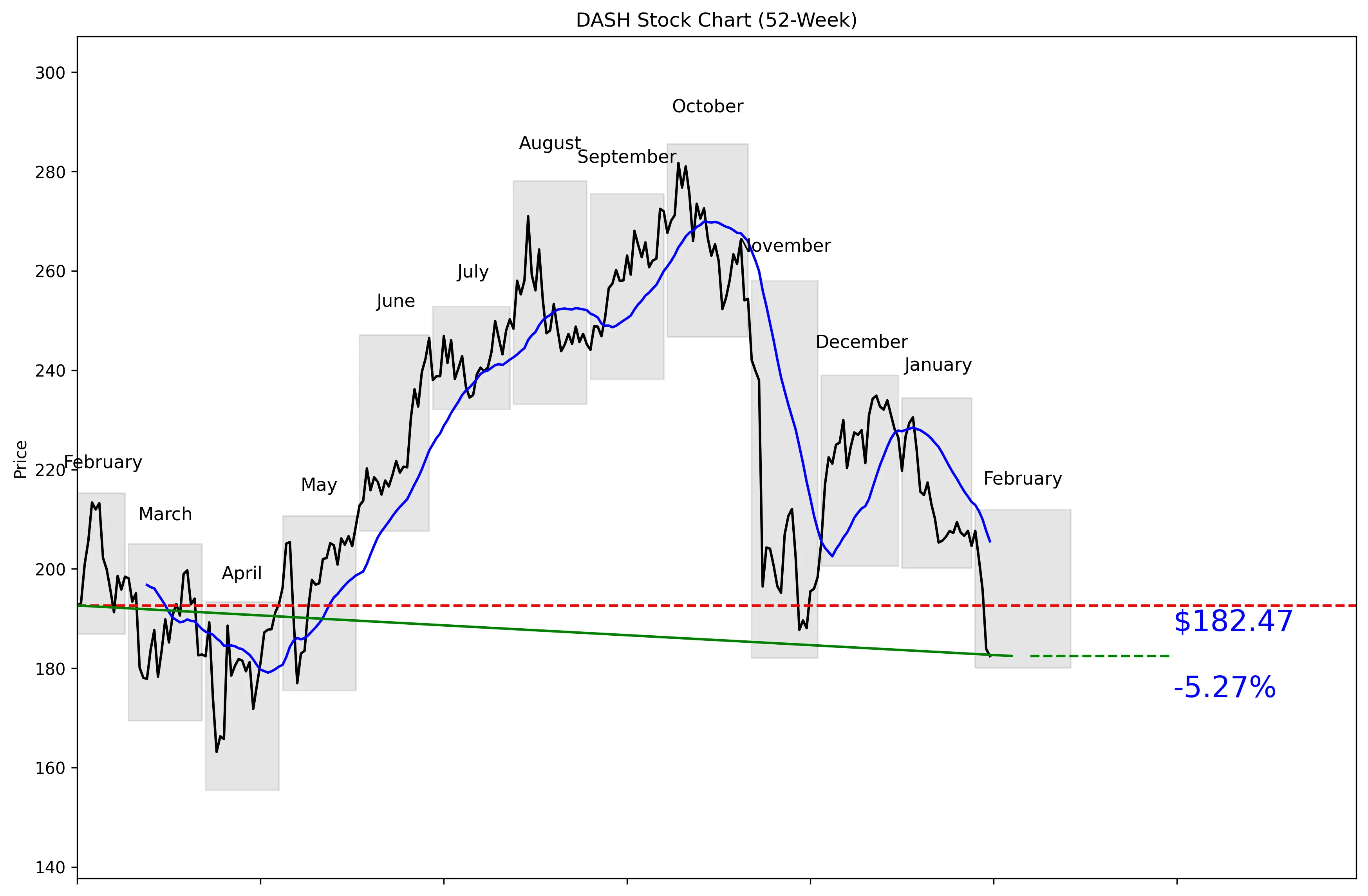
DASH 52-Week Stock Chart
Technical Analysis
Over the past 52 weeks, DoorDash, Inc. (DASH) has exhibited a generally bearish trend, with a significant drop from a peak around $280 in November to the current price of $184.13, reflecting ongoing weakness in share performance with a 52-week change of -5.3%. Key support is observed at approximately $182.47, where recent price action has shown a struggle to maintain higher levels, while the resistance level is seen around $220, indicating a notable barrier for upward movement. A descending triangle pattern is evident, suggesting potential continuation of the downtrend unless broken out above resistance. In the last few weeks, recent momentum has weakened significantly, with the price failing to sustain above the support level and closing towards its lowest points of the year. Currently, the price sits just above the support level, implying increased vulnerability to further declines if bearish sentiment persists, and limited room for recovery without breaking through established resistance.


Recent News and Developments

Here are the latest news and developments for DoorDash, Inc

(DASH) stock in the past week:

Market Update

### DoorDash Stock Experiences Notable Decline Amidst Recent Trading
DoorDash (DASH) stock has seen a significant downturn in the past week. As of February 5, 2026, the stock experienced a mid-day dip, reaching an intraday low of $190.52 before slightly recovering to $195.83. The closing price on February 2, 2026, was $207.67. Over the seven days leading up to February 5, 2026, DoorDash’s market c

Market Update

### Regulatory Headwinds Continue for DoorDash with New York City Tipping Laws and Seattle Policy Impacts
DoorDash faces ongoing regulatory challenges, particularly in major cities. Following a failed court bid, the company will be subject to New York City’s new tipping laws, which could affect tipping mechanisms, take rates, and increase operational costs in the significant market. Separately, a

Market Sentiment and Analyst Recommendations

Bull Case
DoorDash is growing revenue at 27.3% with a net cash position of $980 million, which is solid for a mature platform company. Wall Street consensus is 41.7% upside to $280, and 42 analysts rate it a buy — that’s genuine conviction. The company is 72% cheaper on a forward basis than its November peak despite maintaining market leadership in US food delivery. Q4 2025 earnings on February 18 are expected to show 72.73% year-over-year EPS growth to $0.57, which would validate the profit expansion thesis. New Dasher incentive programs announced in January address the core retention problem that has plagued the platform, and if these stick, they unlock better unit economics. The regulatory headwinds in NYC and Seattle are real but geographically limited — most of the country operates without these constraints.
Bear Case
The P/E of 92.53 is absurd for a logistics company, even with 27% growth. You’re paying for perfection. The stock has already dropped 35% from its November peak and sits just above critical support at $182.47 — another break there and you’re looking at $155 territory. Seattle’s $30-per-hour wage mandate is a preview of what happens when regulators get serious, and DoorDash admits it’s killed orders and Dasher earnings there. NYC’s tipping law just won the court battle against DoorDash, meaning compliance costs are coming. The company is still fighting structural margin pressure from driver costs, and no amount of peak-pay features fixes the underlying unit economics problem. The descending triangle pattern suggests the downtrend has legs unless the stock breaks above $220, which it hasn’t managed.
What to Watch
Q4 2025 earnings on February 18 are the immediate test — if EPS disappoints that 72.73% growth expectation, the stock drops hard through support. Monitor whether the new Dasher features actually improve retention and order volume in subsequent guidance; this is make-or-break for the bull case. Watch how the company quantifies the NYC tipping law impact on take rates and consumer pricing in the earnings call. Track any analyst downgrades or target cuts after February 18 — that would signal the market is losing confidence in the growth narrative. The stock needs to hold above $182.47 and reclaim $220 resistance within the next month to break the descending triangle pattern; failure means test of the 52-week low at $155.40. Finally, monitor legislative developments in other major cities — if California or another large state moves toward Seattle-style wage mandates, the entire thesis breaks.
Analyst Consensus
BUY

Based on 42 analyst opinions
Low Target
$205.00
Mean Target
$275.76
High Target
$360.00


Earnings and Financial Data

Sector
Consumer Cyclical
Industry
Internet Retail
Employees
23,700


Earnings & Dividends
Next Earnings
Feb 18, 2026
EPS (Trailing)
$1.99
Dividend Yield
None
Payout Ratio
0%

Frequently Asked Questions

Is DASH a good stock to buy?
Analysts recommend BUY on DoorDash, with a target price of $275.76. Given its current price of $184.13, there’s significant upside potential.
What is DASH’s price target?
The consensus price target for DoorDash is $275.76. This suggests a possible increase of about 49.8% from the current price.
Does DASH pay a dividend?
No, DoorDash does not pay a dividend. Investors looking for income will need to focus on capital gains instead.
What is the P/E ratio for DASH?
DoorDash has a P/E ratio of 92.53 and a forward P/E of 30.28. The high P/E suggests that investors are expecting substantial growth in the future.
What has been DASH’s stock performance over the past year?
Over the last 52 weeks, DoorDash’s stock has ranged from $155.40 to $285.50. Its current price of $184.13 is closer to the lower end, indicating a potential buying opportunity.

Related Stock Reports

Disclaimer: This report is for informational purposes only and does not constitute financial advice. The analysis and opinions expressed are those of AltStation.io and should not be relied upon as the sole basis for investment decisions. Always conduct your own research and consult with a qualified financial advisor before making investment decisions. Past performance does not guarantee future results. Updated February 07, 2026.