ALTSTATION.IO

Erie Indemnity Company (ERIE) Stock Analysis

By Nova Skye | AltStation.io | Updated February 07, 2026

Price
$288.27
Change
+0.93%
Market Cap
$15.07B
Avg Volume
166.4K

Company Overview

Erie Indemnity Company, headquartered in Erie, Pennsylvania, serves as a managing attorney-in-fact for the Erie Insurance Exchange. The company specializes in insurance brokerage services, focusing on issuing and renewing insurance policies. Their offerings include sales support, underwriting, and administrative services, catering primarily to insurance agents and policyholders in the United States.

In terms of competition, Erie Indemnity is a solid player in the U.S. insurance market. They operate as a market leader in several regions, thanks to their strong brand recognition and extensive network of agents. However, they face challenges from larger competitors like Allstate and State Farm, which have greater resources and wider market reach. The increasing trend towards digital insurance solutions also poses a threat, pushing Erie to innovate and adapt quickly.

Currently, Erie Indemnity is in a growth phase, having reported a revenue increase of over 9% year-over-year in their latest financial results. The company is focusing on expanding its technology platform to enhance customer engagement and streamline operations. Recent initiatives include investments in digital solutions aimed at improving service delivery, which are critical for maintaining their competitive edge in a rapidly changing market.

Key Financials
Market Cap
$15.07B
Revenue
$4.04B
EBITDA
$814.47M
Gross Margin
18.0%
Profit Margin
16.0%
Revenue Growth
6.7%
Total Cash
$600.38M
Total Debt
$54.33M
Free Cash Flow
$409.10M


52-Week Price Performance Analysis

Price Statistics
P/E Ratio
23.25
Forward P/E
20.58
Beta
0.37
52-Week High
$456.93
52-Week Low
$270.07
EPS
$12.40
50-Day Avg
$285.09
200-Day Avg
$326.29
Price/Book
6.53
ERIE 52-Week Stock Chart
Technical Analysis
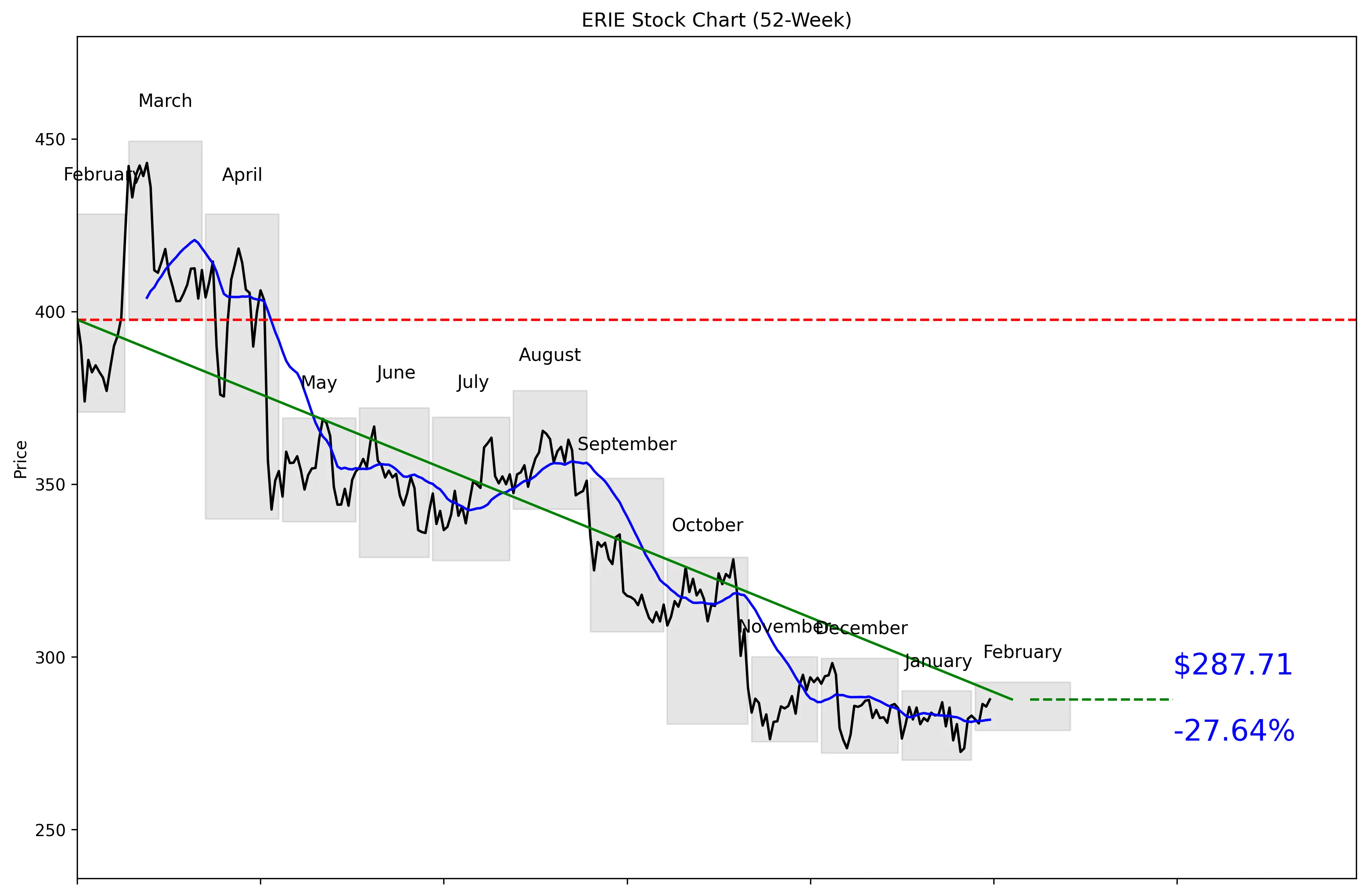
Over the past 52 weeks, Erie Indemnity Company (ERIE) has demonstrated a clear downtrend, with a significant decline of 27.6% from its peak near $450 in February. The key resistance level is around $400, where the stock has struggled to break through multiple times, indicating seller dominance at that range. Support is evident near $287.71, which has been tested recently and suggests a potential pivot point for buyers. Notably, the stock exhibits a bearish continuation pattern, characterized by lower highs and lower lows throughout the year. In the recent weeks, momentum appears weak as the price remains near the lower end of the 52-week range, with the current price at $288.27. This positioning implies that the stock is flirting closely with critical support, raising the risk of further declines if it fails to hold above this level.


Recent News and Developments

Market Update

Here’s a summary of the latest news and developments for Erie Indemnity Company (ERIE) stock from the past week (February 1 – February 7, 2026):

1. Analyst Ratings Maintain “Hold” Consensus Amidst Underperformance

Erie Indemnity (ERIE) continues to hold a consensus “Hold” rating from research analysts, with an average rating score of 2.00. This comes as the company has reportedly underperformed the broader market, with shares declining 29.8% over the past 52 weeks compared to the S&P 500 Index’s 12.2% gain.

2. Q4 and Year-End 2025 Earnings Report Scheduled for Late February

Erie Indemnity is slated to release its financial results for the fourth quarter and full-year 2025 after the market closes on Monday, February 23, 2026. This announcement will be followed by a pre-recorded management webcast on February 24th, providing further insights into the company’s performance. Analysts are expecting an estimated EPS of $3.11 for the quarter.

Market Sentiment and Analyst Recommendations

Bull Case
Erie’s balance sheet is fortress-like with $600M in cash against only $54M in debt, giving the company real financial flexibility. The 7.1% dividend increase in December signals management confidence in cash generation despite the stock’s 29.8% decline over 52 weeks. At 23.25x P/E, the valuation isn’t cheap, but 6.7% revenue growth in an insurance market plagued by underwriting losses shows the company is gaining market share. The recent insider buy by Sarah Shine (EVP) at $283 suggests management sees value near current levels. The Erie Secure Auto expansion into additional states by mid-2026 is a concrete growth driver that could accelerate premium growth in a key product line.
Bear Case
The stock is down 27.6% from its $450 peak and now trades near critical support at $287.71, which means limited downside cushion if sentiment deteriorates further. The consensus “Hold” rating reflects analyst hesitation, and the stock’s underperformance versus the S&P 500 (down 29.8% vs. up 12.2%) is a red flag about competitive or operational headwinds. Insurance companies face structural margin pressure from inflation and weather volatility, which Erie acknowledged directly. The 23.25x P/E is elevated for a company growing at 6.7%, leaving no room for earnings misses. Earnings arrive February 23rd with an estimated EPS of $3.11 for Q4, but with the stock already near support, any disappointment could trigger a breakdown below $287.
What to Watch
The Q4 2025 earnings report on February 23rd is the immediate catalyst, and management needs to beat the $3.11 EPS estimate and provide clarity on margins amid inflationary pressures. Watch the combined ratio (earned premiums divided by losses and expenses) on the earnings call, as this metric directly signals underwriting profitability in insurance. The Erie Secure Auto expansion rollout timeline through mid-2026 needs concrete milestones and state-by-state rollout details to prove it’s a meaningful growth driver. If the stock holds above $287.71 support after earnings, it could set up a retest of the $350-$400 resistance zone; a break below that level signals further downside risk. Monitor dividend sustainability in the earnings report, as the 7.1% increase only makes sense if management sees stable or growing underwriting cash flow. Quarterly combined ratio trends and new premium written growth are the two metrics that will determine whether this is a value trap or a legitimate turnaround.
Analyst Consensus
NONE

Based on None analyst opinions
Low Target
$N/A
Mean Target
$N/A
High Target
$N/A


Earnings and Financial Data

Sector
Financial Services
Industry
Insurance Brokers
Employees
6,715


Earnings & Dividends
Next Earnings
Feb 23, 2026
EPS (Trailing)
$12.40
Dividend Yield
195.0%
Payout Ratio
44.1%

Frequently Asked Questions

Is ERIE a good stock to buy?
ERIE is currently priced at $288.27 with a P/E ratio of 23.25. While it has solid financials as part of the insurance industry, the lack of analyst coverage makes it harder to gauge broader market sentiment. Proceed with caution.
What is ERIE’s price target?
There is currently no analyst price target available for ERIE. This absence might indicate uncertainty within the market about future performance, making it a riskier investment.
Does ERIE pay a dividend?
Yes, ERIE has an impressive dividend yield of 195.0%. This high yield can be attractive to income-focused investors, but it’s crucial to assess its sustainability based on the company’s financial health.
What is ERIE’s recent stock performance?
ERIE has traded within a 52-week range of $270.07 to $456.93, indicating significant volatility. The current price of $288.27 suggests it is closer to the lower end of that range, which could imply a buying opportunity if one believes in its long-term potential.
What sector and industry does ERIE belong to?
ERIE operates in the Financial Services sector, specifically within the Insurance Brokers industry. This sector can be sensitive to economic cycles, and understanding these dynamics is key for potential investors.

Related Stock Reports

Disclaimer: This report is for informational purposes only and does not constitute financial advice. The analysis and opinions expressed are those of AltStation.io and should not be relied upon as the sole basis for investment decisions. Always conduct your own research and consult with a qualified financial advisor before making investment decisions. Past performance does not guarantee future results. Updated February 07, 2026.