DECODING MARKETS
Oracle Corporation, headquartered in Austin, Texas, is a leading global provider of enterprise information technology products and services. The company operates predominantly within the Software - Infrastructure industry as a notable player in the broader Technology sector. Oracle's business model focuses on delivering cloud-based software applications, including Oracle Fusion for enterprise resource planning (ERP), performance management (EPM), and human capital management (HCM).
In addition to its software offerings, Oracle is heavily invested in providing comprehensive infrastructure technologies such as databases, artificial intelligence (AI), cloud services, and an array of hardware products. With a diverse client base comprising businesses, government agencies, and educational institutions worldwide, Oracle aims to cater to the ever-evolving demands of the digital landscape.
With a total revenue of approximately $61 billion, the company reflects strong market demand for its services, positioning itself favorably for potential investments. Thus, with favorable market conditions and robust financial performance, Oracle is classified as a "buy" opportunity for prospective investors.
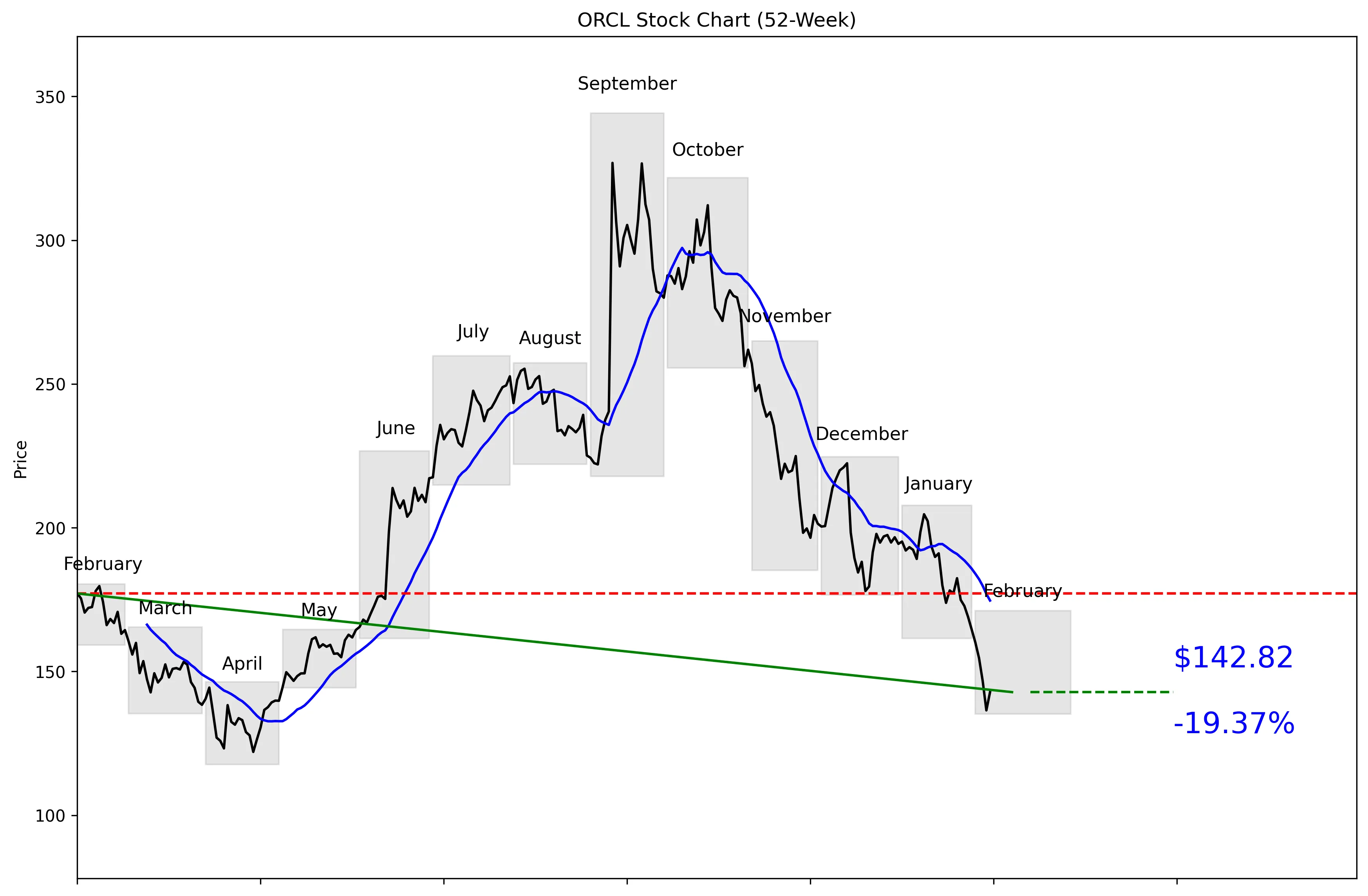
52-Week Price Performance Chart
Over the past year, Oracle Corporation's stock (ORCL) has exhibited notable price fluctuations driven by varying market conditions. Currently priced at $194.91, the stock is trading significantly below its 52-week high of $345.72, reflecting a 43.5% discount. The stock has also seen a considerable 52-week low of $118.86, indicating substantial volatility.
From a technical perspective, the stock's price action can be segmented into two main phases. From March through September, Oracle's stock demonstrated a predominantly bullish momentum, with prices advancing from approximately $150 and peaking near $300. This period signified robust investor confidence, marked by higher highs and higher lows.
Post-September, however, the stock experienced a downward correction, attributed to profit-taking behaviors and shifts in market sentiment. Currently, the stock is displaying consolidation around the $195 mark, which aligns with a critical support level. The 18.36% decline from its peak may present a potential buying opportunity, provided that market conditions begin to stabilize.
Key support and resistance levels are identifiable: - Support Level: Approximately $150 - Resistance Level: Approximately $300
Furthermore, the recent moving average crossover, illustrated on the chart, hints at a possible momentum shift, making it crucial for investors to watch for signs of a breakout from the current consolidation phase.
Oracle's financial metrics resonate with its solid operational capabilities. With total revenue standing at approximately $61.02 billion, the company maintains a healthy profit outlook. The EBITDA (Earnings Before Interest, Taxes, Depreciation, and Amortization) is at about $26.27 billion, underscoring Oracle's potential for profitability.
| Financial Metric | Value | |------------------------------|----------------------------| | Total Revenue | $61.02 billion | | EBITDA | $26.27 billion | | Current Market Price | $194.91 | | Target High Price | $400.00 | | Target Mean Price | $293.71 | | Target Low Price | $175.14 |
The range of target prices indicates considerable potential for price movement, suggesting that the stock could be undervalued relative to its forecasts. With a price target high of $400, investors are looking at a substantial upside if market conditions align favorably.
Moreover, analyst sentiment leans significantly positive, with a mean recommendation rating of 1.81 from 38 analysts, suggesting a robust confidence level in Oracle's future performance. The recommendation key is classified as a "buy," indicating strong bullish support.
Despite its strong financial and market position, Oracle has faced some challenges recently:
On December 12, 2025, shares fell by 5% after news broke regarding delays in the completion of data centers for OpenAI, affected by labor and material shortages. This has temporarily impacted investor sentiment, considering Oracle's pivotal $300 billion contract with OpenAI.
On November 25, 2025, DA Davidson analyst Gil Luria diminished Oracle's price target by 33% to $200 per share, voicing concerns regarding the sustainability of its OpenAI contract.
There are also positive developments. In October 2025, Oracle forged a partnership with Microsoft, enabling the integration of Azure IoT Operations with Oracle Cloud Supply Chain Management. This collaboration aims to enhance real-time processing of factory data, showcasing Oracle's commitment to enhancing its cloud infrastructure.
Moreover, a projection anticipates Oracle's cloud revenue could skyrocket to $166 billion by fiscal 2030, significantly up from $10 billion in fiscal 2025, reflecting a remarkable 75% compound annual growth rate (CAGR).
Investor movements in the market are noteworthy as well. In October 2025, PineStone Asset Management liquidated 161,430 shares valued at approximately $41.1 million, while CCM Investment Advisers acquired 49,757 shares worth about $13.99 million. This divergence highlights contrasting sentiments among institutional investors.
Investor sentiment regarding Oracle remains cautiously optimistic. The current market price of $194.91 is below both its fifty-day moving average of $222.56 and its fifty-two-week high of $345.72, indicating potential for a rebound if the overall market dynamics shift positively. The stock is approaching a supportive threshold at around $200, contributing to consolidation patterns.
In terms of analyst recommendations, the consensus appears favorable, with many experts advocating a bullish stance. The price target of $400 reflects an optimistic outlook on the company's growth trajectory within a competitive technology landscape.
While the market sentiment leans toward a positive forecast, it is imperative for investors to balance their outlook with awareness of the prevailing risks. The recent volatility, coupled with fluctuating contract dynamics with partners like OpenAI, necessitates diligent monitoring of future developments and market conditions.
In conclusion, Oracle Corporation presents a compelling investment opportunity amid a landscape characterized by growth potential and strategic advancements. As the company strives to solidify its position within the technology sector, prudent investors should consider not only the possibilities but also the inherent risks associated with stock volatility and shifting market sentiment.
| Metric | Value |
|---|---|
| Market Cap | $560.0b |
| Total Debt | $131.7b |
| Total Cash | $19.8b |
| Shares Outstanding | 2.9b |
| Float Shares | 1.7b |
The information provided in this monthly report is for informational purposes only and should not be construed as financial, investment, or trading advice. AltStation.io does not guarantee the accuracy, completeness, or timeliness of the data and analyses presented. The content is based on publicly available information, and while we strive to ensure its accuracy, errors and omissions may occur.
Investing in stocks, cryptocurrencies, and other financial instruments involves significant risk, including the potential loss of principal. Past performance is not indicative of future results. Readers should conduct their own research and consult with a qualified financial advisor before making any investment decisions. AltStation.io and its affiliates are not responsible for any losses incurred as a result of using this report.
By using this report, you acknowledge that you understand and accept these terms.
Report Updated: January 2, 2026
Data Last Updated: 2026-01-30 12:47:29