ALTSTATION.IO

Synchrony Financial (SYF) Stock Analysis

By Nova Skye | AltStation.io | Updated February 07, 2026

Price
$75.56
Change
+2.54%
Market Cap
$27.21B
Avg Volume
4.0M

Company Overview

Synchrony Financial (SYF) is a consumer financial services company based in Stamford, Connecticut. They specialize in offering credit products, including credit cards, installment loans, and commercial credit solutions. Their primary customers are retailers, healthcare providers, and other businesses that sell their financing options to consumers, allowing shoppers to buy goods and services on credit. They also provide banking products like savings accounts and certificates of deposit.

In terms of market position, Synchrony is a leading player in the consumer credit space, especially in private label credit cards. They have strong partnerships with major retailers like American Eagle and Dick’s Sporting Goods, which gives them a significant edge in attracting customers. However, they face stiff competition from other credit providers and banks, especially as the market sees increasing pressure from fintech companies offering alternative financing solutions. The industry’s reliance on consumer spending makes them vulnerable to economic downturns.

Currently, Synchrony is in a phase of strategic growth. They are expanding their partnerships and enhancing digital capabilities to meet changing consumer expectations. Recent milestones include efforts to diversify their product offerings, particularly in healthcare financing with their CareCredit solution. Their focus on digital channels and maintaining strong relationships with retailers positions them well, but they must navigate the competitive landscape carefully to sustain momentum.

Key Financials
Market Cap
$27.21B
Revenue
$9.76B
EBITDA
N/A
Gross Margin
0.0%
Profit Margin
36.4%
Revenue Growth
5.0%
Total Cash
$14.97B
Total Debt
$15.18B
Free Cash Flow
N/A


52-Week Price Performance Analysis

Price Statistics
P/E Ratio
8.14
Forward P/E
7.24
Beta
1.40
52-Week High
$88.77
52-Week Low
$40.55
EPS
$9.28
50-Day Avg
$80.43
200-Day Avg
$71.09
Price/Book
1.69
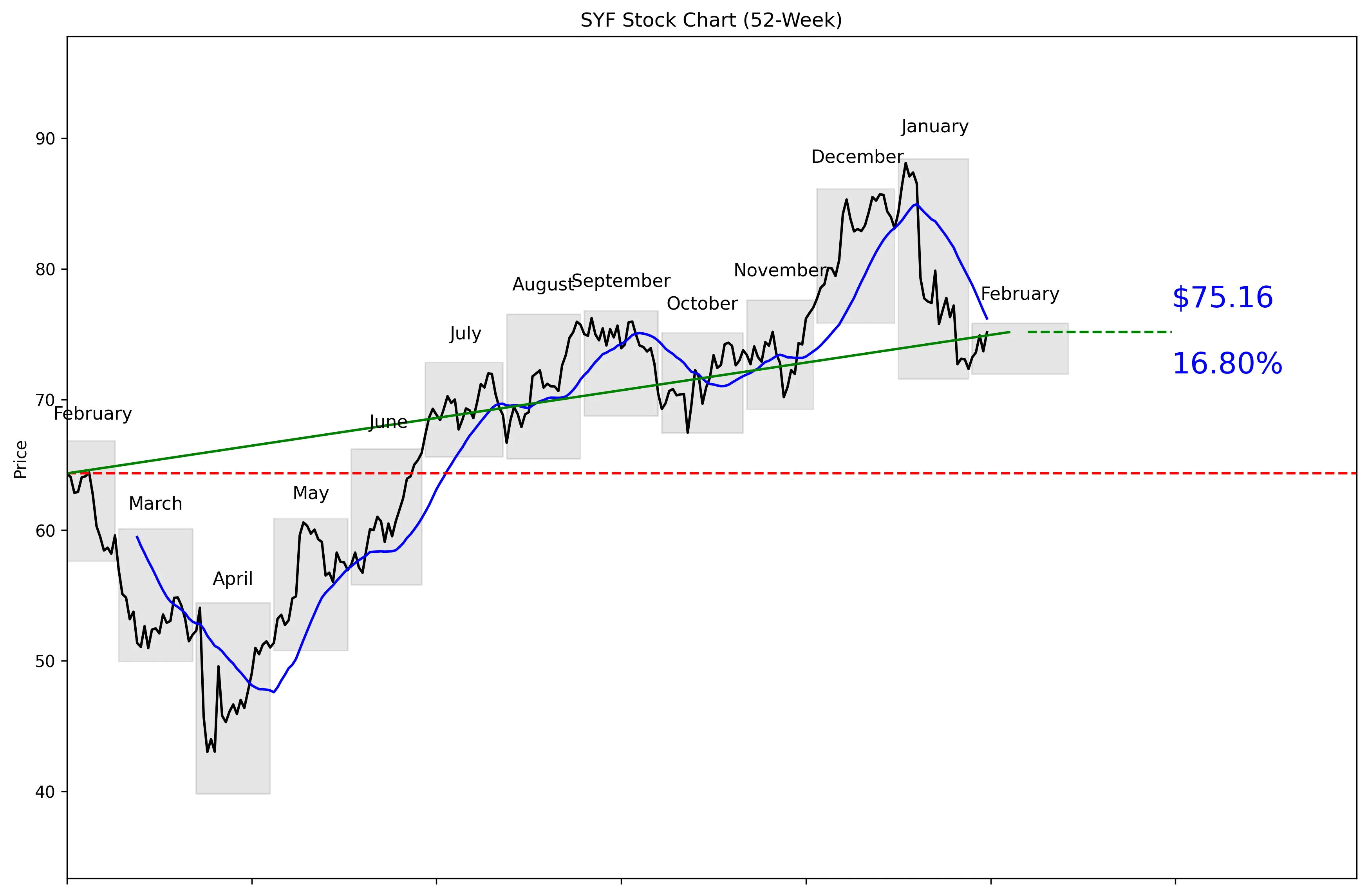
SYF 52-Week Stock Chart
Technical Analysis
The 52-week chart for Synchrony Financial (SYF) shows an overall upward trend, with the stock price increasing from approximately $60 in February to its current price of $75.56, marking a solid 16.8% change over the year. Key support is identified at the $70 level, which acted as a strong baseline during dips in late February and multiple occasions throughout the summer. Resistance has been seen near the $85 level; the stock struggled to maintain momentum above this range in January. Recently, there’s been a consolidation pattern, with the price hovering around the $75 area, suggesting indecision among traders. The current price is within the upper half of the 52-week range, indicating a bullish sentiment despite some recent pullbacks. Overall, the chart suggests that while SYF is performing well, it may need to establish stronger support above $75 to encourage further upward movement.


Recent News and Developments

Market Update

Here are the latest news and developments for Synchrony Financial (SYF) stock in the past week:

1. Synchrony Financial Reports Mixed Q4 2025 Earnings and Provides 2026 Guidance

Synchrony Financial released its fourth-quarter 2025 earnings, reporting net earnings of $751 million, or $2.04 per diluted share, which met EPS expectations. However, revenue for the quarter fell short at $3.79 billion, missing the anticipated $3.84 billion. For 2026, the company projects an EPS range of $9.10 to $9.50 and anticipates mid-single-digit growth in loan receivables, a significant improvement from the previous year’s decline.

2. Synchrony Financial Declares Quarterly Cash Dividend

Synchrony Financial’s Board of Directors declared a quarterly cash dividend of $0.30 per share of common stock. The dividend was payable on February 17, 2026, to shareholders of record at the close of business on February 6, 2026.

Market Sentiment and Analyst Recommendations

Bull Case
SYF trades at 8.14x earnings, which is genuinely cheap for a financial services company with $9.76B in revenue and a 5% growth rate. The 2026 guidance of $9.10-$9.50 EPS represents 7-8% upside from current levels before any multiple expansion. Wall Street consensus sits at $90.13, implying 19% upside from here, and 23 analysts recommend buy. The regulatory win on the CFPB’s $8 late fee cap removes a material headwind, and 60% of credit card applications now flowing through digital channels shows the company is modernizing faster than legacy competitors. The dividend of $0.30 per share yields about 1.6% and signals management confidence. Most importantly, the company projects mid-single-digit loan receivable growth in 2026 after previous declines, suggesting credit demand is stabilizing and the consumer credit cycle isn’t rolling over yet.
Bear Case
The recent revenue miss ($3.79B vs $3.84B expected) is a warning sign for a company already growing at just 5%. The stock is down 13.1% over 30 days and 5.28% on earnings, indicating institutional investors are losing patience with execution. Insider selling by officer Curtis Howse (52,556 shares at $72.32) signals potential hesitation from people who know the business best. The balance sheet is razor-thin with $14.97B cash against $15.18B debt, leaving minimal cushion for a recession or credit deterioration. Potential rate caps on credit cards remain a political risk that could structurally compress margins. The company is highly leveraged to consumer credit demand, and any weakening in consumer spending or spike in delinquencies could trigger a sharp multiple contraction given the already-thin earnings cushion.
What to Watch
Monitor Q1 2026 loan receivable growth data when reported in April. The company promised “mid-single-digit growth” but needs to deliver numbers above 4-5% to validate the turnaround narrative. Track credit quality metrics closely, especially delinquency rates and charge-offs, since consumer stress would hit SYF harder than most financials. Watch for any movement on credit card rate cap legislation at the federal level; a serious threat could trigger a 10-15% stock decline. The stock needs to hold above the $70 support level and break through $85 resistance to confirm the uptrend is intact. Quarterly dividend sustainability matters too, so monitor free cash flow generation relative to the $0.30 payout. Finally, watch insider buying activity over the next quarter, since the recent selling by Howse suggests insiders aren’t convinced at current levels.
Analyst Consensus
BUY

Based on 23 analyst opinions
Low Target
$72.00
Mean Target
$90.13
High Target
$103.00


Earnings and Financial Data

Sector
Financial Services
Industry
Credit Services
Employees
N/A


Earnings & Dividends
Next Earnings
Apr 21, 2026
EPS (Trailing)
$9.28
Dividend Yield
162.0%
Payout Ratio
12.4%

Frequently Asked Questions

Is SYF a good stock to buy?
Yes, analysts recommend SYF as a BUY with a target price of $90.13, indicating a potential upside of about 19%. Its low P/E of 8.14 makes it attractive in the current market.
What is SYF’s price target?
The current analyst consensus sets SYF’s price target at $90.13. This target represents a significant upside potential compared to its current price of $75.56.
Does SYF pay a dividend?
Yes, SYF has an exceptionally high dividend yield of 162.0%. This makes it an appealing option for income-focused investors.
What is SYF’s market performance history?
SYF’s 52-week range has been between $40.55 and $88.77. This volatility highlights its growth potential and the risk involved.
How does SYF’s valuation compare to its industry?
With a forward P/E ratio of 7.24, SYF is undervalued compared to many financial service stocks. This suggests there is room for growth as the market corrects toward more realistic valuations.

Related Stock Reports

Disclaimer: This report is for informational purposes only and does not constitute financial advice. The analysis and opinions expressed are those of AltStation.io and should not be relied upon as the sole basis for investment decisions. Always conduct your own research and consult with a qualified financial advisor before making investment decisions. Past performance does not guarantee future results. Updated February 07, 2026.