ALTSTATION.IO

Vistra Corp. (VST) Stock Analysis

By Nova Skye | AltStation.io | Updated February 07, 2026

Price
$150.93
Change
+5.49%
Market Cap
$51.14B
Avg Volume
5.1M

Company Overview

Vistra Corp. operates as a comprehensive energy provider in the United States, specifically focusing on retail electricity and power generation. They sell electricity and natural gas to residential, commercial, and industrial customers across various states and the District of Columbia. With a generation capacity of about 41,000 megawatts, their diverse energy portfolio includes natural gas, nuclear, coal, solar, and battery storage solutions, serving approximately 5 million customers.

Vistra is a strong player in the independent power producer landscape, leveraging its significant generation capacity and a wide-ranging retail customer base. Their integrated business model gives them an edge over competitors, allowing flexibility in supply and pricing. Key competitors include NextEra Energy and NRG Energy, which present ongoing threats in terms of market share and innovation. Additionally, shifts towards renewable energy and regulatory changes can impact their operations and profitability.

Currently, Vistra is in a growth phase, strategically pivoting towards cleaner energy solutions amid increasing consumer demand for sustainability. They are expanding their solar and battery storage capabilities while managing older fossil fuel assets. Recent milestones like their commitment to achieving net-zero emissions by 2050 and investments in renewable projects position them well for future challenges and opportunities in the evolving energy market.

Key Financials
Market Cap
$51.14B
Revenue
$17.19B
EBITDA
$5.21B
Gross Margin
34.8%
Profit Margin
6.7%
Revenue Growth
-20.9%
Total Cash
$620.00M
Total Debt
$17.54B
Free Cash Flow
$1.85B


52-Week Price Performance Analysis

Price Statistics
P/E Ratio
54.29
Forward P/E
16.04
Beta
1.44
52-Week High
$219.82
52-Week Low
$90.51
EPS
$2.78
50-Day Avg
$164.72
200-Day Avg
$179.08
Price/Book
18.70
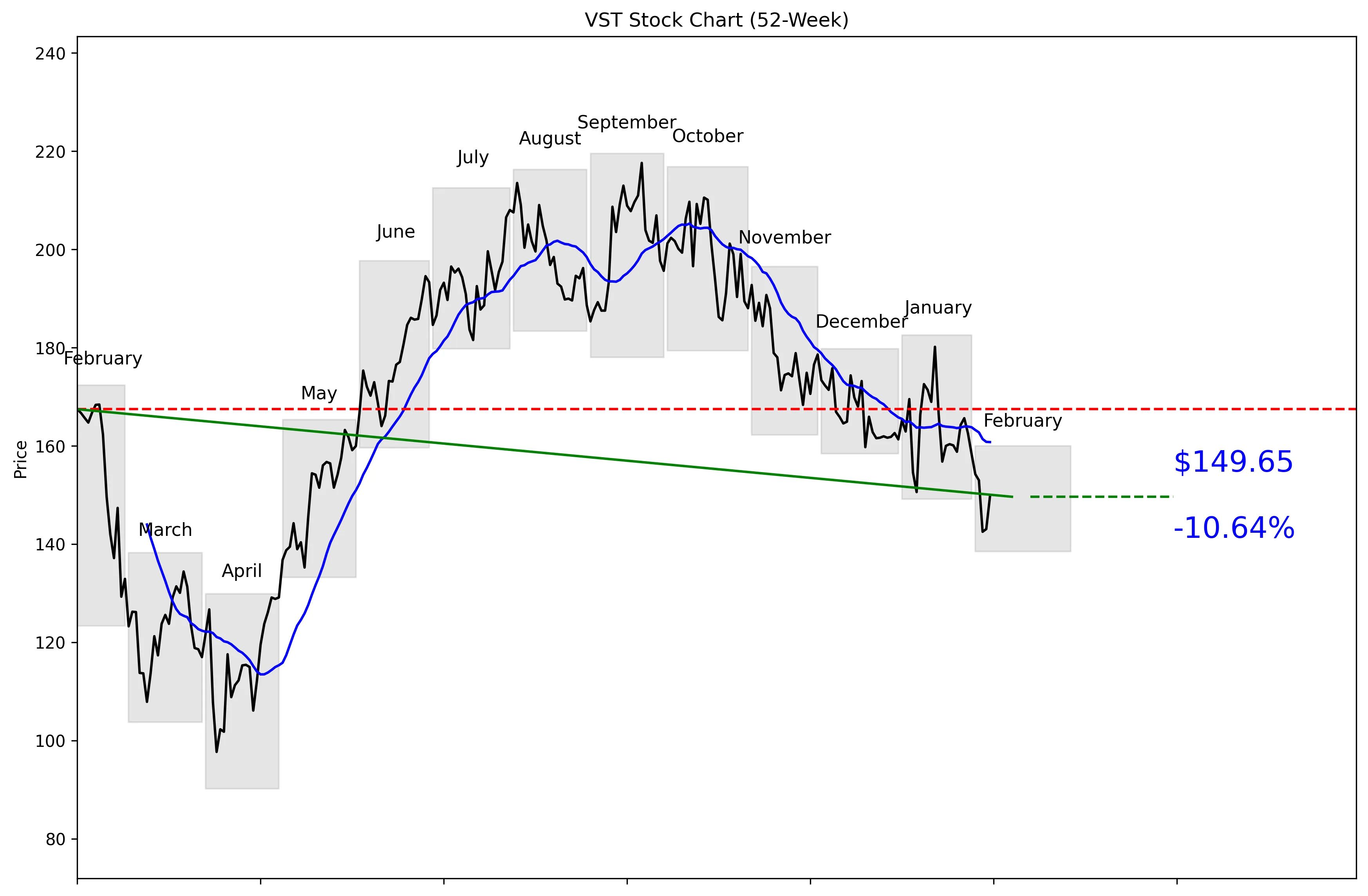
VST 52-Week Stock Chart
Technical Analysis
Vistra Corp. (VST) has shown a bearish trend over the past 52 weeks, marked by a decline from highs around $220 in February to the current price of $150.93, reflecting a significant downward momentum. Key resistance is evident at approximately $180, where the price faced multiple rejections before dropping further, while major support lies around $149.65, which the stock has recently tested. The chart reveals a broad descending triangle pattern, indicating continued selling pressure and a potential for further declines if support fails. In the last few weeks, the momentum has been weak, with the price dropping sharply near the support level, suggesting a lack of buying interest. Currently priced at $150.93, Vistra is trading near the lower end of its 52-week range, which implies an increased risk of a potential breakdown below support levels. This position could prompt a reassessment of investment strategies given the stock’s evident weakness.


Recent News and Developments

Here’s a roundup of the latest news and developments for Vistra Corp

(VST) stock over the past week (February 1-7, 2026):

1. Vistra Stock Experiences Significant Decline Amidst Broader Market Activity

Vistra Corp. (VST) saw its stock price fall by 6.85% on February 4, 2026, closing at $142.52. This movement was part of a larger trend where the stock depreciated by 9.75% over the past month, underperforming the Utilities sector. As of February 6, 2026, the closing price was $149.65.

2. Analysts Maintain “Buy” Consensus with Significant Upside Potential

Despite recent price movements, Vistra continues to hold a “Buy” consensus rating from analysts, with a median price target of $234.50. Recent analyst ratings from January 2026, including Wells Fargo, UBS, and Scotiabank, imply a substantial upside, with some targets reaching $293.00. This indicates ongoing analyst confidence in Vistra’s long-term prospects.

Market Sentiment and Analyst Recommendations

Bull Case
Vistra’s acquisition strategy is working. The Cogentrix deal adds 5,500 MW of natural gas capacity, and the Meta power purchase agreements lock in 2,600 MW of nuclear output at premium rates for 20 years. That’s real, contracted revenue growth. Q4 2025 earnings are expected to show 114.91% EPS growth year-over-year to $2.45, which would validate the operational turnaround. The 54x P/E looks steep until you realize this is a cyclical energy play with a nuclear-powered growth story most utilities can’t match. Analyst consensus sits at $234.50, implying 55% upside from current levels, and the high target of $293 suggests real conviction among the 20 buy-rated analysts covering the stock. If Vistra executes on nuclear expansion and keeps landing PPAs like the Meta deal, the current price near $151 is a gift.
Bear Case
Revenue dropped 20.9% year-over-year, which is brutal for a company trading at 54x earnings. That’s not a cyclical dip—that’s a warning sign. The debt load sits at $17.54 billion against only $620 million in cash, giving Vistra minimal financial flexibility if acquisition integration stumbles or commodity prices collapse. The stock has already fallen 31% from its February 2025 high of $220, and the chart shows a descending triangle with support breaking down around $150. The company just raised $2.25 billion in debt to fund Cogentrix, adding leverage right as interest rates remain elevated. If Meta’s power needs shift, or if nuclear expansion timelines slip, those long-term PPAs become the only thing propping up the valuation. The risk-reward here favors the bears until the revenue trajectory turns positive.
What to Watch
The Q4 2025 earnings report on February 26 is make-or-break. If EPS misses the $2.45 consensus or guidance disappoints, the stock could test $140 support. Watch the revenue figure closely—if it stays negative year-over-year, the bull thesis falls apart regardless of earnings beats. Monitor Cogentrix integration updates starting in Q1 2026; any delays or cost overruns will trigger selling. The debt-to-EBITDA ratio is critical to track; if it climbs above 3.5x, refinancing becomes expensive. Keep tabs on nuclear power purchase agreements—each new PPA like the Meta deal justifies the valuation, but the absence of them signals slowing momentum. Finally, watch if the stock can hold $149.65 support or if it breaks lower to $140; a breakdown below support would confirm the descending triangle pattern and likely trigger a capitulation sell-off.
Analyst Consensus
BUY

Based on 20 analyst opinions
Low Target
$97.00
Mean Target
$230.40
High Target
$293.00


Earnings and Financial Data

Sector
Utilities
Industry
Utilities – Independent Power Producers
Employees
6,850


Earnings & Dividends
Next Earnings
Feb 26, 2026
EPS (Trailing)
$2.78
Dividend Yield
63.0%
Payout Ratio
32.2%

Frequently Asked Questions

Is VST a good stock to buy?
Yes, analysts recommend BUY with a target price of $230.40. Given its strong market cap of $51.14 billion and a favorable forward P/E of 16.04, there’s significant upside potential.
What is VST’s price target?
The consensus price target for VST is $230.40. This reflects an upside of over 52% from the current price of $150.93.
Does VST pay a dividend?
Yes, VST offers a high dividend yield of 63.0%. This is particularly attractive for income-focused investors.
What is VST’s P/E ratio?
VST has a trailing P/E of 54.29, which indicates high earnings expectations. However, its forward P/E is much more reasonable at 16.04, suggesting better valuation going forward.
What has been the stock’s performance over the past year?
VST’s 52-week range is from $90.51 to $219.82. This volatility reflects both market fluctuations and investor sentiment, but the current price positions it favorably within that range.

Related Stock Reports

Disclaimer: This report is for informational purposes only and does not constitute financial advice. The analysis and opinions expressed are those of AltStation.io and should not be relied upon as the sole basis for investment decisions. Always conduct your own research and consult with a qualified financial advisor before making investment decisions. Past performance does not guarantee future results. Updated February 07, 2026.