DECODING MARKETS
Publication Date: December 18, 2025
Intel Corporation, headquartered in Santa Clara, California, stands as a pillar in the semiconductor industry within the technology sector. Founded in 1968, Intel has evolved into a prominent player, designing, developing, manufacturing, and marketing a myriad range of computing products and services worldwide. The company specializes in microprocessors, chipsets, computer systems, hardware products like CPUs and GPUs, alongside memory and storage solutions.
Intel is also making strides into fields such as artificial intelligence (AI), cryptography, and security, offering innovative solutions that cater to diverse computing environments. Its commitment to advancing technology extends to self-driving technology and intelligent edge platforms aimed at bolstering automation and data integrity for an array of manufacturers and service providers. As a key player in the semiconductors industry, Intel's role is pivotal as the global demand for semiconductor products surges, indicating a robust industry landscape that keeps evolving.
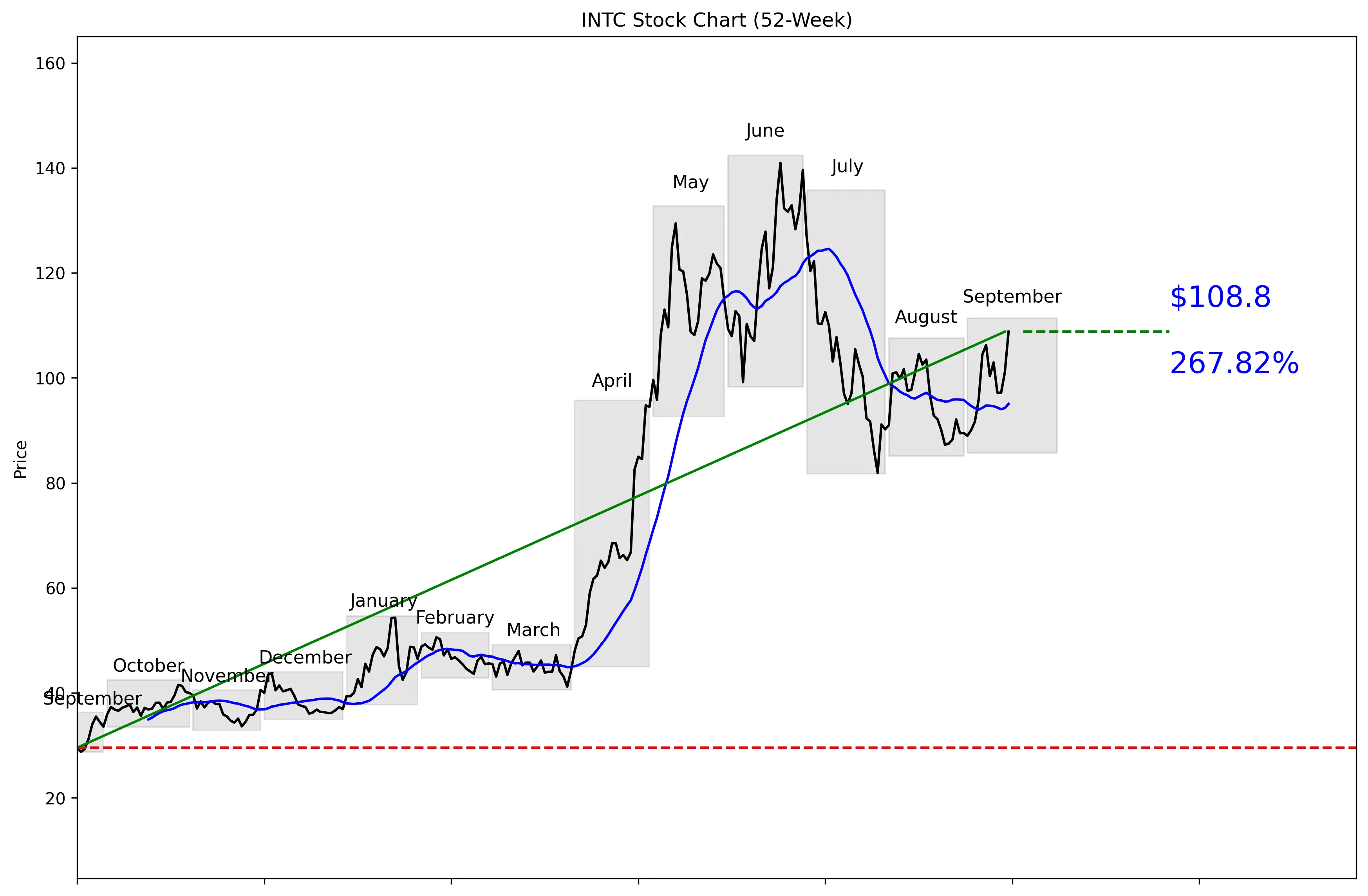
52-Week Price Performance Chart
In the past year, Intel's stock has demonstrated a noteworthy bullish trend. The 52-week stock price performance chart shows that Intel's shares started at approximately $19 in December 2024 and have climbed to a high of nearly $45 by December 2025. This impressive rise indicates a staggering increase of about 89.14%.
The technical analysis reveals significant support and resistance levels critical for investors:
Support Levels: The stock established a strong support around $20, having been tested multiple times between December and March. This support has been instrumental in propelling a following rally.
Resistance Levels: Initial resistance around $25 was overcome in early 2025, allowing the stock to gain traction. A subsequent resistance emerged near $45, representing a significant price point to watch.
The stock is currently trading at $36.05, which is notably below its 52-week high of $44.02 but well above its low of $17.67. The fifty-day moving average stands at $38.0964, suggesting that while the stock has experienced a recent downturn, it still indicates potential upward momentum, provided it maintains above critical support levels.
As we analyze patterns on Intel's stock chart, the breakthrough in September that propelled the stock past previous resistance levels signals a robust upward trajectory. However, recent price action indicates a consolidation phase around $36, hinting at a possible pause or minor correction before a subsequent move. Investors should monitor this consolidation as it could signify either an impending recovery or additional downside risks.
Intel's financial stability reflects its solid market presence and operational efficiency. The company reported a total revenue of approximately $53.44 billion, validating its integral role within the semiconductor market. Key metrics include:
EBITDA of approximately $10.44 billion, which signals the company's operational profitability and its ability to generate earnings before interest, taxes, depreciation, and amortization.
Shares Outstanding: Intel has 4.77 billion shares outstanding, with roughly 132.75 million shares sold short, accounting for about 2.78% of the float. This relatively low short percentage indicates a general confidence among investors.
Market Capitalization: With the stock currently valued at $36.05, market capitalization stands at about $171.2 billion, holding significant weight within the tech sector.
The current investment landscape presents an array of price targets for Intel's stock, with a high target set at $52.00 and a low of $20.40. The average price target is approximately $38.14, alongside a median target of $39.50. This range implies diverse market expectations, and while there are opportunities for upside potential, the varying low target underscores the necessity for careful market analysis.
Recent developments around Intel underscore both opportunity and risk:
National Security Concerns: On December 17, 2025, concerns arose after reports surfaced about Intel testing chipmaking equipment from ACM Research, a firm with ties to China. This provoked reactions from Republican lawmakers fearing implications for national security. However, Intel clarified its position, noting it is not currently utilizing ACM's tools in production and remains compliant with U.S. regulations.
Executive Appointments: In a strategic move to reinforce government relations, Intel appointed Robin Colwell, a former economic adviser to President Trump, as head of its government affairs office. Alongside her, James Chew and Pushkar Ranade have taken on crucial roles within the company. These leadership changes reflect Intel's aim to align more closely with the current U.S. administration and bolster its strategic objectives.
Partnership with Nvidia: Intel's stock saw a spike of nearly 28% following a $5 billion investment from Nvidia geared towards co-developing custom x86 CPUs with Nvidia's RTX GPU chiplets tailored for PCs and AI data centers. This venture is considered a landmark step for Intel in integrating AI technology to revitalize its competitive edge in the market.
As of December 18, 2025, the sentiment surrounding Intel's stock can be summarized through analyst consensus and market positioning:
Analyst Consensus: Amongst 36 analysts, the recommendation score is recorded at 3.04 out of 5, labeled as a "hold." This highlights a general hesitance towards aggressive buying as the market awaits further signals of upward momentum.
Price Targets: With the current price at $36.05, analysts foresee a potential mean target price of $38.14, suggesting a moderate upside. The high target at $52.00 insinuates that investors should be vigilant for signs of breakout potential, while the low target of $20.40 serves as a cautionary indicator of downside risk.
Overall, market sentiment points to a careful strategies for investors. While there are encouraging signs of revenue growth and market movement, the regulatory concerns, competitive pressures, and global economic factors remain crucial elements to monitor closely.
Intel Corporation finds itself at a pivotal junction in a dynamic and high-stakes semiconductor landscape. The upward price trajectory and strong operational performance showcase potential for growth, while external factors such as national security concerns and market volatility necessitate vigilance.
As always, retail investors should conduct comprehensive research, weigh both the opportunities and risks, and stay updated on market developments to inform their investment decisions effectively. With plausible price targets suggesting a favorable outlook, Intel's journey in the semiconductor arena remains a story worth watching closely.
| Metric | Value |
|---|---|
| Market Cap | $174.5b |
| Total Debt | $46.6b |
| Total Cash | $30.9b |
| Shares Outstanding | 4.8b |
| Float Shares | 4.8b |
The information provided in this monthly report is for informational purposes only and should not be construed as financial, investment, or trading advice. AltStation.io does not guarantee the accuracy, completeness, or timeliness of the data and analyses presented. The content is based on publicly available information, and while we strive to ensure its accuracy, errors and omissions may occur.
Investing in stocks, cryptocurrencies, and other financial instruments involves significant risk, including the potential loss of principal. Past performance is not indicative of future results. Readers should conduct their own research and consult with a qualified financial advisor before making any investment decisions. AltStation.io and its affiliates are not responsible for any losses incurred as a result of using this report.
By using this report, you acknowledge that you understand and accept these terms.
Report Updated: December 18, 2025
Data Last Updated: 2026-01-30 12:47:22