
By Chris James
Whirlpool (NYSE: WHR), the company behind Whirlpool, Maytag and KitchenAid appliances, is trading around $33.50. The last time it closed a month that low was March 2009, the bottom of the financial crisis. It is down 87% from its all-time high of $257.68 in May 2021, and down from $94.82 just within the last 12 months.
The pitch writes itself. Iconic brands, 2009 prices, and nobody seriously thinks Whirlpool is going out of business. I don’t think it’s going out of business either. But that’s the wrong question imo.
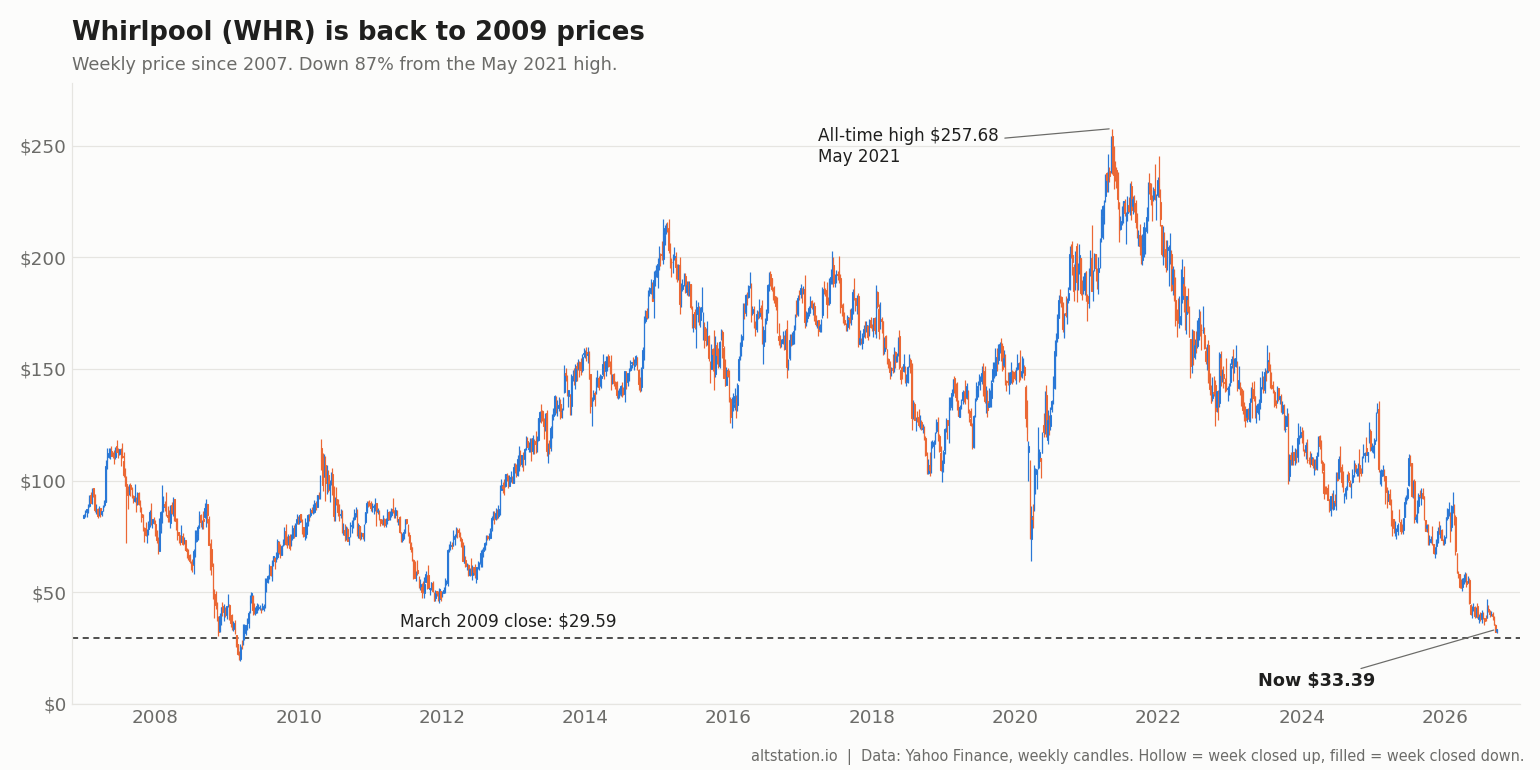
Did the business change, or just the price?
My test for any beaten-down stock is simple. Did the business change, or did only the price change? If only the price moved, that’s an opportunity. With Whirlpool, the business changed. A lot.
Here is what management has told investors to expect for 2026 earnings, and how that changed as the year went on:
| When | 2026 adjusted EPS guidance |
|---|---|
| January | About $7.00 |
| March | About $6.00 |
| May (Q1 report) | $3.00 to $3.50 |
| August (Q2 report) | $2.50 to $3.00 |
Three cuts in eight months, and more than half the expected earnings gone. Along the way:
- The dividend was suspended in May so the cash could go to paying down debt. The stock hit a 14-year low that day.
- A $1.1 billion stock sale. Existing shareholders now own a smaller slice of the company than they did in January.
- $2 billion of secured bonds and a $2 billion credit facility. That pushed the big debt maturities out to 2028, but interest expense is now guided at $350 million a year, up from $300 million. Moody’s and Fitch both downgraded the debt.
- Q2 was a loss. Adjusted EPS came in at negative $0.21, on sales down 6.8%.
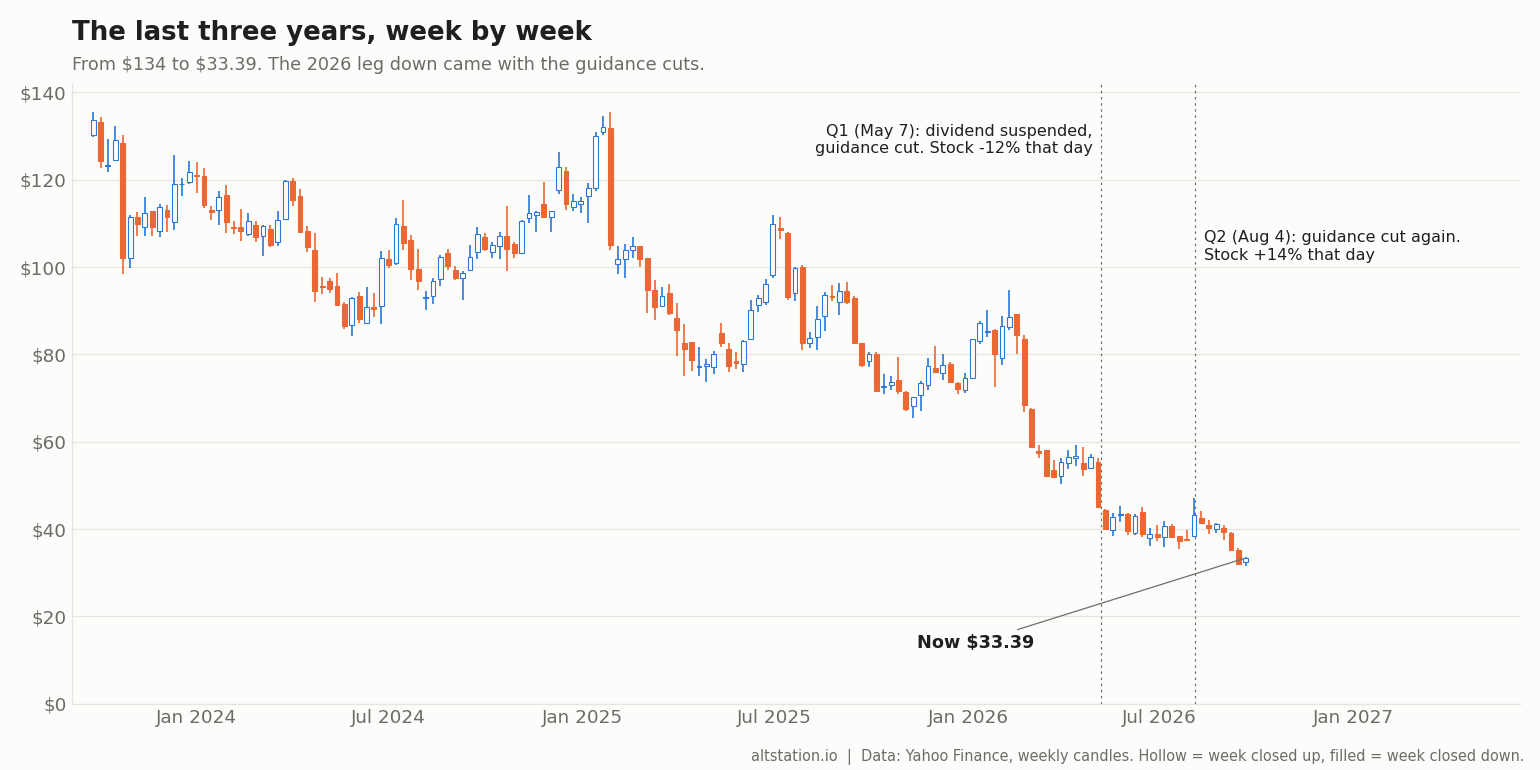
So no, this is not a stock that got dumped for no reason.
Why “not going bankrupt” isn’t enough
Here’s the part most people miss. Whirlpool’s stock is worth about $2.2 billion in total. Its net debt was about $5.8 billion at the end of Q2. Add them together and the market values the whole business at roughly $8 billion. And the lenders get paid first.
That makes the stock a thin slice sitting on top of a lot of debt. Leverage cuts both ways. Here’s the math:
- If the whole business is worth 10% more ($8.8 billion), the stock’s slice goes from $2.2 billion to $3.0 billion. That’s +36%.
- If the whole business is worth 10% less ($7.2 billion), the stock’s slice drops to $1.4 billion. That’s -36%.
Same company, same brands, same factories. A 10% swing in the business becomes a 36% swing in the stock. The brand can survive just fine while shareholders get crushed, and that has already happened twice this year: once with the dividend and once with the dilution.
This is a housing trade, not a value stock
Appliances sell when people move, remodel and build. High mortgage rates mean fewer people move. U.S. appliance demand was down 3.4% year over year in Q2, and the CEO said people are repairing their old machines instead of replacing them. Whirlpool raised prices anyway: 10% on promotional pricing in April and 4% on list prices in July.
So if you buy Whirlpool, what you’re really buying is a view on interest rates and housing. If you think rates come down and people start moving again, this is one of the most direct ways to bet on it. If you think inflation keeps rates higher for longer, which is the Peter Schiff view, that’s the bear case in one sentence.
Pick your macro view first. The ticker comes second.
The tariff irony
In May 2017, Whirlpool petitioned the U.S. International Trade Commission for tariffs on washing machines from Samsung and LG. It got them in February 2018. In Q2 2026, net tariff costs took 2 percentage points off Whirlpool’s margins.
Different tariffs, same lesson. When a company invites Washington into its market, it doesn’t get to decide what Washington does next. That’s not a free market. It’s a favor that eventually comes due.
What I’d need to see
I don’t need Whirlpool to be exciting. I need the bleeding to stop. Four things:
- The Q3 report holds guidance at $2.50 to $3.00. A fourth cut this year would tell me the floor isn’t in.
- Free cash flow above $300 million for 2026, which is what management promised.
- Net debt under $5 billion by year-end, down from about $5.8 billion at the end of Q2.
- Insiders buying with their own money at these prices. Wall Street’s price targets range from $31 to $48. An executive spending their own cash would tell me more than any of them.
My take
Whirlpool probably isn’t going anywhere. It will still be selling washers in 2035. But “won’t go bankrupt” and “cheap” are not the same thing, and this stock has looked cheap all the way down from $94.82.
This is a real turnaround setup with real risk attached. If the Q3 report shows guidance holding, it gets a lot more interesting. Until then it’s a bet on housing, with about $8 billion of enterprise value riding on it and shareholders at the back of the line imo.
I’m not a licensed financial advisor. This is how I’m thinking about Whirlpool, not a recommendation to buy or sell it. Prices as of September 23, 2026. Research and data by Nova Skye, AltStation’s AI analyst. The take is mine.
Sources:
Benzinga, dividend suspension and guidance cut;
Detroit News, 14-year low;
Pulse 2.0, $5.1 billion recapitalization;
Q2 2026 earnings call transcript;
ServiceMag, price increases;
Congressional Research Service, Section 201 washer safeguards;
Whirlpool’s 2017 tariff petition;
analyst price targets.
Price history from Yahoo Finance.