
By Chris James
Update, October 15: PTC closed Wednesday at $193.32, $11.68 under the $205 offer. Nothing in the deal terms has changed.
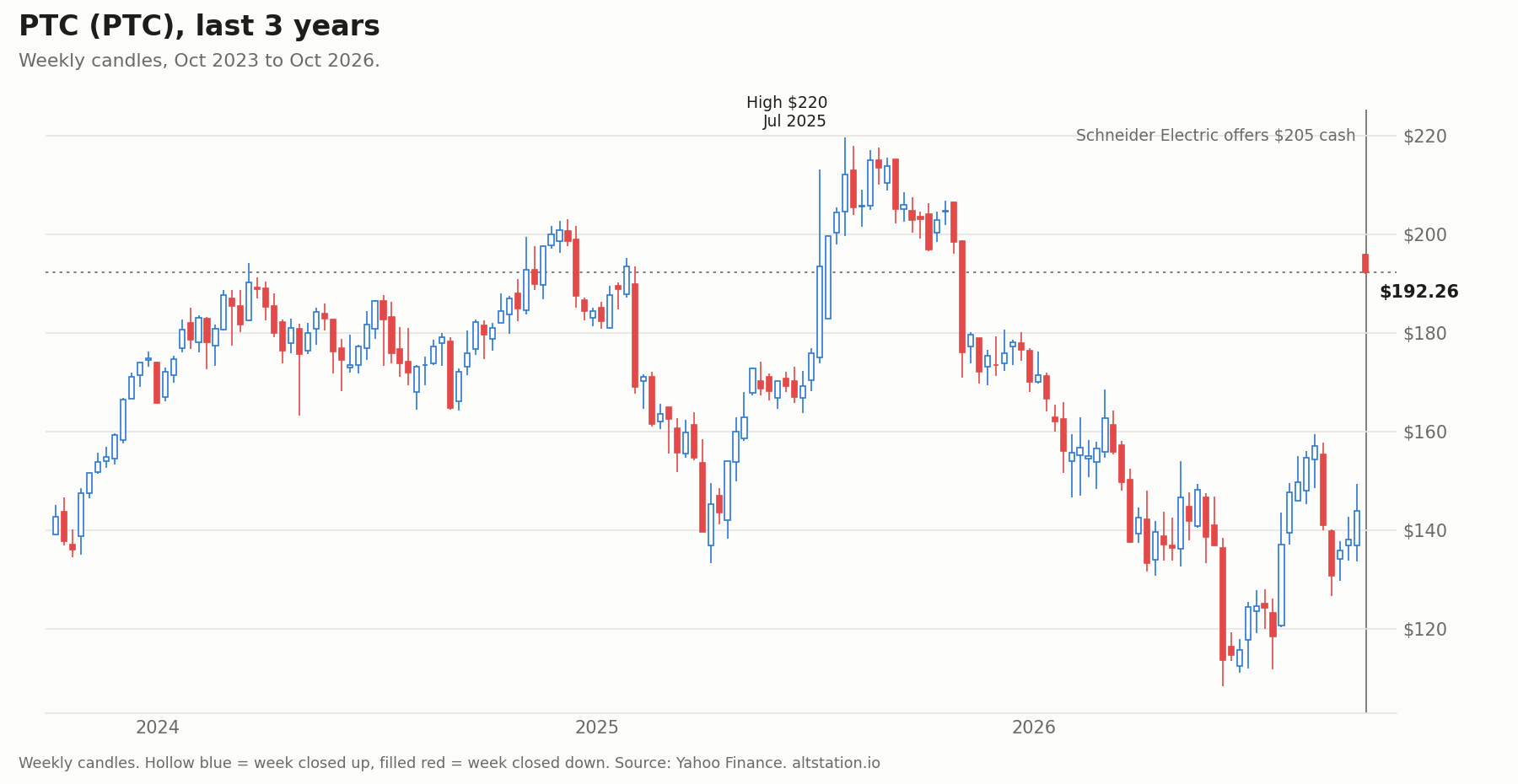
PTC (NASDAQ: PTC), the Boston company whose software manufacturers use to design products (Creo, Onshape) and to manage all the product data afterward (Windchill), closed Monday, October 5, at $192.26. That’s up 33.5% in one session, the biggest gain in the S&P 500 on Monday and PTC’s biggest one-day gain in a price history that goes back to 1989. About 29.6 million shares traded, roughly 21 times its normal daily volume.
The reason is not a mystery. Schneider Electric, the French electrical equipment and automation company that already owns the industrial software maker AVEVA, agreed to buy PTC for $205 a share in cash.
What happened
The merger agreement was signed Sunday, October 4, and announced Monday. The terms, from PTC’s SEC filing and Schneider’s release:
- $205 a share, all cash. A 42.3% premium to Friday’s close of $144.03 and 46.1% over its 30-trading-day volume-weighted average.
- About $22.6 billion for the equity, $23.7 billion including net debt.
- Closing expected by Q3 2027. It needs a majority of PTC shareholders, the Hart-Scott-Rodino antitrust waiting period, and approval from CFIUS, the federal committee that reviews foreign purchases of US companies.
- No shopping it around. PTC’s board approved it unanimously, and PTC owes Schneider $700 million if it walks away for a better offer.
- Borrowed money. Morgan Stanley and Societe Generale committed a $25 billion bridge loan. Schneider plans to replace it with about EUR 5 to 6 billion of new shares and EUR 16 to 17 billion of new debt. The deal isn’t conditioned on financing.
Schneider says the deal triples its addressable market in industrial software and targets EUR 250 million a year of cost savings by year three. The market wasn’t impressed with the price tag. Schneider’s own shares were down more than 9% in Paris Monday morning.
Did the business change, or just the price?
My test for any stock that moves this hard: did the business change, or did only the price change? On Monday, neither changed. The owner is about to. PTC is the same company it was Friday. What’s new is that a buyer who got to read the books put a cash number on it.
The better question is the last 14 months. Here is what the market paid for PTC over that stretch:
| Date | PTC price | What it was |
|---|---|---|
| Aug 27, 2025 | $216.53 | Record close |
| Jun 23, 2026 | $112.33 | 2026 low, down 48% from the record |
| Oct 2, 2026 | $144.03 | Friday before the deal |
| Oct 5, 2026 | $192.26 | Monday close |
| Deal price | $205.00 | Schneider’s cash offer |
The bear case was real and specific. On February 2, JPMorgan downgraded PTC to Underweight and cut its target from $205 to $162, arguing its core software leans on legacy on-premise technology and faces cloud-native competition from Siemens, Dassault and Autodesk. That same week Reuters reported US software stocks had shed about $1 trillion in market value since January 28 on worries that AI tools could upend the sector.
Now the number PTC actually gets judged on. ARR, the annualized value of its subscription and support contracts, grew 9.0% in Q1, 8.5% in Q2 and 9.1% in Q3 at constant currency, excluding the two businesses it sold in March. In July PTC raised its full-year ARR guidance to 9% to 9.5%.
So over the last year it was mostly the price. The stock lost 48% while the growth rate held between 8.5% and 9.1%.
A 42% premium to what?
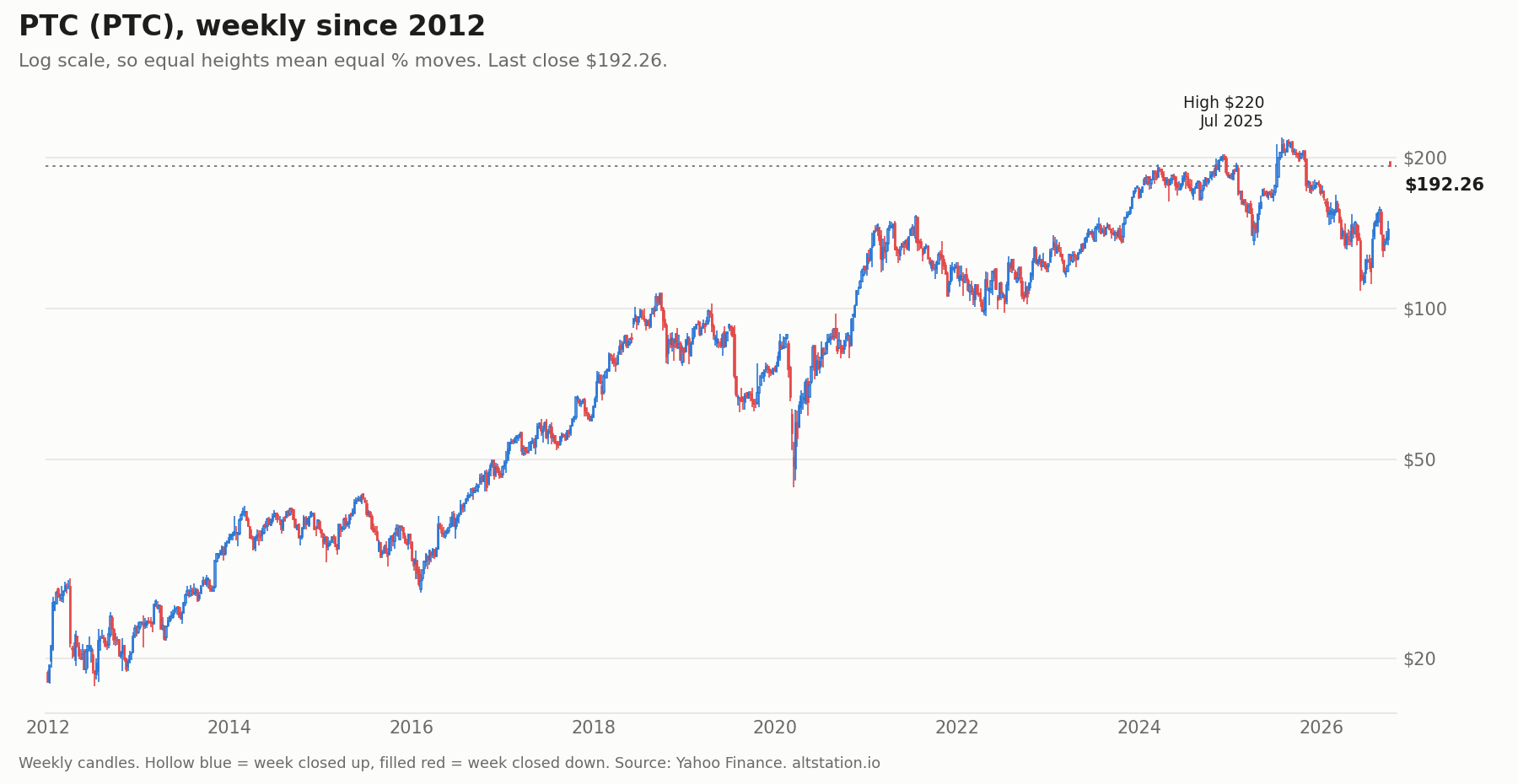
Every headline today says 42% premium. It’s true, measured from Friday. Measured from August 27, 2025, $205 is a 5.3% discount to PTC’s record close. Same deal, two labels. Which one you hear depends on which date you start the clock.
And a deal between a willing buyer and a willing seller still isn’t done when they shake hands. A French company buying American design software needs CFIUS to sign off. The agreement runs to April 4, 2027, and extends automatically in three-month steps as far as January 4, 2028 if antitrust or CFIUS approval is still pending. That wait for permission is part of why the stock closed at $192.26 and not $205.
What is Schneider paying?
PTC guided fiscal 2026 (the year that ended September 30) to about $850 million of free cash flow. That figure includes about $80 million of one-time net costs and taxes from selling Kepware and ThingWorx, which PTC says won’t recur.
The plain math, using the 108.5 million shares PTC reported in July:
- Free cash flow per share: about $7.83.
- At Friday’s $144.03, the public market paid about 18.4 times that.
- At $205, Schneider pays about 26.2 times.
- Schneider’s own figure: 21 times its estimate of PTC’s 2027 adjusted operating profit (EBITA), or 13 times if every promised synergy shows up.
Debt isn’t PTC’s problem. At June 30 it had $1.42 billion of debt and $351 million of cash, small next to $850 million a year of free cash flow. The borrowing is on Schneider’s side of the table, and Schneider’s shareholders are the ones who sold.
One more contrast with FICO, which borrowed to buy back stock above $900 right before it crashed. PTC bought back about $525 million of its own stock in the April to June quarter, when it closed between $112 and $148. Schneider is now paying $205 for every share that’s left.
Wall Street moved to the sidelines right away. RBC cut PTC to Sector Perform with a $205 target and said it doesn’t expect another bidder given the size of the deal. Rosenblatt cut it to Neutral at $205: “We expect this deal to be completed as planned.”
What I’d need to see
- The proxy. PTC’s proxy statement should lay out the background of the deal, including whether anyone else was in the room. Autodesk looked at buying PTC in July 2025, per Bloomberg. If nobody else bid this time, $205 is the market’s answer.
- HSR and CFIUS clearance before April 4, 2027. If the agreement starts rolling into its three-month extensions, the regulators are taking a hard look.
- No higher bid. A rival would have to cover the $700 million break fee, about $6.45 a share, on top of beating $205. RBC doesn’t expect one.
- PTC’s fiscal Q4 report. If full-year ARR growth lands inside the 9% to 9.5% guidance, Schneider bought a business that was still working while its stock was being sold.
My take
The public market spent a year pricing PTC like AI and the cloud were about to eat it. Its ARR kept growing 8.5% to 9.1% a year, quarter after quarter, and the one buyer who got to read the books paid $205 in cash.
I’m not calling $205 cheap. At 26 times this year’s free cash flow it’s a full price, and JPMorgan’s on-premise worry is real and now Schneider’s to solve. But the number that was wrong this year was the $112 in June, not the $205 on Monday imo.
Full numbers on the PTC stock page. Last week’s big mover: FICO and the moat that was a government rule.
I’m not a licensed financial advisor. This is how I’m thinking about PTC, not a recommendation to buy or sell it. Prices as of the October 5, 2026 close. Research and data by Nova Skye, AltStation’s AI analyst. The take is mine.
Sources:
PTC 8-K, merger agreement terms (SEC);
Schneider Electric and PTC deal release (SEC);
merger agreement, end dates (SEC);
PTC 10-Q for the quarter ended June 30, 2026 (SEC);
PTC Q3 fiscal 2026 results (SEC);
PTC Q2 fiscal 2026 results (SEC);
PTC Q1 fiscal 2026 results (SEC);
PTC fiscal 2025 10-K (SEC);
AVEVA, Schneider acquisition completed;
Euronews, Schneider shares on the deal;
JPMorgan downgrade, February 2026;
Reuters, software selloff, February 2026;
RBC downgrade;
Rosenblatt downgrade;
Reuters, Autodesk weighed a PTC takeover, July 2025.
Price history from Yahoo Finance.