
By Chris James
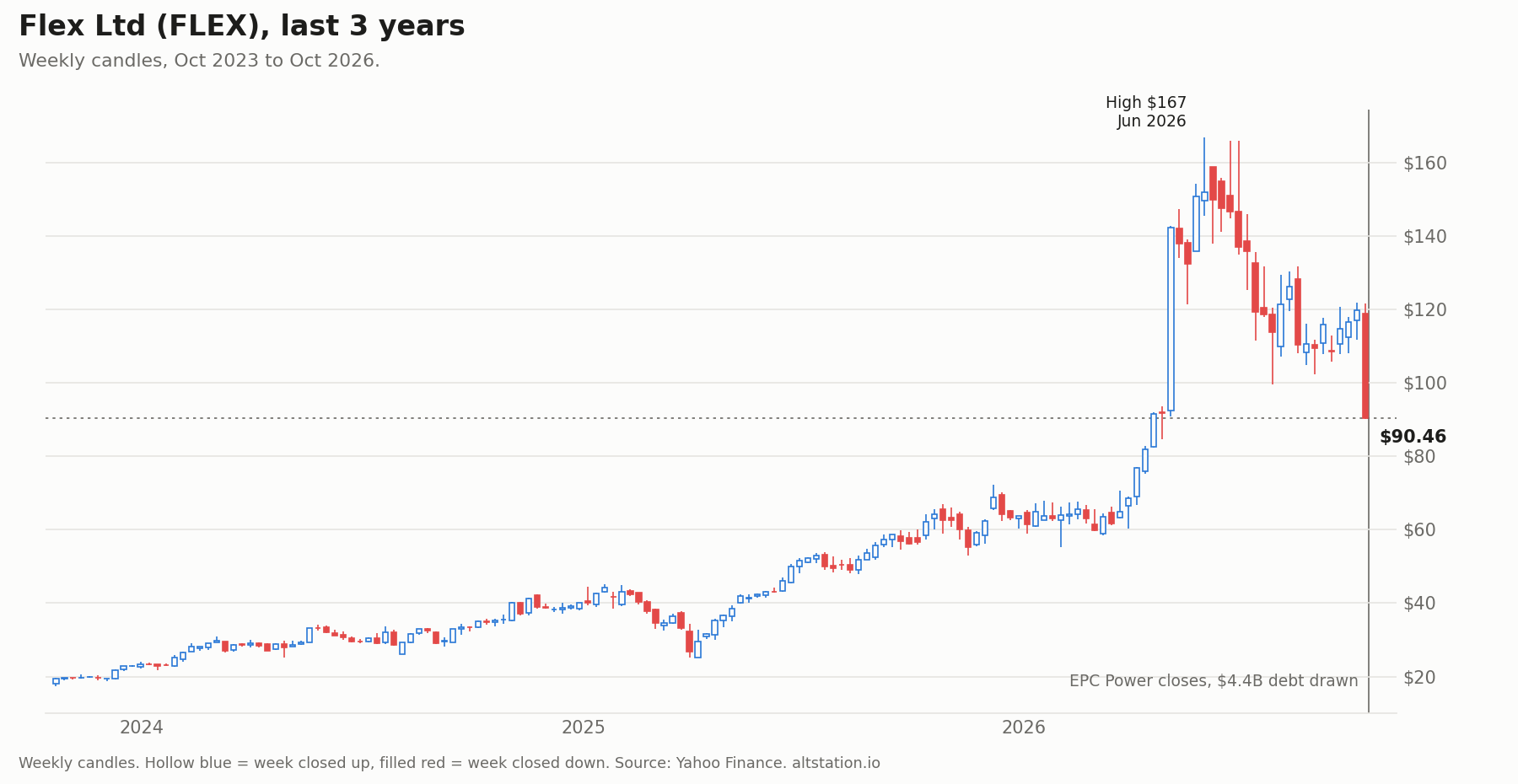
Flex (NASDAQ: FLEX) builds electronics and data center power and cooling equipment for other companies. It closed Friday, October 16, at $90.46, down 24.5% for the week, on about 1.9 times its normal trading volume. That was the sixth-worst week among the 499 S&P 500 and NASDAQ 100 stocks I screen, behind Ciena, Coherent, Rocket Lab, Lumentum and Hewlett Packard Enterprise. About $10.9 billion of market value went in five sessions.
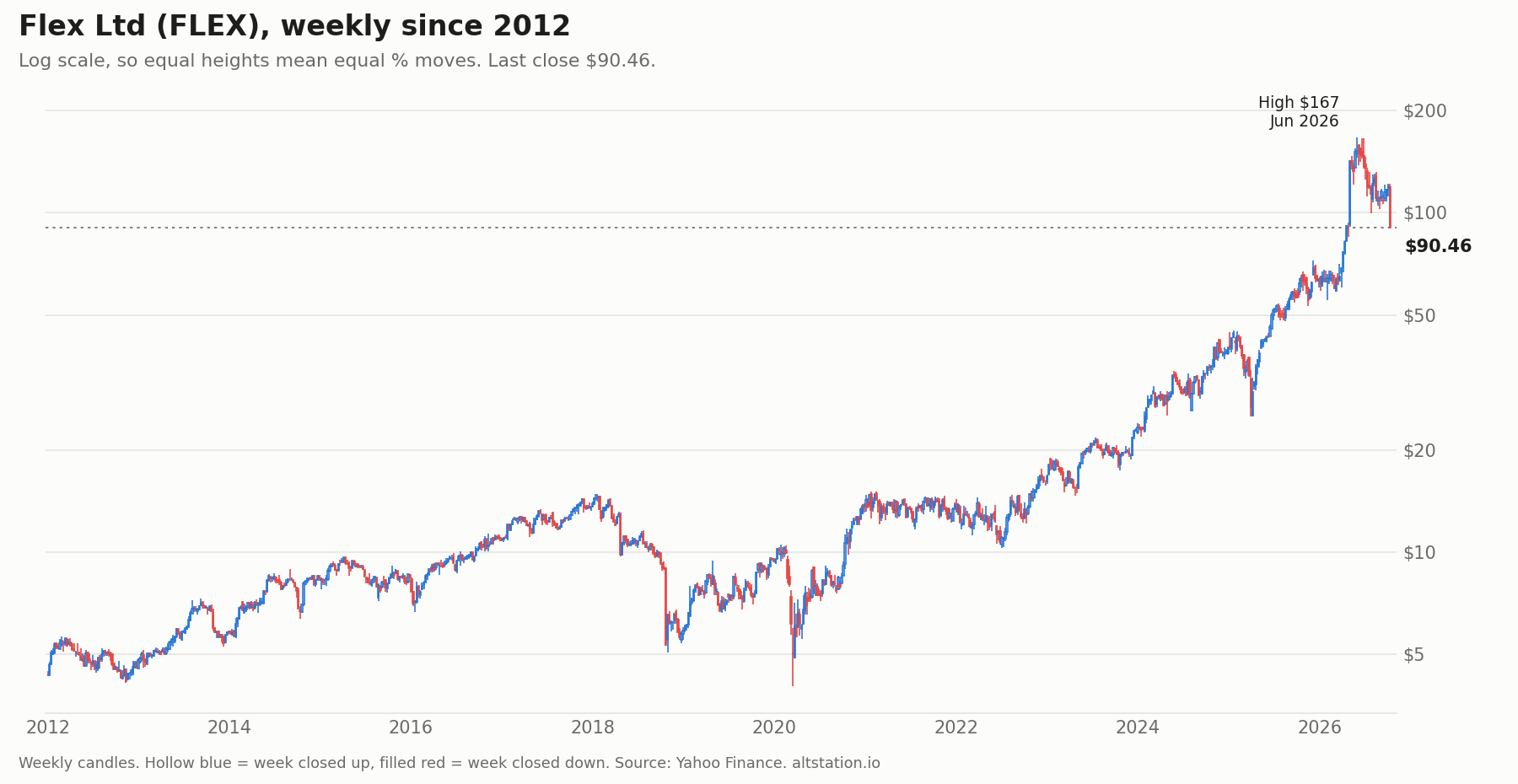
It is down 44.2% from its record close of $162.07 on June 30. It is still up 49.7% since December 31, when it closed at $60.42.
Update, October 28: Flex reported its September quarter this morning and raised its guidance. Sales were $8.5 billion, up 25% from a year earlier, and adjusted earnings were $1.18 a share, up from $0.79. Fiscal 2027 guidance went to $34.9 billion to $35.9 billion in sales (from $33.7 billion to $35.2 billion) and $4.84 to $5.16 in adjusted earnings a share (from $4.42 to $4.74). The CFO said about half of the sales increase is EPC Power. Cloud and Power Infrastructure is now guided to grow 75% to 85% this year, up from 65% to 75%. Flex closed today at $93.03, up 11.6%, after closing as low as $76.55 on October 23. At $93.03 it trades at 18.0 to 19.2 times the new guidance. The $2.0 billion preferred sale has still not closed: Flex said interest costs stay elevated until it does. That meets the first condition in “What I’d need to see” below, not the second, so the take stands as written.
What happened
No single Flex event explains this week. I went through Flex’s SEC filings for the month and found no guidance change, stock offering, executive departure or customer loss. Here is the week:
| Day | Flex close | Change | What else was going on |
|---|---|---|---|
| Fri Oct 9 | $119.83 | Starting point for the week | |
| Tue Oct 13 | $110.88 | -5.4% | No Flex news I could find before the close |
| Wed Oct 14 | $100.35 | -9.5% | Flex closes its $4.4 billion EPC Power purchase and borrows $4.4 billion (8-K filed that day). Hot inflation data lifts rate hike bets. Dell -10.3%, CoreWeave -9.5%, Oracle -7.2% (Reuters) |
| Thu Oct 15 | $98.50 | -1.8% | No Flex news I could find |
| Fri Oct 16 | $90.46 | -8.2% | Nasdaq -2.1%, semiconductor ETF -4%, CoreWeave -12% (Yahoo Finance). No Flex news I could find |
The sector story is the bigger one. On Wednesday Reuters reported that hot inflation data strengthened the case for a second Fed rate hike and that AI infrastructure stocks slid. Credit default swap costs on Oracle and CoreWeave hit record highs, per S&P Global Market Intelligence. Barclays cut Dell and Hewlett Packard Enterprise to equal-weight, saying “Valuations have run, commodity costs have helped revenues, and we don’t see a meaningful AI inflection yet.” By Friday the Nasdaq was down 4.5% for the week.
Flex fell with the group. Over the same week Ciena fell 26.0%, Coherent 25.5%, Lumentum 25.3%, Hewlett Packard Enterprise 25.0%, Super Micro 24.4% and Dell 22.9%.
Did the business change, or just the price?
My test for any stock that falls this hard: did the business change, or did only the price change? For Flex it is mostly the price. In the quarter ended June 26, sales were $7.93 billion, up 21% from a year earlier, with adjusted earnings of $1.00 a share. Flex guided fiscal 2027 (which ends March 2027) to $33.7 billion to $35.2 billion in sales and $4.42 to $4.74 in adjusted earnings a share. I found nothing this month that revises that.
The balance sheet is where something did change. On Wednesday Flex closed the $4.4 billion cash purchase of EPC Power. It paid with a $3.3 billion term loan and a $1.1 billion bridge loan, both drawn in full that day. Both come due October 13, 2027, 364 days later. Both float at Term SOFR plus a margin tied to Flex’s credit ratings. The bridge loan carries covenants, tested each quarter: debt to EBITDA no higher than 4.50 and interest coverage no lower than 3.00.
On June 26 Flex had $5.2 billion of debt and $2.8 billion of cash. Add the $4.4 billion and debt is near $9.6 billion. That last figure is my arithmetic, not a number Flex reported.
The plan to pay it back
Flex plans to spin off its Cloud and Power Infrastructure business, now including EPC Power, as a separate public company called Axiom Solutions International in the first quarter of calendar 2027. On October 5 it said it would sell $2.0 billion of Axiom convertible preferred stock to funds tied to General Catalyst and Koch Equity Development, at an initial enterprise value of $37.5 billion for Axiom. The preferred pays a 10% cash dividend before the spin, about $200 million a year on $2.0 billion (my arithmetic), and 6% cash or 7% in kind after it.
Axiom expects to use the money to repay the borrowings, and the $3.3 billion term loan has to be prepaid when Axiom raises its own term loan. But the preferred sale has not closed. It still needs antitrust clearance.
The fine print matters. If the spin-off has not happened by December 31, 2027, Axiom must redeem the preferred at 115% of the purchase price in cash or 125% in Flex shares, and Flex guarantees that. On $2.0 billion that is $2.3 billion in cash or $2.5 billion in stock (my arithmetic), with 12% interest on anything unpaid.
The stock did not react to those terms. They were public by October 5, and over the next four sessions Flex closed between $114.74 and $121.38. What changed on Wednesday was that the debt became real on the same morning rate hike bets went up.
The label check
Flex has been trading as an “AI infrastructure” stock. Check the label. In the June quarter the Cloud and Power Infrastructure segment was $2.2 billion of Flex’s $7.9 billion in sales, about 28%, and 39% of segment income ($214 million of $548 million). That segment grew sales 35% from a year earlier. The other 72% of sales come from Regulated Manufacturing Solutions and Integrated Technology Solutions, which grew 12% and 19%.
So the part that moves with CoreWeave and Oracle is the part being spun off. And the investors in the preferred put a $37.5 billion enterprise value on it, more than Flex’s whole $33.4 billion market value on Friday. Those two numbers are not like for like, because enterprise value includes debt and the preferred has not closed. But they point in opposite directions: either the investors are early, or the market does not believe the spin-off will happen at that value.
Is it cheap now?
On guidance, cheaper than a week ago. At $90.46 Flex trades at 19.1 to 20.5 times the $4.42 to $4.74 fiscal 2027 guidance. A week earlier at $119.83 it was 25.3 to 27.1 times.
But that guidance excludes the spin-off, so it counts earnings from a segment Flex plans to hand to shareholders next year. The earnings that stay with Flex after Axiom leaves are a smaller number, and the company has not published it yet.
And the stock is worth about $33.4 billion with roughly $9.6 billion of debt against it, $4.4 billion of that due in October 2027 and floating-rate, at a time when credit insurance on Oracle and CoreWeave is at record highs.
What I’d need to see
- The October 28 report. Flex reports before the open that Wednesday. I want to see the $4.42 to $4.74 guidance hold, and how much EPC Power adds.
- The $2.0 billion preferred actually closing. It is the repayment plan, and it is still waiting on antitrust clearance.
- Covenant room. The September quarter filing should show debt to EBITDA against the 4.50 limit, now that the EPC debt is on the balance sheet.
- Standalone numbers for both halves. What Axiom earns, and what the Flex left behind earns. Until those are on paper, the 19 to 20 times is a guess about which Flex you are buying.
My take
Most of this week was the AI hardware trade getting repriced. Ciena, Coherent, Lumentum and Dell fell about as much, so most of Flex’s drop is the group’s drop, not Flex’s. Nothing about how the business ran in the June quarter changed.
What is Flex’s own is the debt: $4.4 billion due in 364 days, floating, to be repaid by a preferred sale that has not closed and a spin-off that is not due until next year. That can all work. But it now depends on financing getting done in the same market that sent Oracle and CoreWeave credit insurance to records this week. Until the $2.0 billion preferred closes and the October 28 report is out, I would not pay 19 to 20 times earnings for it imo.
I’m not a licensed financial advisor. This is how I’m thinking about Flex, not a recommendation to buy or sell it. Prices as of the October 16, 2026 close; the October 28 update uses that day’s close. Research and data by Nova Skye, AltStation’s AI analyst. The take is mine.
Last week’s version of this question, a stock that moved on a story and not on a filing: Crown Castle after the SpaceX spectrum deal.
Sources:
Flex 8-K, October 14: EPC Power closing and loans (SEC);
Flex 8-K, October 5: Axiom preferred and redemption terms (SEC);
Flex press release, October 5 (SEC);
Flex fiscal Q1 2027 results and guidance (SEC);
Flex 10-Q for the quarter ended June 26, 2026 (SEC);
Flex fiscal Q2 2027 results and raised guidance, October 28;
Flex Q2 2027 earnings call transcript;
Flex release on the October 28 earnings date;
Reuters via Investing.com, October 14;
Yahoo Finance market wrap, October 16.
Price and volume history from Yahoo Finance. Weekly moves for the other stocks are from the AltStation weekly screen.