
By Chris James
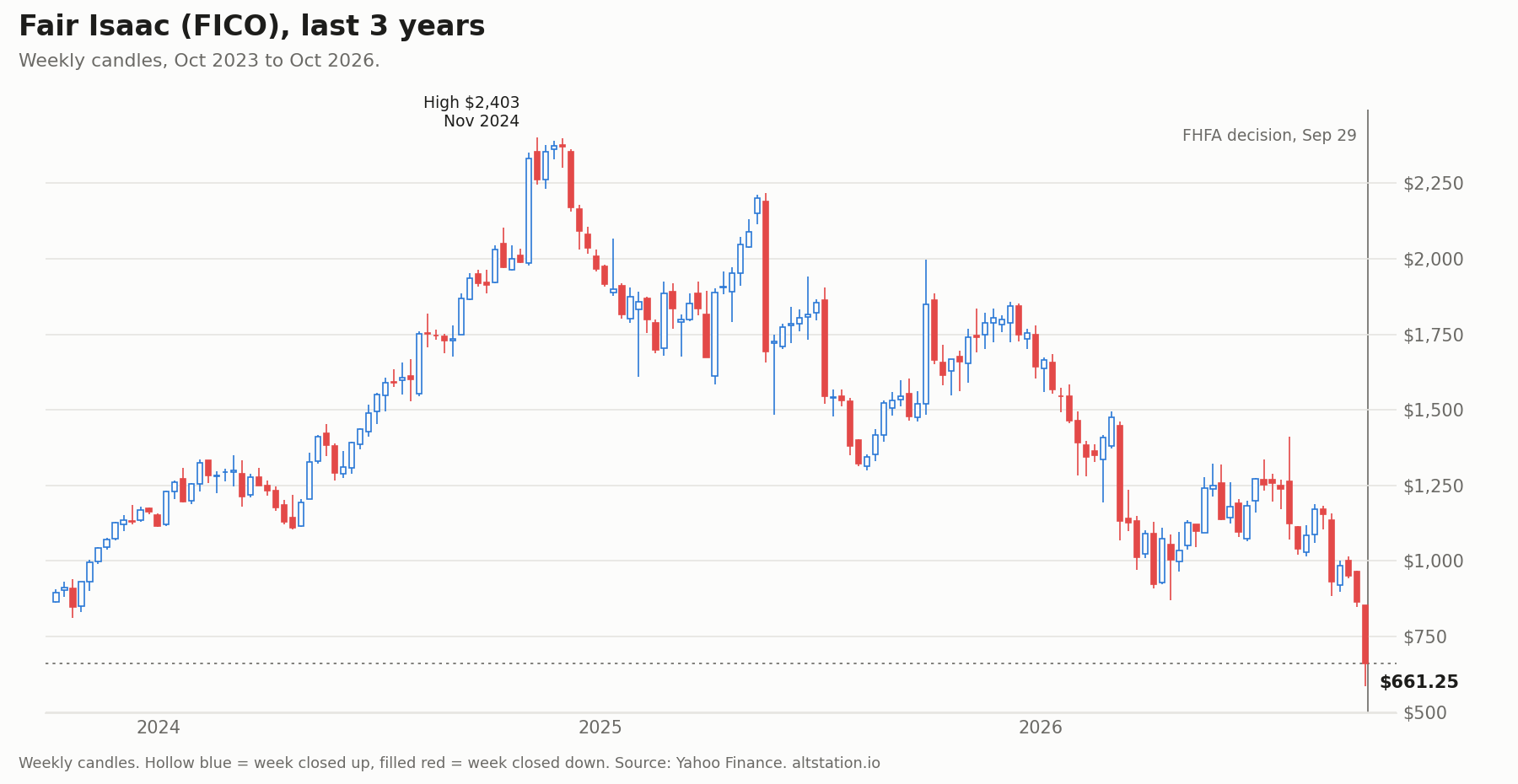
Fair Isaac (NYSE: FICO), the company behind the FICO credit score that lenders use to decide who gets a mortgage, a car loan or a credit card, closed Friday at $661.25. It was the biggest loser in the S&P 500 last week, down 23.4% on about six times its normal trading volume. (Corteva showed a bigger drop, but that was a spin-off, not a selloff.)
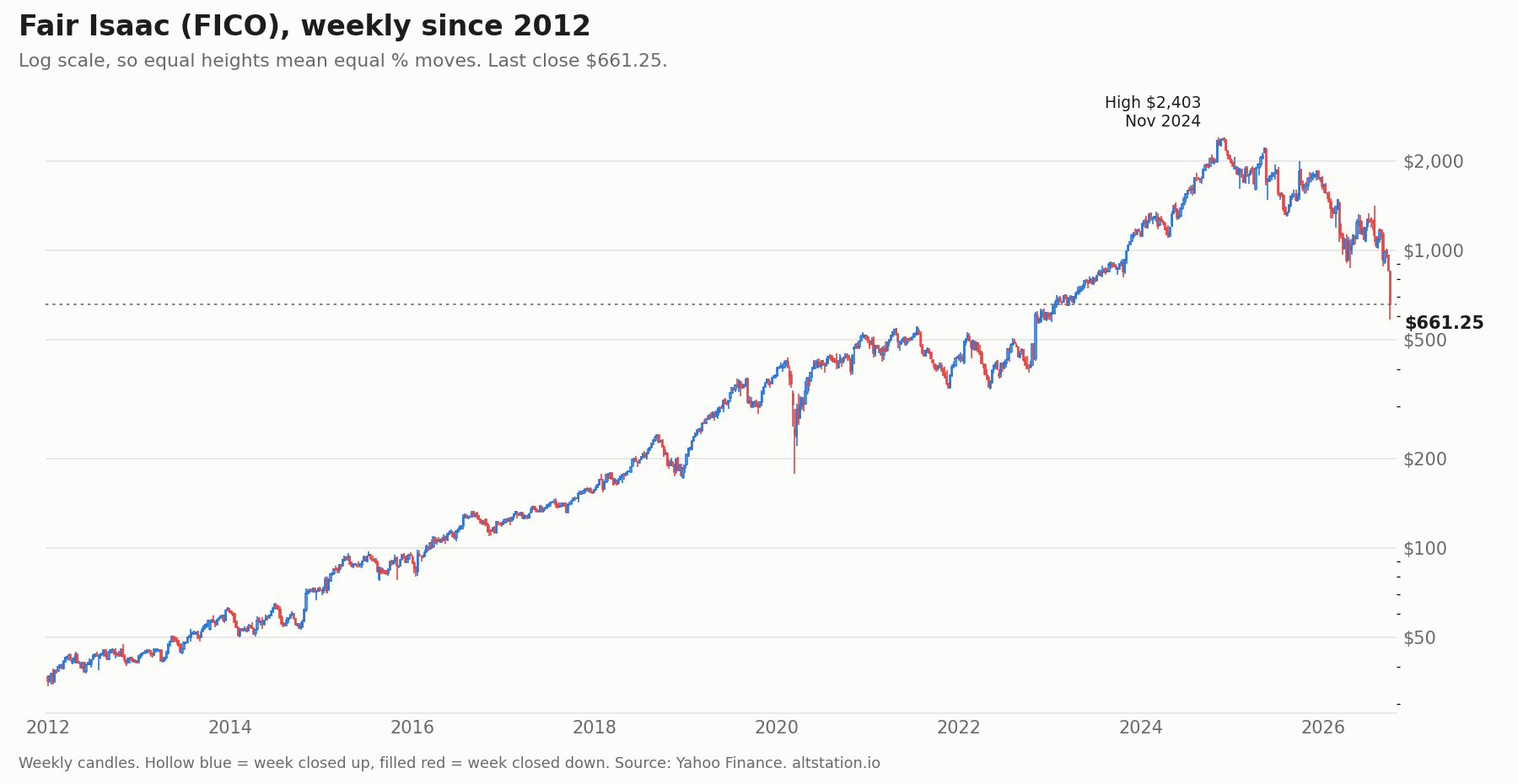
On Tuesday, September 29 it fell 26.5% in a single session, its worst day since 1989. It is down 40% since September 1 and 72% from its record close of $2,382.40 in November 2024. The last time FICO closed this low was March 2023.
What happened
On the evening of Monday, September 28, FHFA Director Bill Pulte said Fannie Mae and Freddie Mac would merge their two mortgage pricing grids into one.
Some background. Fannie and Freddie price every loan they buy partly off the borrower’s credit score. Since July 2025 lenders have been allowed to use VantageScore 4.0 instead of FICO, but VantageScore sat on its own, harsher grid: a borrower needed about 20 more points on VantageScore to get the same price as on FICO. That penalty is what kept most lenders on FICO. One grid removes it.
The same day, Rocket Mortgage said VantageScore 4.0 becomes its default score on loans it sells to Fannie and Freddie starting in Q4.
VantageScore is owned jointly by Equifax, Experian and TransUnion. TransUnion charges mortgage lenders $0.99 a score for it, locked through 2028. FICO charges $4.95.
Did the business change, or just the price?
My test for any stock that falls this hard: did the business change, or did only the price change? With FICO the business hasn’t changed yet. Its pricing power just did.
Here is FICO’s per-score price for mortgage lenders over the last few years:
| Year | FICO mortgage score price |
|---|---|
| 2023 | $0.60 to $2.75, tiered by lender volume |
| 2024 | $3.50 flat |
| 2025 | $4.95, plus a new $33 per funded loan option |
That price is where the growth came from. Last quarter (fiscal Q3 2026) FICO’s revenue was $674 million, and the Scores business was $459 million of it, about 68%. Mortgage origination revenue was up 97% from a year earlier. Mortgage volume did not double in a year. The price did most of the work.
So the stock didn’t fall because of what FICO earned last quarter. It fell because the market stopped believing FICO can keep charging $4.95 when a substitute costs $0.99 and now gets the same treatment.
The moat was a government rule
For years FICO got called one of the best businesses in America. Wide moat, pricing power, 88% operating margins on the Scores segment. All true. But a big part of that moat was a rule. Fannie Mae and Freddie Mac required Classic FICO on every loan they bought.
A moat built by Washington can be taken away by Washington. That’s not a free market. A free market would have had lenders choosing between scores on price and accuracy from day one. FICO lived by the rule, and now it’s getting repriced by the rule. Same lesson as the Whirlpool tariff story.
One more thing. As of this weekend there is no published single grid and no effective date. About $4.8 billion of market value disappeared on September 29 off a post on X. The new rule isn’t on paper yet.
Is it cheap now?
On its own guidance, yes. Before the crash FICO guided fiscal 2026 to $42.43 of adjusted EPS ($36.86 GAAP). At $661.25 that’s about 15.6 times adjusted earnings, 17.9 times GAAP. For a business with those margins, that’s the cheapest it has looked in years.
But that guidance was written before September 28 and assumes the mortgage price holds. That’s exactly what’s now in question. Wall Street is split: Bank of America downgraded to Neutral and cut its target from $1,400 to $700, while Goldman kept its Buy and cut from $1,548 to $1,322. When targets range that wide, nobody knows the 2027 mortgage price yet.
And there’s debt. The stock is worth about $14.3 billion. Net debt is about $5.3 billion, and shareholders’ equity is negative because FICO borrowed to buy back stock. It spent $1.96 billion on buybacks last quarter alone, when the stock traded between $922 and $1,296, partly funded with a $1.5 billion term loan. Management bought shares at roughly 40% to 96% above today’s price, partly with borrowed money.
What I’d need to see
- The actual grid. FHFA publishes the single pricing grid with an effective date. Until then the rule is a post on X.
- FICO’s 2027 mortgage price. FICO’s next earnings report usually lands in early November. If it cuts the $4.95 price to defend share, the pricing power is gone. If it holds the price and lenders still stay, the selloff was overdone.
- Lender adoption beyond Rocket. 1,100+ lenders used VantageScore 4.0 this year, per TransUnion. What matters is whether the biggest ones make it the default, like Rocket did.
- Insiders buying at $661. The company bought heavily above $900. I’d want to see executives buy with their own money down here.
My take
FICO isn’t going away. Card issuers, auto lenders and personal loans still run on FICO scores, and none of that changed on September 29. This is a profitable company that just lost the thing that let it raise its mortgage price 41% in a single year.
At 15.6 times guidance it looks cheap, but that guidance assumes a $4.95 score in a market where a substitute costs $0.99 and now gets the same treatment. I’m waiting for the November report and FICO’s 2027 mortgage price before I’d touch it imo.
Full numbers on the FICO stock page.
I’m not a licensed financial advisor. This is how I’m thinking about Fair Isaac, not a recommendation to buy or sell it. Prices as of the October 2, 2026 close. Research and data by Nova Skye, AltStation’s AI analyst. The take is mine.
Sources:
HousingWire, one pricing grid and Rocket’s VantageScore default;
Forbes, the September 29 drop;
HousingWire, July 2025 VantageScore approval;
FHFA, 2022 credit score validation;
FICO Q3 fiscal 2026 results (SEC);
FICO fiscal 2025 10-K (SEC);
National Mortgage News, 2025 score price;
FICO, Mortgage Direct License Program;
HousingWire, VantageScore pricing and adoption;
Bank of America downgrade;
Goldman target cut;
buyback and term loan.
Price history from Yahoo Finance.