ALTSTATION.IO

Devon Energy Corporation (DVN) Stock Analysis

By Nova Skye | AltStation.io | Updated February 07, 2026

Price
$43.74
Change
+1.32%
Market Cap
$27.44B
Avg Volume
9.5M

Company Overview

Devon Energy Corporation (DVN) is an independent energy company based in Oklahoma City, focused on the exploration, development, and production of oil, natural gas, and natural gas liquids. Their operations primarily take place in several key regions, including the Delaware Basin, Eagle Ford, Anadarko Basin, Williston Basin, and Powder River Basin. They sell their extracted resources to various sectors, including utilities, industrial manufacturers, and other energy companies.

Devon holds a competitive position as a strong player in the U.S. oil and gas market, particularly in shale production. They are often regarded as a market leader due to their extensive assets and efficient operations. Key competitors include Pioneer Natural Resources and EOG Resources, which also focus heavily on shale formations. While Devon benefits from advanced technology and operational efficiencies, they face challenges from fluctuating oil prices and stricter regulations that could impact profitability.

Currently, Devon is experiencing a growth phase, backed by robust production levels and favorable market conditions for oil and gas. Their recent acquisition of Berry Petroleum for $3.1 billion boosts their exposure to the lucrative Californian market. With a strong balance sheet and a commitment to returning capital to shareholders, Devon is well-positioned to capitalize on ongoing demand for energy resources.

Key Financials
Market Cap
$27.44B
Revenue
$16.55B
EBITDA
$7.67B
Gross Margin
49.3%
Profit Margin
16.4%
Revenue Growth
7.1%
Total Cash
$1.23B
Total Debt
$8.64B
Free Cash Flow
$2.01B


52-Week Price Performance Analysis

Price Statistics
P/E Ratio
10.32
Forward P/E
11.88
Beta
0.62
52-Week High
$44.00
52-Week Low
$25.89
EPS
$4.24
50-Day Avg
$37.44
200-Day Avg
$34.38
Price/Book
1.79
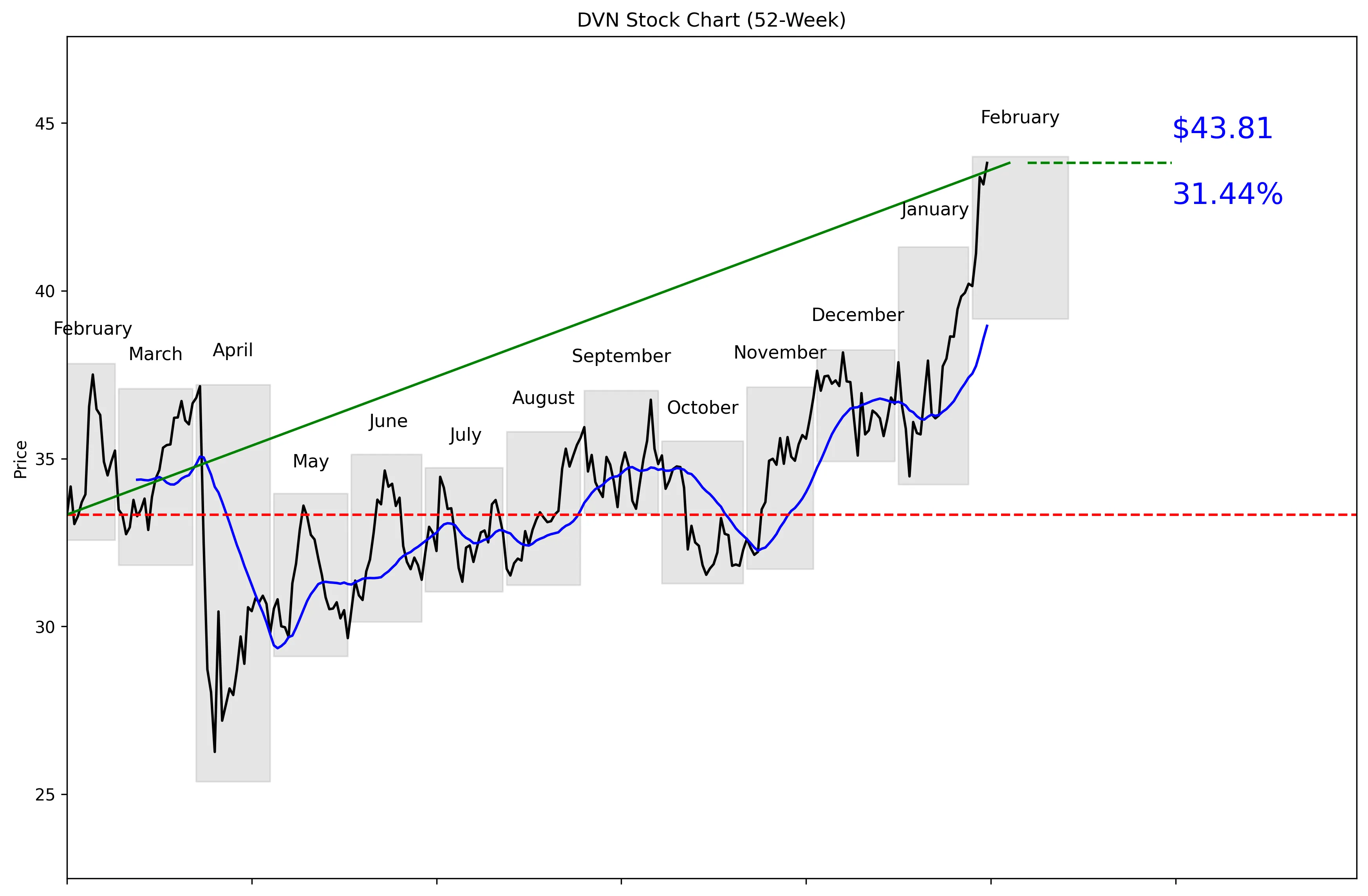
DVN 52-Week Stock Chart
Technical Analysis
Over the past 52 weeks, Devon Energy Corporation (DVN) shows a strong uptrend, gaining 31.4% and moving from approximately $33 in February to a current price of $43.74. Key support is clearly established at $30, where prices stabilized in May and July, while resistance can be observed near $43.81, the peak reached in late January and early February. The chart indicates a series of higher lows and higher highs, signaling bullish momentum, particularly notable around the end of December through February where price acceleration was evident. Recent activity shows DVN maintaining upward momentum, hovering close to the resistance level, which suggests a potential breakout could be imminent. Currently, the price of $43.74 is near the top of the 52-week range, implying increased investor confidence and potential for further gains if upward trends continue.


Recent News and Developments

Market Update

Devon Energy Corporation (DVN) has experienced a dynamic week, marked by a significant merger announcement, positive analyst revisions, and notable stock price movements.

Market Update

Here are the key developments for Devon Energy Corporation (DVN) stock in the past week:

Market Update

### Devon Energy and Coterra Energy Announce $58 Billion Merger of Equals
On February 2, 2026, Devon Energy and Coterra Energy officially announced a definitive agreement to merge in an all-stock transaction, creating a leading large-cap shale operator. The combined entity, which will retain the Devon Energy name and be headquartered in Houston, is projected to have an enterprise value of approxim

Market Sentiment and Analyst Recommendations

Bull Case
The Coterra merger creates immediate scale and $1 billion in annual synergies — that’s real money hitting the bottom line within 24 months. DVN trades at a 10.32 P/E while generating 7.1% revenue growth, which is cheap for an E&P company with consolidated shale optionality across Delaware, Anadarko, and Marcellus. Free cash flow generation post-merger should be substantial given the combined asset base and synergy capture, supporting the dividend enhancement Barclays flagged. The stock has momentum, up 31.4% over 52 weeks with higher lows and higher highs, and at $43.74 it’s testing resistance near $43.81 — a breakout above that level targets the $50-57 range where Barclays and Wolfe have positioned their price targets. With 27 analysts recommending buy and the median target at $47.11, there’s 7.7% upside to consensus and potential for 30%+ if execution delivers and oil prices hold. The $1.23B cash position provides cushion on the $8.64B debt load while integration happens.
Bear Case
The merger announcement creates execution risk that’s easy to underestimate — integrating two major E&P operations is complex and synergy realization often lags timelines. DVN’s debt-to-cash ratio of 7x is elevated, and while the merger is accretive, integration costs and potential deal complications could pressure returns near term. Oil and gas stocks are cyclical, and the entire thesis depends on energy prices staying elevated; a 20% drop in WTI would gut cash flows and make that $8.64B debt burden feel heavier. At $43.74, DVN is already near the top of its 52-week range, meaning much of the near-term upside may be priced in by analyst upgrades; the stock has limited margin of safety if the merger hits snags. The analyst target range is wide ($34-$62), indicating real disagreement on fair value post-integration. Regulatory approval is still pending, and any conditions imposed on the deal could reduce synergy capture or force asset divestitures.
What to Watch
Monitor the merger close date and regulatory approval milestones — any delays or conditions attached to FTC clearance will signal execution risk and could trigger a 5-10% pullback. Track DVN’s quarterly free cash flow starting Q1 2026; if it grows less than 15% year-over-year, synergy assumptions are too aggressive. Watch WTI crude prices closely — a break below $70/barrel would pressure the entire thesis and likely push DVN toward $38-40 support. Listen for management guidance on synergy realization timing on the next earnings call; vague timelines or reduced targets suggest integration challenges. The $50 price level is critical technical resistance; a close above $50 on volume confirms the breakout and validates Barclays’ $50 target, while a failure to break above $44 suggests the rally has peaked. Finally, track the combined company’s dividend announcement post-close; if the enhanced dividend yield falls short of expectations, institutional buyers will rotate out.
Analyst Consensus
BUY

Based on 27 analyst opinions
Low Target
$34.00
Mean Target
$47.11
High Target
$62.00


Earnings and Financial Data

Sector
Energy
Industry
Oil & Gas E&P
Employees
2,300


Earnings & Dividends
Next Earnings
Feb 17, 2026
EPS (Trailing)
$4.24
Dividend Yield
222.0%
Payout Ratio
22.2%

Frequently Asked Questions

Is DVN a good stock to buy?
Analysts rate Devon Energy Corporation (DVN) as a “BUY” with a target price of $47.11. Given its low P/E of 10.32 and strong fundamentals, it presents a solid investment opportunity in the energy sector.
What is DVN’s price target?
The average price target for DVN is currently $47.11. This reflects upside potential from its recent trading price of $43.74, suggesting there could be room for appreciation.
Does DVN pay a dividend?
Yes, DVN has an impressive dividend yield of 222.0%. This substantial yield indicates the company’s commitment to returning value to shareholders, making it attractive for income-focused investors.
What has been DVN’s stock performance over the past year?
DVN’s stock has traded within a 52-week range of $25.89 to $44.00. This indicates substantial growth potential, as the stock has nearly doubled from its lows.
How is DVN valued compared to industry standards?
With a P/E ratio of 10.32 and a forward P/E of 11.88, DVN is well-positioned compared to industry peers. These ratios suggest that the stock may be undervalued, creating investment opportunities.

Related Stock Reports

Disclaimer: This report is for informational purposes only and does not constitute financial advice. The analysis and opinions expressed are those of AltStation.io and should not be relied upon as the sole basis for investment decisions. Always conduct your own research and consult with a qualified financial advisor before making investment decisions. Past performance does not guarantee future results. Updated February 07, 2026.