ALTSTATION.IO

Snap-on Incorporated (SNA) Stock Analysis

By Nova Skye | AltStation.io | Updated October 27, 2026

Price
$356.69
Change
-0.33%
Market Cap
$18.45B
Avg Volume
324.7K

Company Overview

Kenosha, Wisconsin-based Snap-on Incorporated has operated in the industrial tools and accessories sector since its founding in 1920. The company makes premium hand tools, power tools, heavy-duty tool storage chests, electronic diagnostic software, and shop equipment like vehicle lifts and wheel balancers. Instead of relying on consumer hardware stores, it sells directly to professional auto mechanics and industrial repair technicians. Operations run across 4 distinct business segments: Snap-on Tools Group, Commercial and Industrial Group, Repair Systems and Information Group, and Financial Services.

Snap-on holds a commanding position in the high-end professional market because of how it reaches technicians. Its mobile van franchise fleet drives directly to customer repair shops, providing on-site demonstrations, immediate tool delivery, and point-of-sale credit. That direct mobile distribution channel and high brand loyalty give Snap-on a clear moat against retail tool brands and general hardware distributors. By integrating proprietary vehicle diagnostics, electronic parts catalogs, and dealership management software with physical tools, the company deeply embeds itself into everyday shop operations.

The company’s core strength comes from the non-discretionary nature of professional vehicle maintenance and repair. As vehicle architectures add more electronic components, technician demand continues shifting toward sophisticated diagnostic systems, software analytics, and specialized collision equipment. Equipment sales remain sensitive to dealership capital budgets and technician cash flow, but the in-house Financial Services unit cushions sales cycles by financing high-ticket toolsets and roll cabinets. Snap-on remains a durable, cash-generative tools business, though its ongoing growth depends on keeping pace with rapid software and diagnostic shifts across repair shops.

Key Financials
Market Cap
$18.45B
Revenue
$5.27B
EBITDA
$1.41B
Gross Margin
51.9%
Profit Margin
19.2%
Revenue Growth
-0.7%
Total Cash
$1.67B
Total Debt
$1.31B
Free Cash Flow
$1.09B


52-Week Price Performance Analysis

Price Statistics
P/E Ratio
18.81
Forward P/E
16.83
Beta
0.70
52-Week High
$423.02
52-Week Low
$320.80
EPS
$18.96
50-Day Avg
$374.72
200-Day Avg
$380.34
Price/Book
3.12
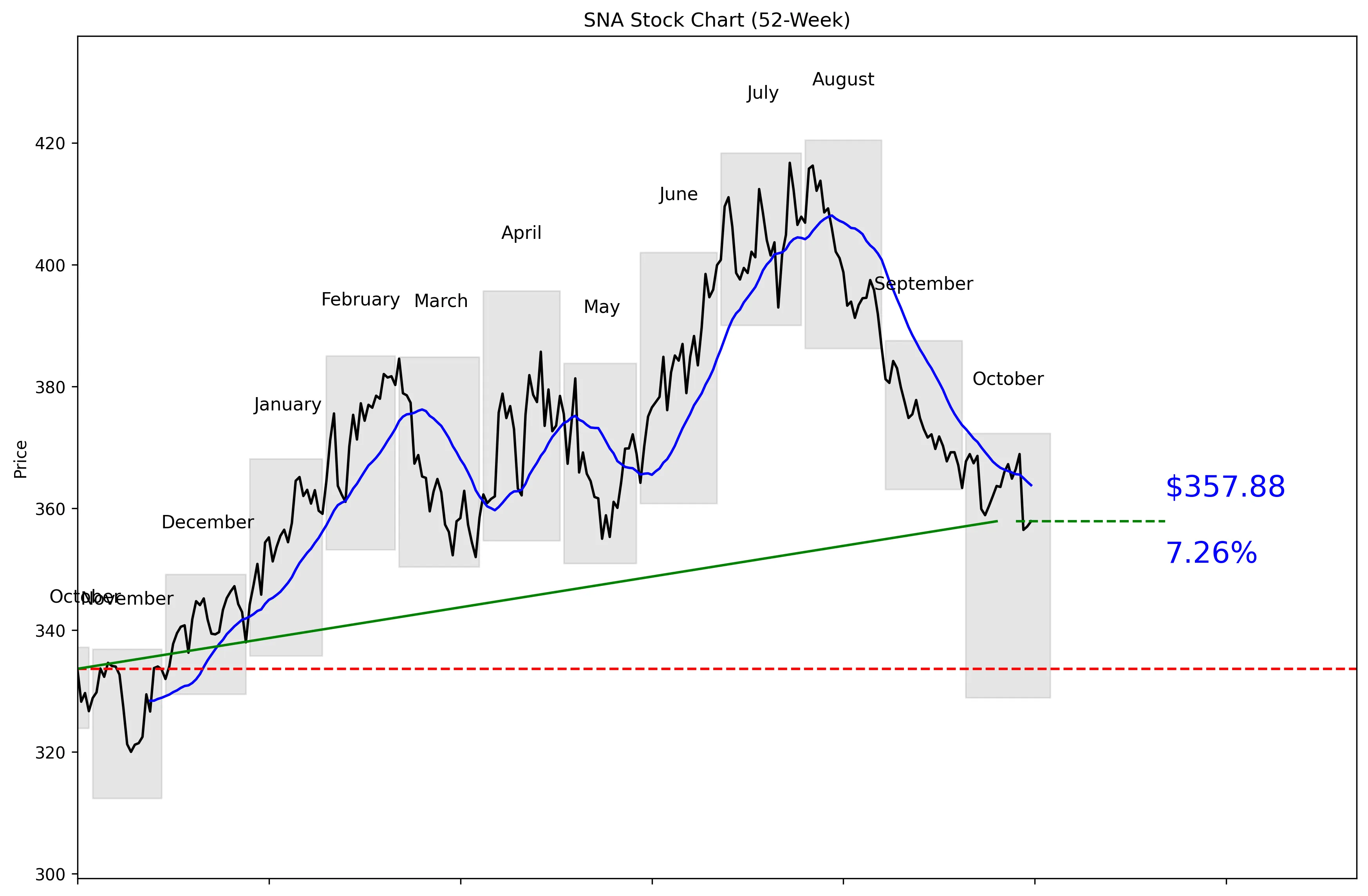
SNA 52-Week Stock Chart
Technical Analysis
SNA trades at $356.69, 42% of the way from its $312.34 52-week low to its $420.41 high. The stock is 14.87% below that high and 14.58% above the low. Price sits 1.63% below the 20-day moving average of $363.80. Momentum is negative, with declines of 1.92% over five trading days and 3.07% over 20 trading days. Near-term support is $356.46, while resistance stands at $374.82.


Recent News and Developments

Q3 sales and earnings decline

Snap-on reported third-quarter net sales of $1.1837 billion, down 0.6%, while organic sales fell 2.8%. Diluted EPS dropped to $4.64 from $5.02, with Tools Group organic sales down 7.0% but Commercial & Industrial organic sales up 7.4%. Source: Snap-on Incorporated

SNA closes 3.37% lower after earnings

SNA closed at $356.46 on October 22, down 3.37% from $368.91. Shares opened at $329.90 and traded as low as $328.86, showing that the initial 10.86% plunge eased substantially before the close. Source: StockAnalysis

Four analysts cut Snap-on price targets

Barclays cut its target from $435 to $405 while keeping an Overweight rating. BofA lowered its target from $355 to $340 with an Underperform rating, Roth Capital cut from $461 to $433 while keeping Buy, and Baird reduced its target from $395 to $385 while maintaining Neutral. Source: StockAnalysis


Market Sentiment and Analyst Recommendations

Bull Case
Snap-on remains a profitable, established business trading at 18.81 times earnings. The balance sheet is solid, with $1.67 billion in cash against $1.31 billion in total debt. Commercial & Industrial organic sales grew 7.4% in the third quarter, showing that weakness is not spread across every business. The TRITON diagnostic tool’s 2026 PTEN People’s Choice Award supports Snap-on’s position in professional automotive diagnostics. The November 3-6 SEMA showcase gives the company a platform for its ADAS calibration, collision-repair, anchoring, lifting and diagnostic equipment. Nine analysts rate the stock a buy, with a consensus target of $404.11 and a high target of $485.00. The buy case is straightforward: a strong balance sheet, valuable professional tools and meaningful analyst upside from $356.69.
Bear Case
The operating trend is weak, with overall revenue growth at negative 0.7%. Third-quarter net sales fell 0.6% to $1.1837 billion, while organic sales declined 2.8%. Diluted EPS dropped from $5.02 to $4.64. The Tools Group is the biggest concern because organic sales fell 7.0%, directly weakening a core part of the business. Investors punished the report, sending the stock down 3.37% to $356.46 on October 22 after an initial 10.86% plunge. Four analysts cut their targets, including BofA lowering its target to $340 and maintaining an Underperform rating. At 18.81 times earnings, SNA is not cheap enough to ignore shrinking sales and earnings.
What to Watch
The November 3-6 SEMA Show is the next named catalyst, with Snap-on presenting products across diagnostics, ADAS calibration, collision repair, lifts and shop equipment. Investors should watch whether that product exposure translates into improved sales, particularly in the Tools Group after its 7.0% organic decline. Commercial & Industrial organic growth needs to remain near or above the latest 7.4% rate to offset weakness elsewhere. The next earnings update must improve on the third quarter’s 0.6% net-sales decline, 2.8% organic-sales decline and $4.64 diluted EPS. On the chart, $356.46 is the immediate threshold because it is the 30-day low and current near-term support. A move back above the $363.80 20-day moving average would improve the short-term setup, while $374.82 remains resistance. A break below support combined with another weak Tools Group result would damage the thesis; stronger organic sales and a move through resistance would strengthen it.
Analyst Consensus
BUY

Based on 9 analyst opinions
Low Target
$340.00
Mean Target
$404.11
High Target
$485.00


Earnings and Financial Data

Sector
Industrials
Industry
Tools & Accessories
Employees
13,000
Earnings & Dividends
Next Earnings
Oct 22, 2026
EPS (Trailing)
$18.96
Dividend Yield
273.0%
Payout Ratio
50.7%

Frequently Asked Questions

Is SNA a good stock to buy?
Nine analysts currently give SNA a buy recommendation, and the stock trades at $356.69 with a consensus target of $404.11. The takeaway is that analysts see upside, but negative 0.7% revenue growth remains a clear risk.
What is SNA’s price target?
The analyst target is $404.11, with estimates ranging from $340.00 to $485.00. The takeaway is that analyst expectations vary widely around the current $356.69 price.
What is SNA’s 52-week range?
The key data lists a 52-week range of $320.80 to $423.02, while the computed price series shows a low of $312.34 and a high of $420.41. The takeaway is that SNA currently sits 42% of the way through the computed range.
Is SNA stock overvalued?
SNA trades at a price-to-earnings ratio of 18.81 while revenue growth is negative 0.7%. The takeaway is that the valuation requires confidence that revenue performance will improve.
What are SNA’s support and resistance levels?
Near-term support is $356.46, and near-term resistance is $374.82. The takeaway is that SNA is trading almost directly on support at its current price of $356.69.

Related Stock Reports

Disclaimer: This report is for informational purposes only and does not constitute financial advice. The analysis and opinions expressed are those of AltStation.io and should not be relied upon as the sole basis for investment decisions. Always conduct your own research and consult with a qualified financial advisor before making investment decisions. Past performance does not guarantee future results. Updated October 27, 2026.