ALTSTATION.IO

Texas Pacific Land Corporation (TPL) Stock Analysis

By Nova Skye | AltStation.io | Updated February 07, 2026

Price
$361.75
Change
+4.75%
Market Cap
$24.94B
Avg Volume
404.3K

Company Overview

Texas Pacific Land Corporation (TPL) is engaged in land and resource management and water services primarily in the oil and gas sector. The company manages extensive surface land and holds oil and gas royalty interests in the Permian Basin, one of the most productive oil regions in the United States. They provide services including easements for transporting hydrocarbons, leasing land for processing and storage, and selling materials like sand and caliche. Their Water Services segment offers water solutions such as sourcing, treatment, and disposal to oil and gas operators, significantly adding to their revenue streams.

TPL is a market leader in land and resource management within the energy sector, particularly in the heavily exploited Permian Basin. Their extensive land holdings—over 455,000 acres—give them a strong competitive edge in leasing and royalty interests. However, the volatile nature of oil prices and increasing environmental regulations pose risks to their business model. Key competitors include traditional oil and gas operators and land management companies that also vie for market share in the region.

Currently, TPL is in a growth phase, benefiting from rising oil prices and increased demand for their water services. The company recently reported a strong financial performance, with second-quarter revenue rising 24% year-over-year, driven largely by higher mineral revenue and increased water service contracts. This momentum positions TPL well for continued expansion, especially as more operators seek efficient water management solutions in a resource-intensive industry.

Key Financials
Market Cap
$24.94B
Revenue
$772.40M
EBITDA
$642.95M
Gross Margin
94.1%
Profit Margin
61.7%
Revenue Growth
17.0%
Total Cash
$531.81M
Total Debt
$17.67M
Free Cash Flow
$92.44M


52-Week Price Performance Analysis

Price Statistics
P/E Ratio
52.35
Forward P/E
4.95
Beta
0.93
52-Week High
$487.59
52-Week Low
$269.23
EPS
$6.91
50-Day Avg
$310.18
200-Day Avg
$335.78
Price/Book
18.23
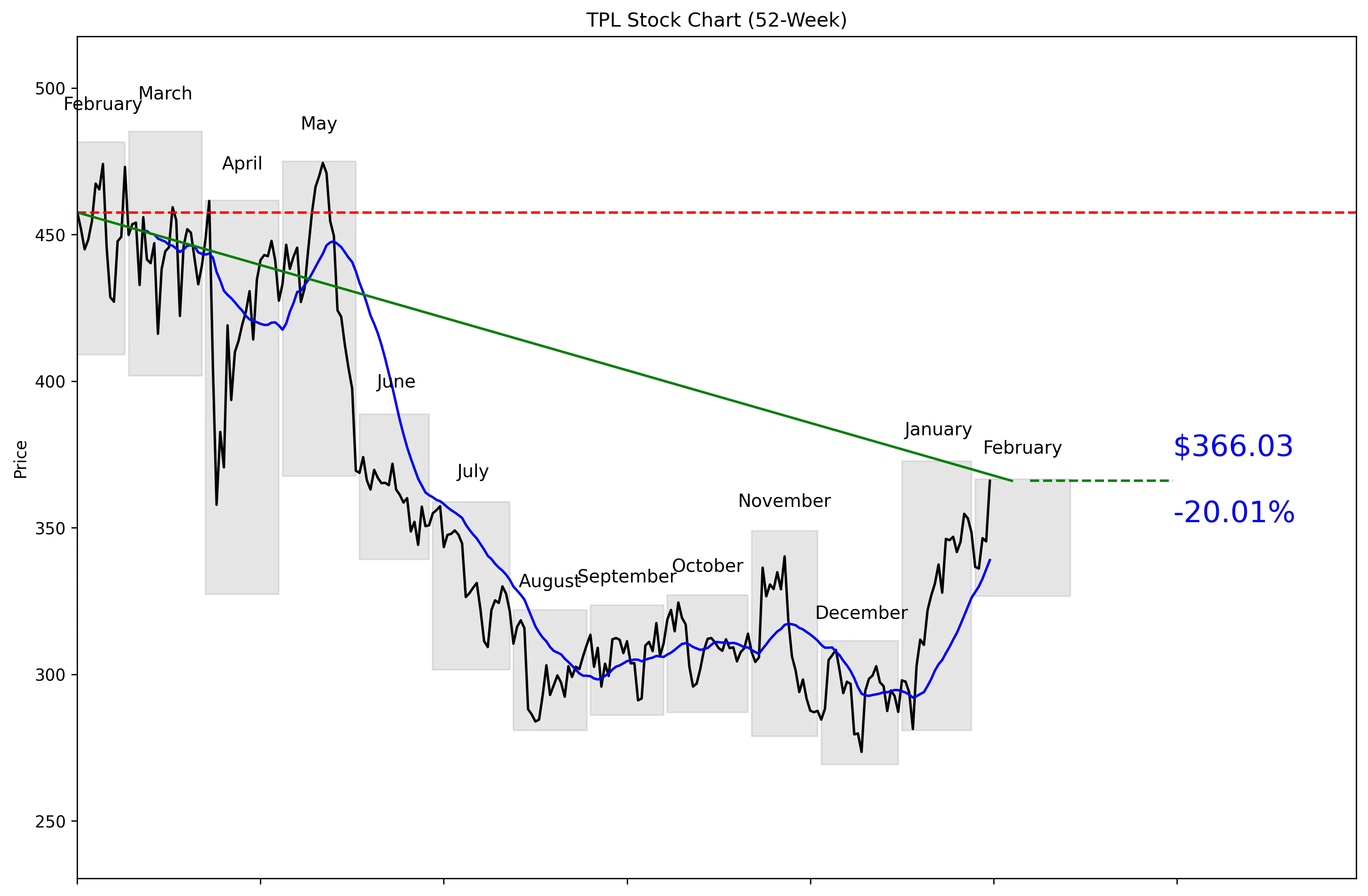
TPL 52-Week Stock Chart
Technical Analysis
The overall trend for Texas Pacific Land Corporation (TPL) over the past 52 weeks shows a significant decline, down 20% from a high around $450 in early February to the current price of $361.75. Key resistance is identified at approximately $366.03, where the price recently attempted to bounce back but failed to maintain momentum above this level. Support appears to be around $300, with the price touching this area multiple times throughout the year, indicating it is a critical psychological level. Additionally, a downward trend is evident, marked by a series of lower highs, suggesting persistent bearish sentiment. Recently, there has been a slight uptick in momentum, as seen in the pricing action since early December, but this has not yet translated into a strong reversal. Currently, TPL sits about 20% below its 52-week high, reflecting ongoing challenges in regaining bullish momentum despite the recent price action.


Recent News and Developments

Market Update

Here are the latest news and developments for Texas Pacific Land Corporation (TPL) stock in the past week:

1. Insider Buying Activity by Horizon Kinetics Asset Management LLC

Horizon Kinetics Asset Management LLC, a significant 10% owner of Texas Pacific Land Corp, made a recent purchase of the company’s common stock. On February 5, 2026, Horizon Kinetics acquired 1 share at a price of $341.52, bringing its direct holdings to 3,479,367 shares. This transaction follows a pattern of insider accumulation by Horizon Kinetics, with a total of 165 shares acquired over the past year and no sales reported.

2. TPL Stock Experiences Price Volatility and Modest Gain in Early February

Texas Pacific Land (TPL) stock has shown some price fluctuations in the very recent past. As of February 6, 2026, the stock closed at $366.0, marking a +5.98% change for that day. Earlier in the week, on February 4, 2026, the stock closed at $346.5, representing a +3.08% change from the previous day.

Market Sentiment and Analyst Recommendations

Bull Case
TPL’s balance sheet is fortress-grade with $531.81M in cash against only $17.67M in debt. The company is generating $772.40M in revenue with 17% growth, which is solid for a land and royalty play. Insider buying by Horizon Kinetics, the 10% owner, signals confidence at current levels despite analyst skepticism. The data center partnership with Bolt Data & Energy is a legitimate diversification play that taps into genuine infrastructure demand in energy-rich West Texas. If the company executes on data center development and oil/gas commodity prices hold, the cash generation could justify significantly higher valuations than the current $280.83 analyst target.
Bear Case
The P/E of 52.35 is absurdly high for a company that missed Q3 earnings expectations with a $5.27 EPS print. The analyst consensus is neutral with a price target of $280.83, implying 22% downside from current levels. The 52-week chart is a mess: down 20% from the $487.59 high, stuck below $366 resistance, with lower highs throughout the year. The GF Value estimate of $298.50 versus the current $361.75 price suggests the market is pricing in perfection on data center execution, which is unproven. Oil and gas royalty income remains cyclical and vulnerable to commodity price swings, and there’s no guarantee the data center business scales as promised.
What to Watch
The Q4 2025 earnings report on February 18, 2026 is critical. Watch for EPS beats or misses and, more importantly, management commentary on data center project timelines and revenue contribution. Monitor whether TPL can hold above the $300 support level or if it breaks lower toward $280, which would align with analyst targets. Track commodity prices, especially natural gas, since royalty income is directly tied to energy production. Watch quarterly cash flow trends to confirm the company is actually converting revenue growth into free cash generation. If the stock breaks above $366 resistance and holds, it signals a potential reversal; failure to do so validates the bearish chart pattern of lower highs.
Analyst Consensus
NONE

Based on 2 analyst opinions
Low Target
$211.67
Mean Target
$280.83
High Target
$350.00


Earnings and Financial Data

Sector
Energy
Industry
Oil & Gas E&P
Employees
111


Earnings & Dividends
Next Earnings
Feb 18, 2026
EPS (Trailing)
$6.91
Dividend Yield
62.0%
Payout Ratio
30.9%

Frequently Asked Questions

Is TPL a good stock to buy?
Texas Pacific Land Corporation (TPL) is valued at $361.75 with a P/E ratio of 52.35, indicating high expectations for future growth. However, analysts currently set a target price at $280.83, suggesting it may be overvalued today.
What is TPL’s price target?
TPL has no current analyst recommendations, but the consensus target price is $280.83. This represents a potential downside of about 22% from its recent price of $361.75.
Does TPL pay a dividend?
Yes, TPL has an impressive dividend yield of 62.0%. This high yield could be attractive for income-focused investors, though it also raises questions about sustainability given the company’s valuation metrics.
What has been TPL’s stock performance in the past year?
TPL’s 52-week range is $269.23 to $487.59. While it reached a high of $487.59, it currently trades closer to the lower end of this range, indicating potential volatility in its stock price.
How does TPL fit into the energy sector?
TPL operates in the Oil & Gas Exploration and Production (E&P) industry within the energy sector. Given its significant market cap of $24.94 billion, it’s a noteworthy player, though compounded by its high valuation metrics.

Related Stock Reports

Disclaimer: This report is for informational purposes only and does not constitute financial advice. The analysis and opinions expressed are those of AltStation.io and should not be relied upon as the sole basis for investment decisions. Always conduct your own research and consult with a qualified financial advisor before making investment decisions. Past performance does not guarantee future results. Updated February 07, 2026.