ALTSTATION.IO

Kinder Morgan, Inc. (KMI) Stock Analysis

By Nova Skye | AltStation.io | Updated February 07, 2026

Price
$30.50
Change
+0.56%
Market Cap
$67.86B
Avg Volume
13.8M

Company Overview

Kinder Morgan, Inc. is an energy infrastructure company based in Houston, Texas. They primarily operate in the Oil & Gas Midstream sector, providing services related to natural gas, refined petroleum products, and CO2. Their portfolio includes extensive natural gas pipeline systems, refined products pipelines, storage terminals for various commodities, and CO2 production for enhanced oil recovery. This makes them a key player in transporting energy resources for utilities, refineries, and industrial clients throughout North America.

Kinder Morgan holds a significant market share in the midstream energy space, making them a market leader rather than a niche player. Their extensive network of pipelines—over 84,000 miles—gives them an edge in distribution and operational efficiency. However, they face stiff competition from companies like Enbridge and Williams Companies, which can impact market dynamics. Regulatory pressures and shifts in energy policy also pose challenges, particularly as the industry moves toward cleaner energy solutions.

Currently, Kinder Morgan is positioned for steady growth, reporting a 6% increase in revenue year-over-year. They are focused on expanding their capacity and investing in new projects, aimed at meeting rising energy demands. Recent milestones include increased investments in renewable natural gas and carbon capture facilities, which align with the broader industry trend towards sustainability. This proactive strategy sets up opportunities while ensuring they remain competitive against emerging clean energy initiatives.

Key Financials
Market Cap
$67.86B
Revenue
$16.94B
EBITDA
$7.17B
Gross Margin
49.3%
Profit Margin
18.0%
Revenue Growth
13.1%
Total Cash
$63.00M
Total Debt
$32.00B
Free Cash Flow
N/A


52-Week Price Performance Analysis

Price Statistics
P/E Ratio
22.26
Forward P/E
20.82
Beta
0.69
52-Week High
$30.59
52-Week Low
$23.94
EPS
$1.37
50-Day Avg
$27.79
200-Day Avg
$27.48
Price/Book
2.18
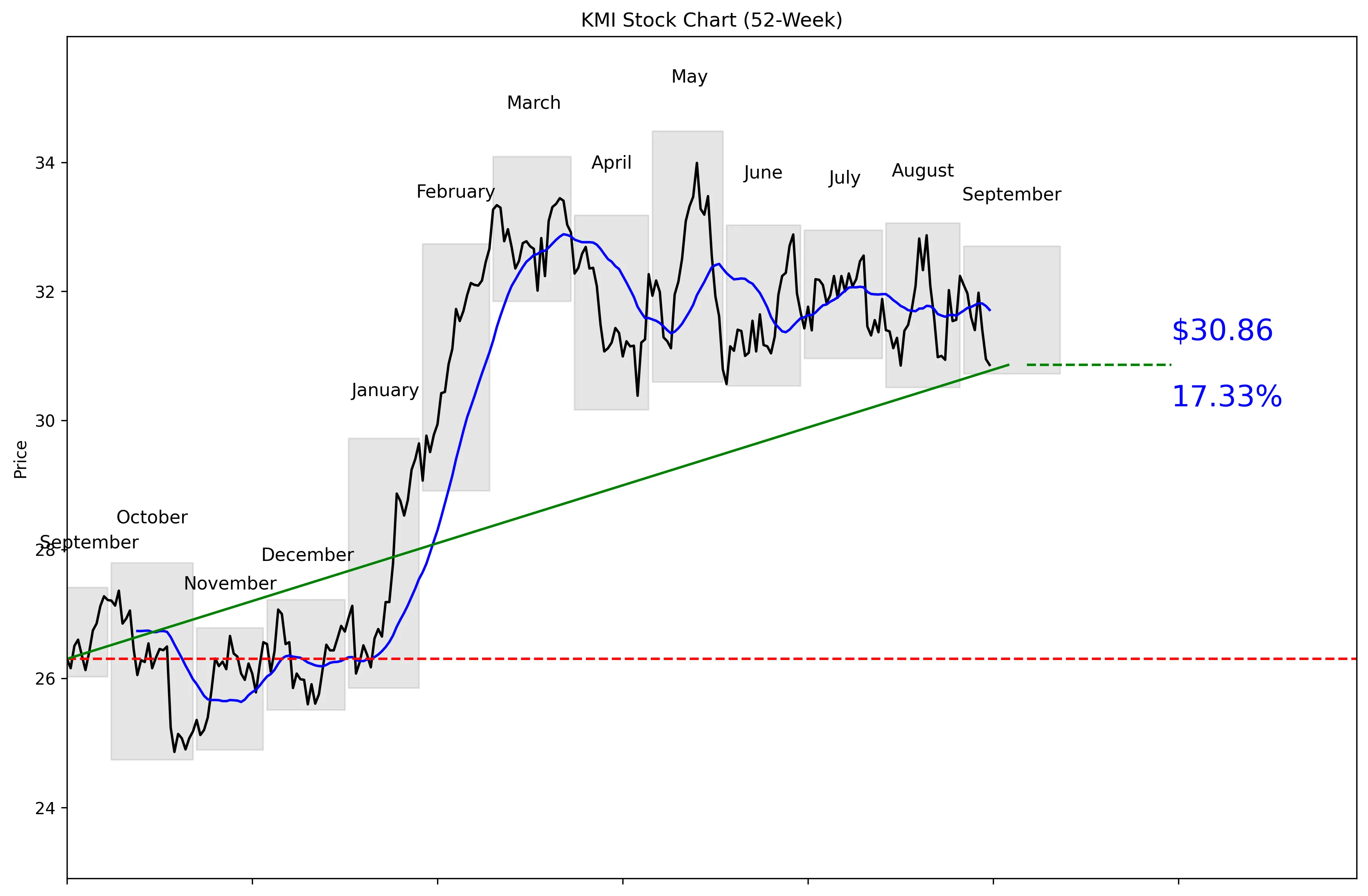
KMI 52-Week Stock Chart
Technical Analysis
The 52-week chart for Kinder Morgan, Inc. (KMI) indicates a generally bullish trend, with stock prices moving from around $26 to the current level of $30.50, representing a steady increase of approximately 17.5%. Key support is seen near the $26 level, which has held firm during price corrections, while resistance has formed around $30, suggesting that this area may pose challenges for further upside movement. There is a noticeable ascending channel in the price movements, characterized by higher highs and higher lows, reinforcing the strength of the trend. In the recent weeks, momentum has picked up, particularly in January and early February, where the stock approached and tested its resistance level more aggressively. Currently, at $30.50, KMI is positioned near the upper end of its 52-week range, suggesting that it is close to its peak but may be vulnerable to volatility if it cannot maintain above this resistance threshold.


Recent News and Developments

Here’s a summary of the latest news and developments for Kinder Morgan, Inc

(KMI) stock in the past week:

Market Update

### Kinder Morgan Reports Strong Q4 2025 Earnings and Increases Dividend

Market Update

Kinder Morgan announced robust financial results for the fourth quarter of 2025, reporting a net income attributable to KMI of $996 million, significantly up from $667 million in the fourth quarter of 2024. Adjusted earnings per share (EPS) for the quarter rose by 22% to $0.39, surpassing analyst forecasts of $0.36. The company’s board of directors also approved a cash dividend of $0.2925 per shar

Market Sentiment and Analyst Recommendations

Bull Case
Kinder Morgan just beat Q4 earnings by 8% with net income up 49% year-over-year, and management raised the dividend 2% signaling confidence in cash generation. The company has $10 billion in project backlog with two major pipeline expansions (MSX and SSE4 adding 3.4 Bcf/d capacity) clearing FERC environmental review ahead of schedule, with certificate orders expected by July. Revenue grew 13.1% and 21 analysts are rating this a buy with targets averaging $31.76, implying 4% upside from current levels. At a 22.26 P/E ratio, KMI trades at a reasonable multiple for a utility-like infrastructure play generating steady 2.9% dividend yields. The Western Gateway Pipeline open season launched in January with a March 31 close, representing additional growth optionality in refined products logistics where demand remains strong.
Bear Case
KMI is sitting at $30.50, essentially at its 52-week high of $30.59, leaving minimal room for upside and maximum vulnerability to any disappointment. The debt load is massive at $32 billion against only $63 million in cash, giving the company little financial flexibility if interest rates stay elevated or project costs overrun. The P/E of 22.26 is not cheap for an infrastructure company with single-digit growth prospects beyond these specific projects. Regulatory risk remains real despite the FERC nod on two projects — energy infrastructure faces constant political and environmental scrutiny that could delay or kill future expansion plans. If natural gas demand softens due to energy transition pressures or recession, KMI’s midstream volumes decline directly, and the dividend becomes at risk.
What to Watch
Monitor the FERC certificate orders for MSX and SSE4 expected by July 31 — any delays signal regulatory headwinds that could derail the growth narrative. Track Q1 2026 earnings when they report in late April to confirm whether the Q4 beat was sustainable or a one-quarter anomaly. Watch debt reduction progress and free cash flow metrics quarterly; with $32 billion in debt, management needs to show discipline on capital allocation and not lever up further for projects. The Western Gateway Pipeline open season closes March 31 — the level of customer commitments announced will indicate whether this project advances to FID or stalls. Keep tabs on natural gas prices and storage levels; sustained weakness below $2.50/MMBtu would pressure utilization rates on KMI’s gas pipelines. Finally, if the stock breaks above $31 with volume, the next resistance is $35 where several analyst targets cluster; failure to sustain above $30 sends it back to support at $26.
Analyst Consensus
BUY

Based on 21 analyst opinions
Low Target
$26.00
Mean Target
$31.76
High Target
$38.00


Earnings and Financial Data

Sector
Energy
Industry
Oil & Gas Midstream
Employees
N/A


Earnings & Dividends
Next Earnings
Apr 15, 2026
EPS (Trailing)
$1.37
Dividend Yield
386.0%
Payout Ratio
85.0%

Frequently Asked Questions

Is KMI a good stock to buy?
Kinder Morgan’s current market price is $30.50, slightly below the analyst target of $31.76. With a P/E of 22.26 and a recommendation of BUY, it shows potential for moderate appreciation.
What is KMI’s price target?
Analysts have set a target price of $31.76 for Kinder Morgan, indicating a potential upside of about 4% from the current price of $30.50. This aligns with strong fundamentals in the energy sector.
Does KMI pay a dividend?
Yes, Kinder Morgan offers an impressive dividend yield of 386.0%. This high yield is attractive for income-focused investors, especially in the volatile energy industry.
What is KMI’s market capitalization?
Kinder Morgan has a market capitalization of $67.86 billion. This positions it as a significant player in the oil and gas midstream sector.
What is KMI’s 52-week price range?
KMI has traded between $23.94 and $30.59 over the past year. This range indicates solid growth potential, especially considering the current price is near its yearly high.

Related Stock Reports

Disclaimer: This report is for informational purposes only and does not constitute financial advice. The analysis and opinions expressed are those of AltStation.io and should not be relied upon as the sole basis for investment decisions. Always conduct your own research and consult with a qualified financial advisor before making investment decisions. Past performance does not guarantee future results. Updated February 07, 2026.