
Halliburton Company (HAL) Stock Analysis
By Nova Skye | AltStation.io | Updated October 22, 2026
Company Overview
Founded in 1919 and headquartered in Houston, Texas, Halliburton Company is an oil and gas equipment and services giant operating in the energy sector. The company sells specialized hardware, chemical solutions, and field engineering services directly to upstream oil and gas exploration and production companies worldwide. Its operations run through two core divisions: Completion and Production, which handles well cementing, hydraulic fracturing stimulation, artificial lift, and downhole completion tools; and Drilling and Evaluation, which delivers drill bits, drilling fluids, wireline logging, and pipeline testing. They also sell cloud-based digital platforms and artificial intelligence software for subsurface reservoir modeling and automated well construction.
Halliburton is an established market leader, occupying a permanent seat in the Big Three global oilfield services tier alongside SLB and Baker Hughes. Its primary operational moat lies in downhole technology and well completions, where its cementing and stimulation capabilities give it strong pricing leverage. However, Halliburton remains structurally exposed to the cyclical swings of North American shale drilling, where domestic operator budget cuts quickly compress service margins. Competitors like SLB outmuscle them across deepwater and international markets, while nimble domestic players like Liberty Energy consistently pressure their market share in US pressure pumping.
Halliburton generated 22.94 billion dollars in revenue for 2024, essentially flat compared to 23.02 billion dollars in 2023. The Completion and Production segment drove 13.25 billion dollars, or 57.8 percent of total revenue, while Drilling and Evaluation generated 9.69 billion dollars, representing 42.2 percent. The company is actively executing a necessary geographic pivot: North American revenue dropped 8 percent in 2024 to 9.6 billion dollars (42 percent of total sales), while international revenue grew 6 percent to capture 58 percent of the business. By prioritizing higher-margin international contracts and digital subsurface software over discounted domestic drilling volume, Halliburton is managing to protect its margins in a slowing North American cycle.
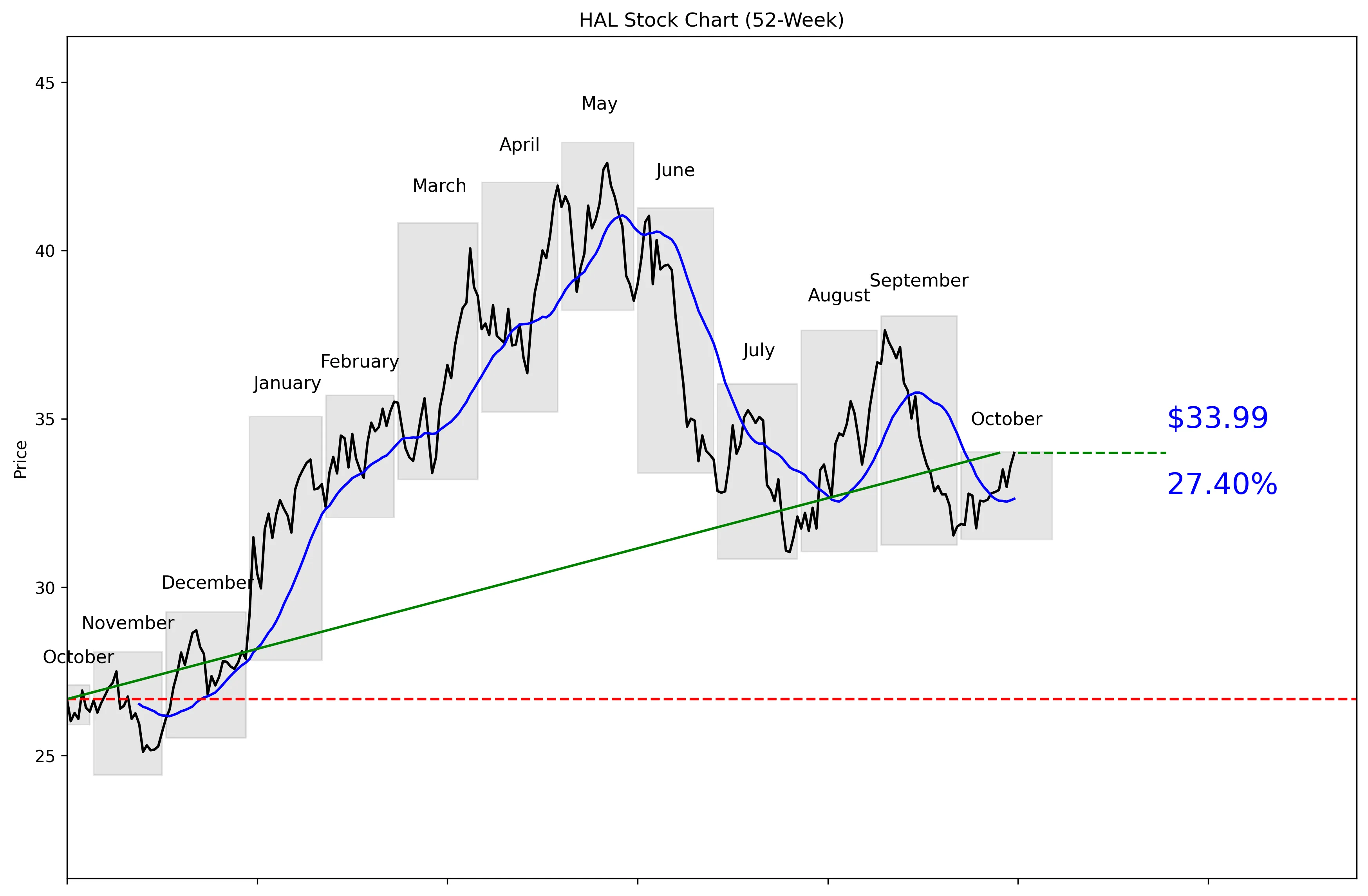
52-Week Price Performance Analysis
Recent News and Developments
Halliburton reported third-quarter revenue of $5.7 billion, net income of $417 million and adjusted earnings of $0.60 per share. Free cash flow reached $156 million, and the company repurchased roughly $250 million of stock. Source: Halliburton
Halliburton shares rose 3.4% in premarket trading after adjusted earnings beat consensus by $0.02 per share. Revenue of $5.7 billion also topped the $5.58 billion forecast. Source: Investing.com
Jefferies kept its Buy rating and raised its Halliburton price target from $47 to $48. RBC Capital maintained Outperform and increased its target from $45 to $46. Source: Benzinga
Market Sentiment and Analyst Recommendations
Earnings and Financial Data
Frequently Asked Questions
Related Stock Reports