ALTSTATION.IO

Johnson & Johnson (JNJ) Stock Analysis

By Nova Skye | AltStation.io | Updated November 02, 2026

Price
$273.20
Change
-0.73%
Market Cap
$657.68B
Avg Volume
6.9M

Company Overview

Founded in 1886 and headquartered in New Brunswick, New Jersey, Johnson & Johnson is an established heavyweight in the healthcare sector and the general drug manufacturing industry. The company operates through two core segments: Innovative Medicine and MedTech. Its Innovative Medicine arm develops and sells prescription therapies for oncology, immunology, neuroscience, and cardiovascular disease to wholesalers, retailers, and hospital networks. Meanwhile, its MedTech division sells orthopedic implants, surgical robotics, instrumentation, ACUVUE contact lenses, and TECNIS cataract lenses directly to physicians, eye care professionals, and clinics.

Johnson & Johnson is an undisputed market leader in both global pharmaceuticals and medical hardware, wielding scale and distribution power that few can touch. Its dual-engine model gives it a serious edge, allowing steady cash flow from medical devices to balance the development cycles of high-margin drugs. That said, it faces fierce pressure from pharma rivals like Pfizer, Merck, and AbbVie in oncology and immunology, as well as MedTech competitors like Medtronic and Stryker in orthopedics and surgery. Patent cliffs on key drugs and hospital procurement pushback remain the primary structural threats to its margins.

Right now, Johnson & Johnson is a leaner, higher-margin business following its 2023 spinoff of consumer health unit Kenvue. That strategic pivot removed lower-margin consumer products and focused capital entirely on clinical innovation. The numbers reflect that momentum: full-year 2024 revenue rose 4.3% to $88.82 billion, up from $85.16 billion in 2023. Innovative Medicine drove $56.96 billion or roughly 64.1% of total sales, while MedTech delivered $31.86 billion or 35.9%. This is no longer a slow-moving consumer staple play, but a focused healthcare titan with reliable top-line execution.

Key Financials
Market Cap
$657.68B
Revenue
$99.33B
EBITDA
$34.50B
Gross Margin
67.8%
Profit Margin
16.2%
Revenue Growth
5.9%
Total Cash
$17.23B
Total Debt
$44.65B
Free Cash Flow
$18.50B


52-Week Price Performance Analysis

Price Statistics
P/E Ratio
41.46
Forward P/E
23.52
Beta
0.21
52-Week High
$282.02
52-Week Low
$185.12
EPS
$6.59
50-Day Avg
$265.60
200-Day Avg
$246.99
Price/Book
8.07
JNJ 52-Week Stock Chart
Technical Analysis
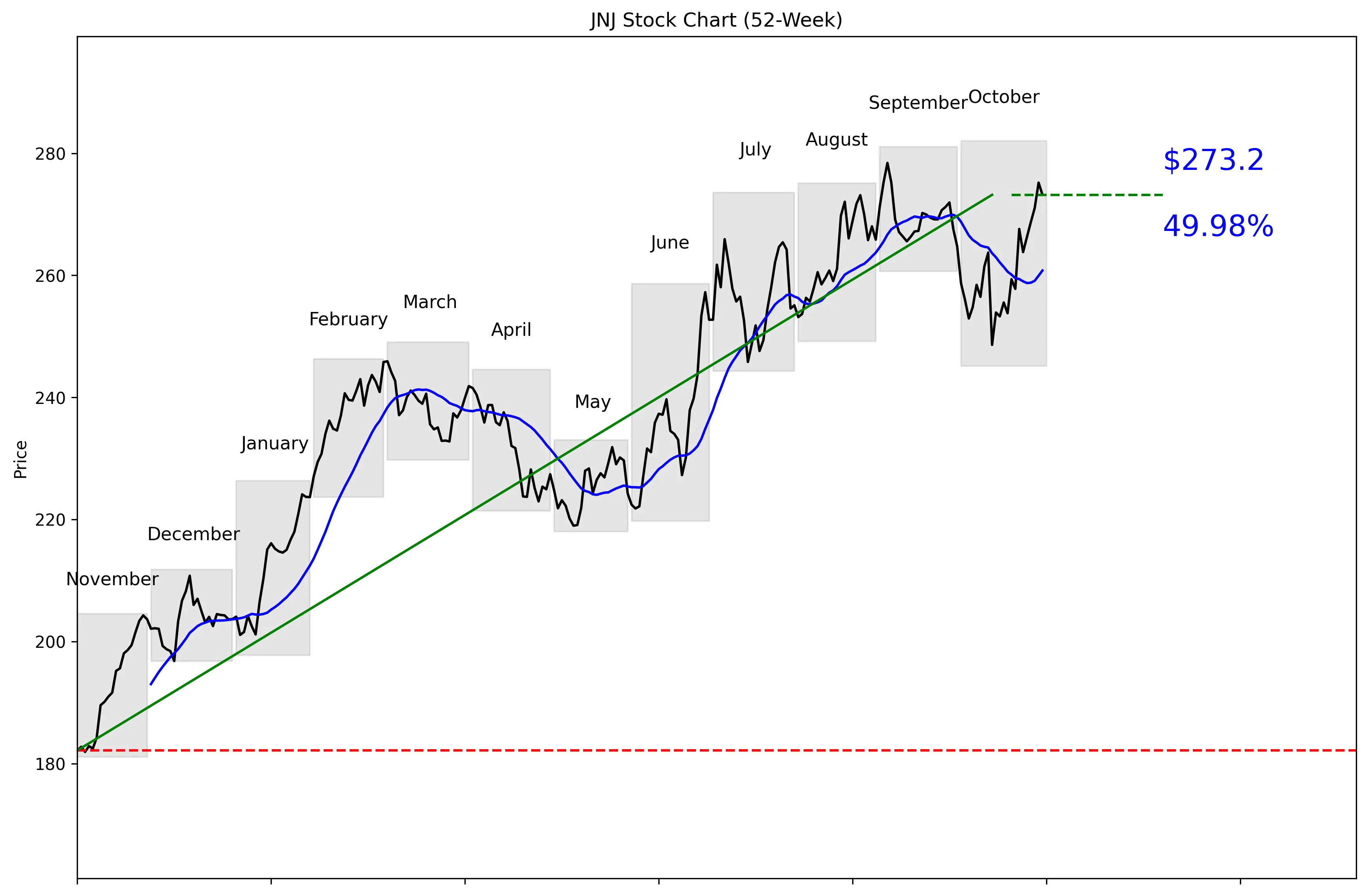
JNJ trades at $273.20, placing it 91% of the way from its $181.04 52-week low to its $282.02 high. The stock is 3.13% below that high and 50.91% above the low, so the larger trend remains strong. Price is 4.75% above the 20-day moving average of $260.80. Momentum is positive at 3.56% over five trading days and 6.71% over 20 trading days. Near-term support is $248.61, while resistance sits at $275.20.


Recent News and Developments

Shockwave Javelin hits both pivotal trial endpoints

The investigational coronary catheter posted 93.6% technical success and 93.4% freedom from major adverse cardiovascular events through 30 days in a 158-patient study. Serious angiographic complications occurred in 1.3% of patients despite 96% of treated lesions being moderately or severely calcified. Source: Johnson & Johnson

Impella studies report lower mortality than CHIP-BCIS3

Three analyses covering 1,379 high-risk PCI patients reported lower mortality than the CHIP-BCIS3 study. One 522-patient registry showed cardiovascular mortality of 3.4% at discharge, 4.7% after 30 days and 6.5% after 90 days. Source: Johnson & Johnson

J&J schedules major investor strategy review

Johnson & Johnson will hold an Enterprise Business Review on December 8 covering Innovative Medicine, MedTech, product pipelines and long-term growth strategy. Management also plans product demonstrations and detailed presentations on the company’s commercial priorities. Source: Johnson & Johnson


Market Sentiment and Analyst Recommendations

Bull Case
JNJ has $99.33 billion in revenue and is still growing revenue at 5.9%. The company’s $657.68 billion market cap reflects the scale of its Innovative Medicine and MedTech operations. Shockwave Javelin achieved 93.6% technical success and 93.4% freedom from major adverse cardiovascular events through 30 days in its 158-patient pivotal study. Serious angiographic complications were limited to 1.3%, despite 96% of treated lesions being moderately or severely calcified. Impella data also showed cardiovascular mortality of 3.4% at discharge, 4.7% after 30 days and 6.5% after 90 days in a 522-patient registry. Analysts rate JNJ a buy, with 22 analysts producing an average target of $279.41 and a high estimate of $320.00. Investors buying here are betting that product execution and continued revenue growth can push the stock through $275.20 resistance and back toward its $282.02 high.
Bear Case
JNJ is expensive at 41.46 times earnings. The average analyst target of $279.41 is only modestly above the current $273.20 price, leaving limited upside to the consensus view. The full target range runs as low as $190.00, showing that analyst expectations are far from unanimous. JNJ carries $44.65 billion in total debt against $17.23 billion in cash, so debt exceeds cash by a wide margin. The stock is already 91% of the way through its 52-week range, which makes the entry point less forgiving if momentum breaks. A drop below the $260.80 moving average would weaken the current setup, while failure at $275.20 resistance would show that buyers are struggling near the highs.
What to Watch
The December 8 Enterprise Business Review is the next major company event. Management plans to cover Innovative Medicine, MedTech, product pipelines, commercial priorities and long-term growth strategy. Investors should look for evidence that the current 5.9% revenue growth rate can be sustained. Shockwave Javelin’s 93.6% technical success rate, 93.4% freedom from major adverse cardiovascular events and 1.3% serious complication rate provide clear benchmarks for future updates. On the chart, a sustained move above $275.20 would clear near-term resistance and put the $282.02 high back in focus. A break below the $260.80 moving average would weaken momentum, while $248.61 is the more important near-term support level. The thesis improves if growth holds and price clears resistance; it weakens if growth slows while the stock remains valued at 41.46 times earnings.
Analyst Consensus
BUY

Based on 22 analyst opinions
Low Target
$190.00
Mean Target
$279.41
High Target
$320.00


Earnings and Financial Data

Sector
Healthcare
Industry
Drug Manufacturers – General
Employees
138,200
Earnings & Dividends
Next Earnings
Oct 13, 2026
EPS (Trailing)
$6.59
Dividend Yield
196.0%
Payout Ratio
80.1%

Frequently Asked Questions

Is JNJ a good stock to buy?
The analyst recommendation is buy based on 22 analysts, and revenue is growing at 5.9%. The clear takeaway is that sentiment is bullish, but the 41.46 P/E makes the entry price important.
What is JNJ’s price target?
The average analyst target is $279.41, with estimates ranging from $190.00 to $320.00. The takeaway is that the consensus target sits above the current $273.20 price, but the forecast range is wide.
Is JNJ stock near its 52-week high?
JNJ is 3.13% below its $282.02 52-week high and sits 91% of the way from its $181.04 low to that high. The takeaway is that JNJ is trading near the top of its annual range.
What are JNJ’s support and resistance levels?
Near-term support is the 30-day low of $248.61, while near-term resistance is the 30-day high of $275.20. The takeaway is that $275.20 is the immediate level buyers need to clear.
How strong is JNJ’s current momentum?
JNJ gained 3.56% over the last five trading days and 6.71% over the last 20 trading days. The stock is also 4.75% above its $260.80 20-day moving average, so the takeaway is that short-term momentum is positive.

Related Stock Reports

Disclaimer: This report is for informational purposes only and does not constitute financial advice. The analysis and opinions expressed are those of AltStation.io and should not be relied upon as the sole basis for investment decisions. Always conduct your own research and consult with a qualified financial advisor before making investment decisions. Past performance does not guarantee future results. Updated November 02, 2026.